|
This guide provides instructions on how to update the firmware components of the WLC series controllers, considering the specific models and previous firmware versions of the device being update.
This guide is intended for technical personnel who perform device updates through the command line interface (CLI).
Designation | Description | |
|---|---|---|
[ ] | In the command line, optional parameters are shown in square brackets; when entered, they provide additional options. | |
{ } | In the command line, mandatory parameters are shown in curly braces. Select one of the parameters. | |
«,» «-» | In the command description, these characters are used to define ranges. | |
«|» | In the description of the command, this sign means 'or'. | |
Semibold font | Notes, warnings, or information are shown in bold. | |
<Semibold italic> | Keyboard keys are shown in bold italic within angle brackets. | |
| Examples and results of the commands are given within the text boxes. |
Notes contain important information, tips or recommendations on device operation and setup. |
Warnings inform users about hazardous conditions which may cause injuries or device damage and may lead to the device malfunctioning or data loss. |
The information block contains information on the use of the device. |
Depending on the model and update component, the following files should be used later in the guide body:
| WLC model | HW version | Firmware | Secondary bootloader | Primary bootloader |
|---|---|---|---|---|
| WLC-15 | all | wlc15-1.30.2-build14.firmware | wlc15-1.30.2-build1.uboot | none |
| WLC-30 | all | wlc30-1.30.2-build14.firmware | wlc30-1.30.2-build1.uboot | none |
WLC-3200 | all | wlc3200-1.30.2-build13.firmware | wlc3200-1.30.2-build1.uboot | wlc3200-1.30.2-build1.bdk |
| ESR-15 | all | esr15-1.30.2-build15.firmware | esr15-1.30.2-build1.uboot | none |
| ESR-15R | all | esr15-1.30.2-build15.firmware | esr15-1.30.2-build1.uboot | none |
| ESR-30 | all | esr3x-1.30.2-build15.firmware | esr30-1.30.2-build1.uboot | none |
ESR-3200 | all | esr3200-1.30.2-build14.firmware | esr3200-1.30.2-build1.uboot | esr3200-1.30.2-build1.bdk |
| vWLC | — | vwlc-1.30.2-build14.firmware | — | — |
Prior to initiating the firmware update on WLC controllers, it is necessary to create a backup of the current configuration. Copying the current configuration from the WLC controllers is possible both using remote file copying protocols and to locally connected USB/MMC media.
When migrating from a newer version of the firmware to an older one (downgrade), it is possible that the older version of the firmware will not be able to apply the configuration saved in the newer version. As a result, the configuration will be lost and the WLC controller will boot with an empty configuration. |
To create a backup copy of the current configuration of the controller using remote file copy servers, do the following:
To create a backup copy of the current configuration of the service router on a locally connected USB/MMC storage:
Depending on the remote file copy protocol, one of the following commands must be executed in the CLI of the controller:
|
|
|
|
|
1. Define the volume label of the connected USB/MMC storage.
|
|
2. Copy the file to the USB/MMC storage that is currently in use.
When executing copy commands to USB/MMC media, instead of the <USB_DISK> or <MMC_DISK> fields, use the real volume labels defined in step 1. |
|
|
In case of configuration loss on the controller due to operational issues, firmware update, or rollback to a previous firmware version, the controller configuration can be restored using a previously created backup copy.
Copying a configuration backup to the WLC controllers is possible both using remote file copying protocols and to locally connected USB/MMC media.
When migrating from a newer version of the firmware to an older one (downgrade), it is possible that the older version of the firmware will not be able to apply the configuration saved in the newer version. As a result, the configuration will be lost and the WLC controller will boot with an empty configuration. If the configuration is empty, the controller can only be connected to using a console connection and the default login/password (admin/password). |
To restore the configuration of the service router from a backup copy using remote file copy servers, do the following:
To restore the controller configuration from a backup copy from a locally connected USB/MMC storage, do the following:
Depending on the protocol for remote file copying, run one of the following commands in the CLI of the controller:
|
|
|
|
|
1. Define the volume label of the connected USB/MMC storage.
|
|
2. Copy the file to the USB/MMC storage that is currently in use:
When executing copy commands to USB/MMC media, instead of the <USB_DISK> or <MMC_DISK> fields, use the real volume labels defined in step 1. |
|
|
To apply and confirm operation of the configuration loaded earlier in the 'system:candidate-config' section, run the following commands:
|
Currently used secondary bootloader (U-Boot) and main firmware versions can be checked:
To check the current firmware version and the version of the secondary bootloader (U-boot) in the CLI of the main firmware, execute the show version command:
|
To check the current firmware version and the version of the secondary bootloader (U-boot) in the output of the console interface when loading the controller, do the following:
1. Connect to the WLC controller via the Console interface on the front panel of the controller using the following parameters of the PC RS-232 interface:
2. Reboot the controller using one of the following methods:
|
3. During the loading, information about the versions will be displayed in the console:
Primary bootloader (sbi, bl1 depending on the controller model):
|
|
|
Secondary bootloader (U-boot):
|
Main firmware version:
|
ESR-15, ESR-30, ESR-3200, vWLC are updated using the same algorithm. |
Before updating, use the show date command to verify that the correct date and time are set on the device. If an incorrect date is set on the controller, certificate validation will prevent the configuration changes from being applied after the update. |
Firmware version 1.30.2 is cumulative (it contains updated versions of the primary and secondary loaders), so it will be enough to:
Turning off the power before the boot system {image-1|image-2} command is finished may cause the controller to malfunction. |
Minimal firmware version of AP:
The firmware for the AP must be downloaded to the controller before updating it. Then after rebooting the WLC, the AP will automatically update to the new firmware. If the firmware has been downloaded to the controller after it has been updated, then the clear wlc ap command must be executed to reconnect the APs and update the firmware.
Updating to version 1.30.2 can be done from any previous version, but the recommendations for each version described below must be followed. When updating from version 1.15.3, the secondary bootloader must be updated at the same time as the main firmware (see section Secondary bootloader update). |
ESR-15, ESR-30, ESR-3200, vWLC (started with 1.27.0 version) are updated using the same algorithm. |
Before updating, use the show date command to verify that the correct date and time are set on the device. If an incorrect date is set on the controller, certificate validation will prevent the configuration changes from being applied after the update. |
Firmware version 1.30.2 is cumulative (it contains updated versions of the primary and secondary loaders), so it will be enough to:
Turning off the power before the boot system {image-1|image-2} command is finished may cause the controller to malfunction. |
Minimal firmware version of AP:
The firmware for the AP must be downloaded to the controller before updating it. Then after rebooting the WLC, the AP will automatically update to the new firmware. If the firmware has been downloaded to the controller after it has been updated, then the clear wlc ap command must be executed to reconnect the APs and update the firmware.
Updating to version 1.30.0 can be done from any previous version, but the recommendations for each version described below must be followed. When updating from version 1.15.3, the secondary bootloader must be updated at the same time as the main firmware (see section Secondary bootloader update). |
After updating to version 1.30.0 it will be possible to update the controller and AP firmware via WEB interface. |
ESR-15, ESR-15R, ESR-30, ESR-3200 are updated using the same algorithm. |
Before updating, use the show date command to verify that the correct date and time are set on the device. If an incorrect date is set on the controller, certificate validation will prevent the configuration changes from being applied after the update. |
Firmware version 1.26.1 is cumulative (it contains updated versions of the primary and secondary loaders), so it will be enough to:
Turning off the power before the boot system {image-1|image-2} command is finished may cause the controller to malfunction. |
Minimal firmware version of AP:
The firmware for the AP must be downloaded to the controller before updating it. Then after rebooting the WLC, the AP will automatically update to the new firmware. If the firmware has been downloaded to the controller after it has been updated, then the clear wlc ap command must be executed to reconnect the APs and update the firmware.
Updating to version 1.26.1 can be done from any previous version, but the recommendations for each version described below must be followed. When updating from version 1.15.3, the secondary bootloader must be updated at the same time as the main firmware (see section Secondary bootloader update). |
ESR-15, ESR-15R, ESR-3200 are updated using the same algorithm. |
Firmware version 1.19.2 is cumulative (it contains updated versions of the primary and secondary loaders), so it will be enough to:
In version 1.19.2 there is a transition from personal board-profiles to universal radio-profiles, the transition will convert the configuration, board-profiles will be replaced by pre-configured radio-profiles, you should check the radio-profile configuration.
If you have customized individual profiles for access points and have redefined board-profiles (settings of radio interfaces of access points), in which auto channel selection was enabled and the list of channels in the parameter limit-channel was not set, then after the update the list of channels from the common radio-profiles will be used. If it is necessary to change channels – set the required limit-channel list in the individual profile of the required access point.
Minimal firmware version of AP:
It is necessary to download the firmware for the AP to the controller. The AP will be updated automatically after connection.
Updating to version 1.19.2 can be done from any previous version, but the recommendations for each version described below must be followed. |
After the update, you need to edit the configuration according to the changes:
In 1.19.1, selective inclusion of vlan in SoftGRE tunnels is supported. service-vlan command is added in softgre-controller section, the specified vlans will be included in tunnels after update. In 1.19.0 all created vlans were included in tunnels. Need to add used vlans for Wi-Fi to the configuration.
softgre-controller service-vlan add 3 exit |
Configuration of telnet, ssh, web, snmp services on AP is supported, after update they will be disabled. They can be enabled in ap-profile.
On AP web is disabled/enabled simultaneously for HTTP/HTTPS services. |
To enable, go to wlc → ap-profile default-ap → services.
wlc(config-wlc-ap-profile)# services wlc(config-wlc-ap-profile-services)# snmp-server Enable SNMP service wlc(config-wlc-ap-profile-services)# ip http Configure web-configurator service https Configure web-configurator service ssh Configure SSH service telnet Configure telnet service |
Unlike firmware version 1.19.0 and later, earlier versions do not support cumulative updates. Therefore, in addition to the main firmware, the secondary bootloader must also be updated. As a result, the update process is as follows:
After the update it is necessary to edit the configuration according to the changes. The scheme of access point registration on the controller has been changed. Now not only port 8043 but also port 8044 is used. It is necessary to add port 8044 to object-group service sa:
object-group service sa port-range 8044 exit |
After the WLC is updated, the APs will be listed in the provisioning service and will be waiting for authorization. To view the list of unauthorized access points, use the command:
show wlc service-activator aps |
The following command is used to authorize all AP in the list:
join wlc ap |
The following command is used to authorize a specific AP:
join wlc ap <MAC_AP> |
It is possible to enable automatic authorization mode in the configuration:
wlc# configure wlc(config)# wlc wlc(config-wlc)# service-activator wlc(config-wlc-service-activator)# aps join auto wlc(config-wlc-service-activator)# do commit wlc(config-wlc-service-activator)# do confirm |
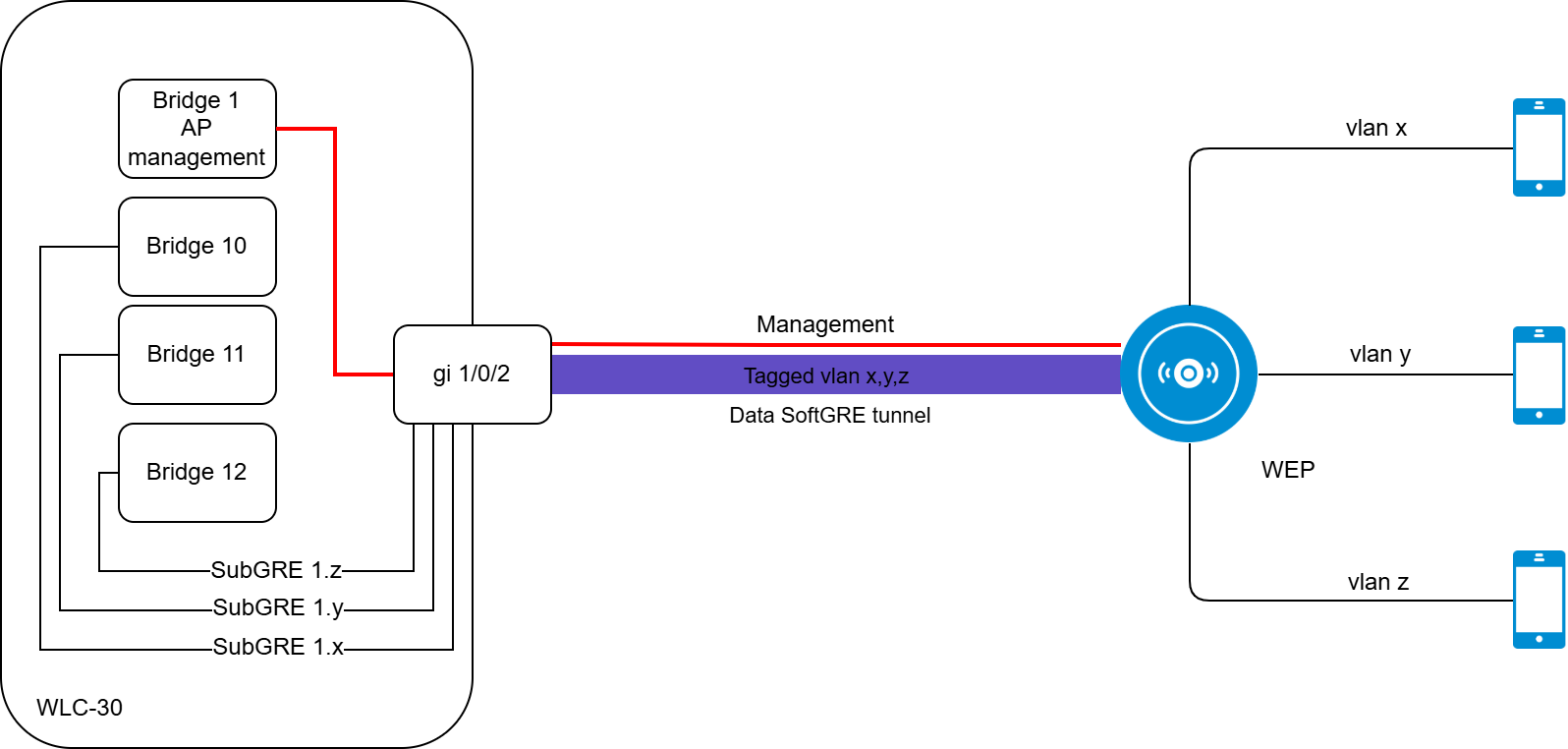
The scheme of SoftGRE tunnels enabling has been changed:
In 1.15.3 version:
Client traffic comes from the AP to a gre-tunnel with a specified vlan tag, on the WLC side a separate subgre-tunnel is created for each vlan and included in the specified Bridges, when leaving the subgre the vlan tag is removed. With this implementation, a subgre-tunnel must be created for each vlan and included in one of the Bridges. WLC does not know vlans that are issued at the moment of radius authorization (if c-vlans with external radius server are used), and cannot raise tunnels for such clients.
In 1.19.0 version:
The logic of SoftGRE tunnels operation in wlc mode has been changed. Previously subgre was unconditionally included in Bridge by WLC configuration, in the new implementation subgre tunnels are absent. Vlan specified in SSID configuration is included in WLC without sub-tunnel termination in Bridge. The use of c-vlan in client traffic tunneling scheme is supported. For correct operation, the vlan must be created in the WLC settings and must be a member of the Bridge or interface.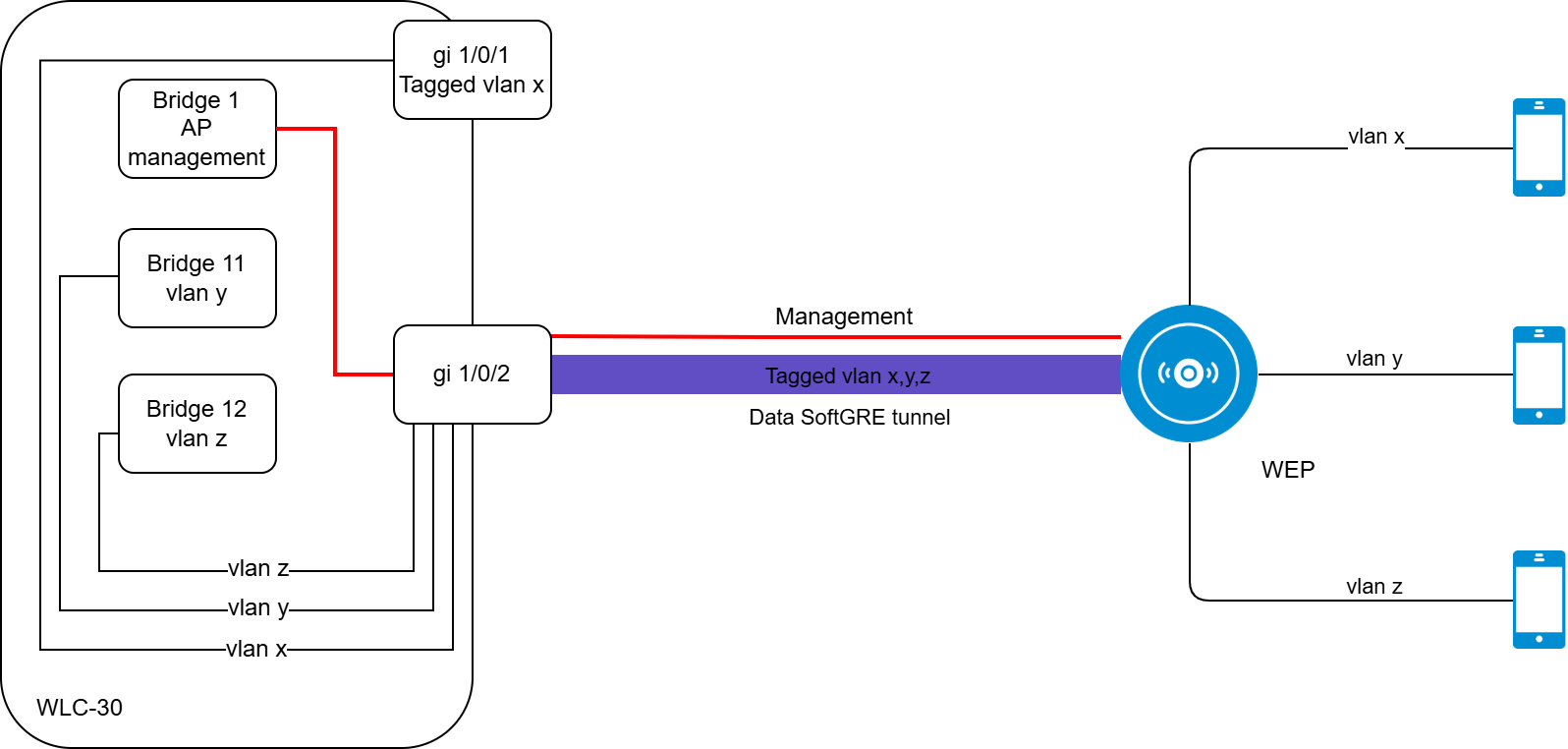
To raise tunnels, the location parameter, which was previously set on Bridge and in ap-location for SSIDs, is no longer used. Instead, you must enable tunnel mode in ap-location. The vlan-id in ssid-profile must match the vlan-id in bridge users.
| Firmware version 1.15.3 | Firmware version 1.19.0 |
|---|---|
bridge 3 | bridge 3 |
ap-location default-location | ap-location default-location description default-location mode tunnel ap-profile default-ap board-profile WEP-1L default_wep-1l_profile board-profile WEP-200L default_wep-200l_profile board-profile WEP-20L default_wep-20l_profile board-profile WEP-2L default_wep-2l_profile board-profile WEP-30L default_wep-30l_profile board-profile WEP-3ax default_wep-3ax_profile board-profile WEP-3ax-Z default_wep-3ax-z_profile board-profile WOP-20L default_wop-20l_profile board-profile WOP-2L default_wop-2l_profile board-profile WOP-30L default_wop-30l_profile board-profile WOP-3ax default_wop-3ax_profile ssid-profile default-ssid exit |
| vlan 3 force-up exit |
Wireless-controller is renamed to softgre-controller:
| Firmware version 1.15.3 | Firmware version 1.19.0 |
|---|---|
wireless-controller | softgre-controller |
WLC monitoring commands have been changed:
| In 1.15.3 version | In 1.19.0 version | Command description |
|---|---|---|
| show wlc connected-ap | show wlc ap | View the list of access points monitored by the controller |
| show wlc connected-ap detailed | sh wlc ap detailed | View detailed information on all authorized access points |
| show wlc connected-ap detailed <MAC_AP> | sh wlc ap detailed <MAC_AP> | View detailed information on one of the authorized access points |
| show wlc connected-ap-clients <MAC_AP> | sh wlc clients ap <MAC_AP> | View information about the wireless client connections of a specific access point |
| show wlc connected-ap-clients <MAC_AP> detailed | sh wlc clients ap <MAC_AP> detailed | View detailed information about the wireless client connections of a specific access point |
| show wlc connected-client <MAC_STA> | sh wlc clients <MAC_STA> | View wireless client connection information by its MAC address |
| show wlc connected-client <MAC_STA> detailed | sh wlc clients <MAC_STA> detailed | View detailed connection information of a wireless client by its MAC address |
| show wlc connected-ap-interfaces <MAC_AP> | show wlc ap interfaces <MAC_AP> | View information and counters on access point interfaces |
| show wlc connected-ap-radios <MAC_AP> | show wlc ap radios <MAC_AP> | View the basic parameters of the access point's radio interfaces |
Updating the secondary bootloader requires uploading the file to the controller and rebooting the controller. The operation can be combined with updating the main firmware.
When downloading the secondary bootloader using remote file copying servers, it is necessary to:
When loading the secondary bootloader using a USB/MMC key, it is necessary to:
|
|
|
|
|
|
The rules for using firmware files for the different models are described in the section Files used for the update.
1. Define the volume label of the connected USB/MMC storage:
|
|
2. Copying file from the USB/MMC storage:
When executing copy commands to USB/MMC media, instead of the <USB_DISK> or <MMC_DISK> fields, use the real volume labels defined above. |
|
|
When uploading firmware using remote file copy servers:
When loading the firmware using a USB/MMC media:
|
|
|
|
|
|
The rules for using firmware files for the different models are described in the section Files used for the update.
1. Define the volume label of the connected USB/MMC storage:
|
|
2. Copying file from the USB/MMC storage:
When executing copy commands to USB/MMC media, instead of the <USB_DISK> or <MMC_DISK> fields, use the real volume labels defined above. |
|
|
WLC controllers store two firmware images (image-1 and image-2) at the same time.
1. Check the contents of the firmware images uploaded to the controller:
|
When loading a firmware file to the system:firmware partition, the upload is always made to the currently inactive partition.
2. Select the partition containing firmware version 1.30.2 as bootable:
wlc# |
3. Check that the image containing firmware version 1.30.2 is selected for upload:
|
If a firmware version that was released earlier than the current firmware version is selected for subsequent download, the current configuration cannot be converted after a reboot and a empty configuration (no factory settings) will be applied. With an empty configuration, the controller can only be connected to using a console connection and the default admin/password. |
Reboot the controller using the following command:
|