A backup connection to external telephone networks must be organized using existing copper connection lines in analog form. For this purpose, TAU-32M.IP modular subscriber gateway with TAU32M-M8O or TAU32M-M4S4O-R modules installed can be used.
The SMG-3016 is used as the PBX. The configuration principles will be similar for the ECSS-10 PBX.
There is a primary SIP link to the PSTN provider, the failure of which must be backed up. The primary link via E1 channels is backed up in the same way.
There are several (from 1 to 32) copper lines to the provider.
In case of failure of the main link, it is necessary to transparently switch to making calls via copper lines.
Incoming calls from copper lines should always be accepted and distributed to subscribers or forwarded to IVR.
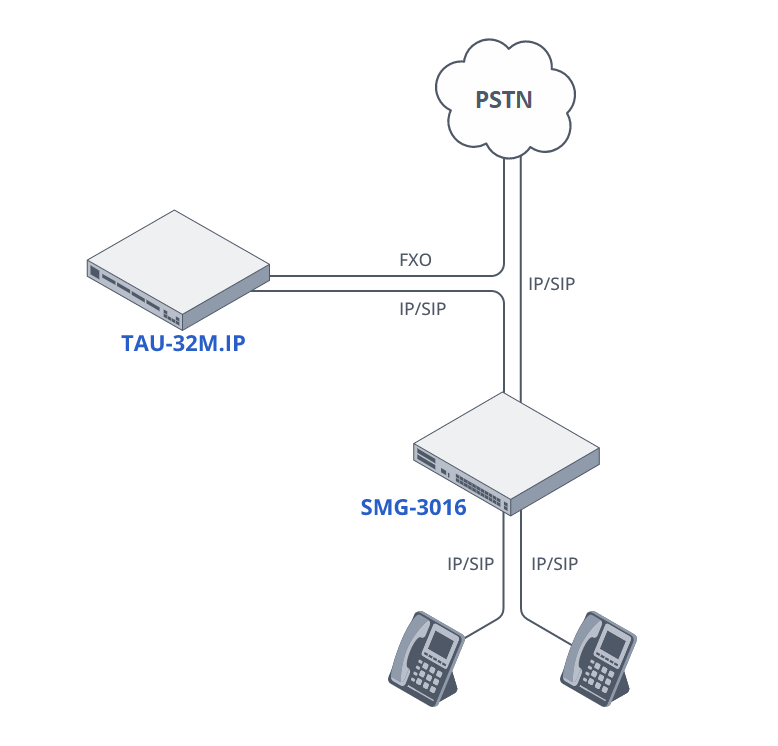
Figure 1. Connection diagram for the TAU-32M.IP analog gateway with FXO ports.
The TAU-32M.IP analog modular gateway allows to use up to four TAU32M-M8S, TAU32M-M8O, or TAU32M-M4S4O-R analog port submodules in any combination. Thus, up to thirty-two FXO ports can be obtained for connection to a higher-level PBX via analog copper lines. These ports can be used for access to external telephone networks as an alternative to SIP connection in case of failure of the main digital communication channels.
FXO ports are grouped into a call group. An outgoing call from SMG is routed to the call group number and distributed to one of the available FXO ports. The FXO port picks up the line and dials the number when the other party answers.
An incoming call from the other party goes to the FXO port and is directed to the hotline number specified on that port. The hotline number can be set as the number of a specific subscriber or, for example, an IVR number, where the caller will be prompted to dial the extension number of the desired subscriber.
The modular design of the TAU-32M.IP analog gateway allows to use not only FXO cards, but also cards with FXS ports for connecting analog telephone sets.
FXS ports can be configured both for calls between themselves and for calls via FXO ports. FXS ports can also work with a higher-level PBX using SIP and H.323 protocols.
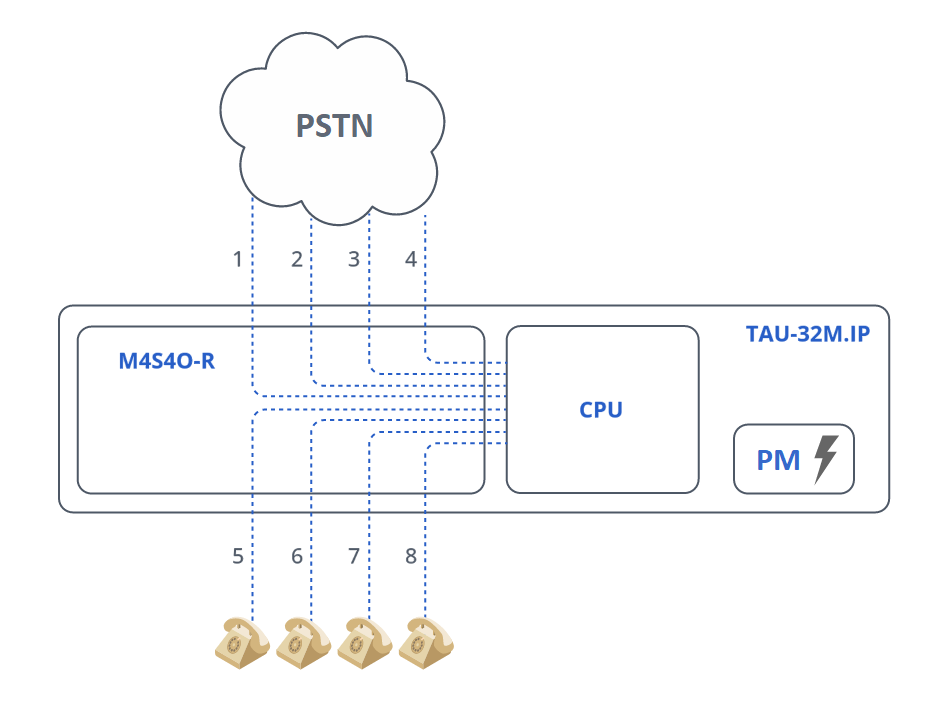
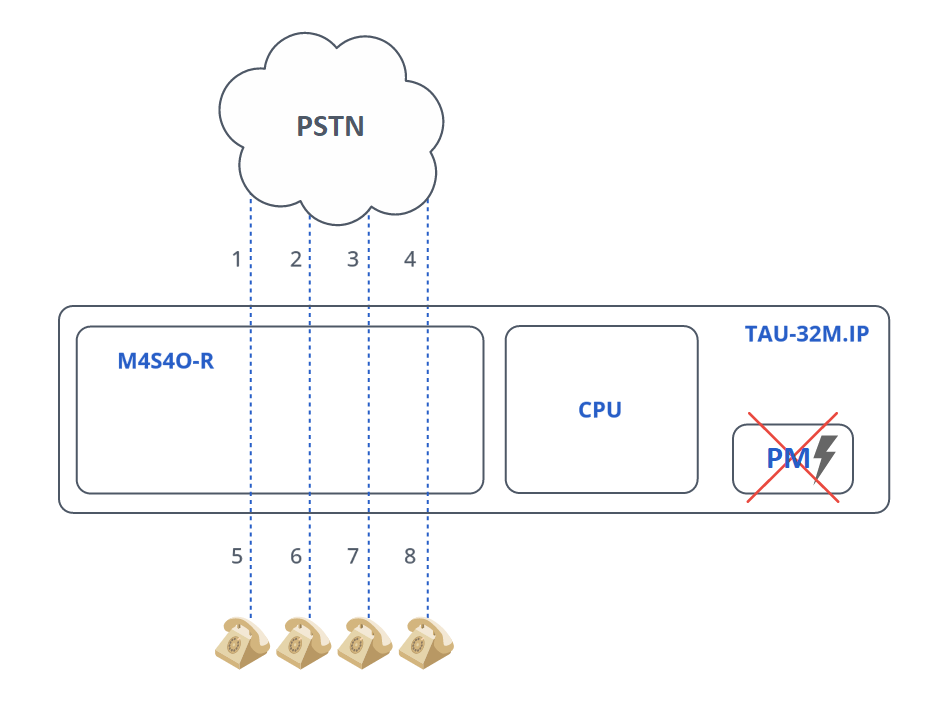
The TAU32M-M4S4O-R card has 4 FXO ports and 4 FXS ports. When power is supplied to the TAU-32M.IP, the ports can be used in the same way as the ports on the TAU32M-M8O and TAU32M-M8S cards, as described above. However, when power is lost, the FXS ports are directly connected to the FXO ports in pairs. Port 1 (FXO) connects to port 5 (FXS), port 2 to port 6, and so on. Thus, telephones connected to FXS ports are connected directly to the lines of the higher-level PBX and can make calls as if they were connected directly.
|
|
| Figure 2. Normal operation | Figure 3. Operation in power failure mode |
When configuring numbering for these telephones, it should be noted that when the power is turned off, numbers from telephone lines to the PBX will be sent to the telephones. Therefore, in normal TAU operation, in some cases, to avoid confusion when operating in “emergency” mode, direct routing of incoming calls from the higher-level PBX to the same telephones should be configured. However, in other cases, priority may be given to centralized processing of incoming calls, and then it is advisable to route them to the operator.