EVI Scud is a module of the access control and management system designed for organizing access control in a company.
By default, the controller connects to the EVI platform using the domain name evi-core.eltex.local. There are two ways to change the platform address:
The platform address is set via DHCP using DHCP Option 43. The string format is: <SERVER-NAME/IP-ADDRESS>:<PORT>, where:
After receiving an address different from the current one, the controller will automatically begin reconnecting to the new platform address. |
The controller automatically retrieves the time from the platform – no additional configuration is required. |
You need to access the web interface of the IPA-ER-020 controller. For more information about the device, refer to the IPA-ER-020 PACS controller manual.
Connect to the device's web interface using the IP address assigned by DHCP, or go to http://192.168.1.10 if DHCP is not available on the network. |
On the authorization page, enter the following data in the Login and Password fields:
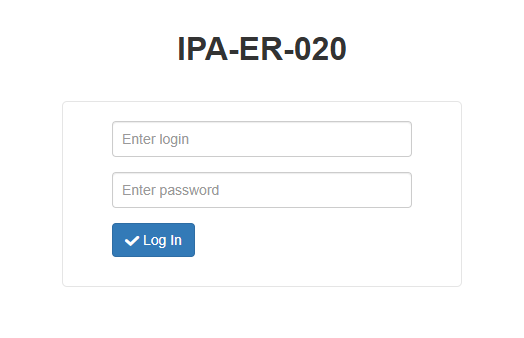
Click the Log In button.
Switch to Network settings, select the EVI Platform tab.
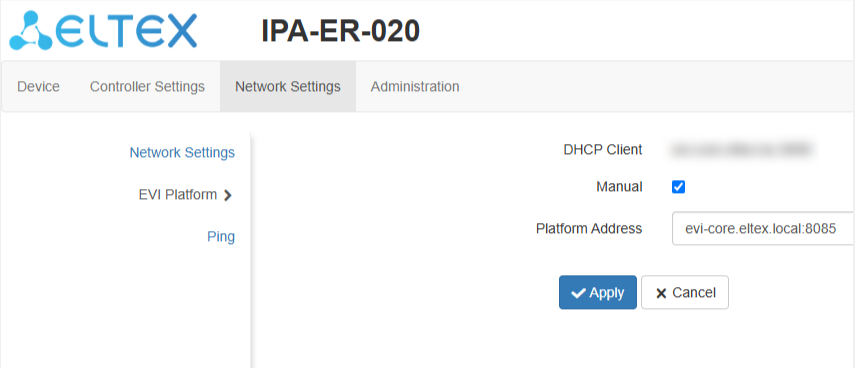
Select the Manual option.
In the Platform Address field, enter the desired server address in the following format:
<evi-core IP address>:8085 |
Click the Apply button.
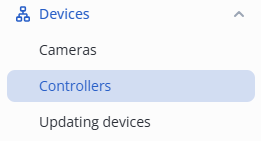
In the web interface, switch to the Controllers page in the Devices section.
Click the three dots to the right of the firmware Version column and click the Authorize button.
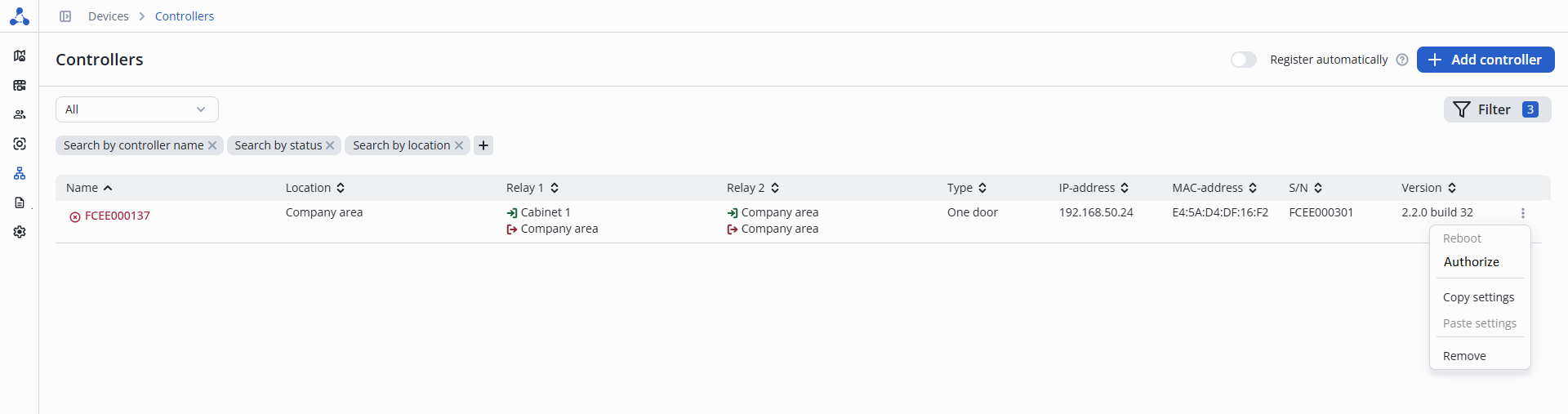
The serial number is entered automatically; click the Authorize button.
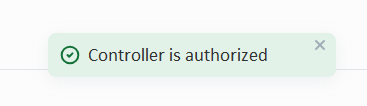
Once the item has been successfully added, a notification will appear at the bottom center of the screen indicating that the operation was successful.
The IPA-ER PACS controller has the default address of the EVI Platform server: evi-core.eltex.local.
Specifying this domain name in the DNS server will allow controllers to automatically connect to your EVI platform.
If an address other than the default address is required, then a DHCP server must be pre-configured.
To do this, enter the server address of your EVI platform in option 43. After that, all controllers will automatically connect to the specified address.
Switch to the web interface to the Controllers page in the Devices section.
Switch the Register automatically toggle to the active position.

All controllers will then be added to the system automatically.
To work with IPA-ER it is recommended to use a reader with current consumption up to 200 mA or power the reader directly from the power supply.
A reader with speaker control support and passage prohibition indication is recommended.
The communication interface between the controller and the reader operates using the Wiegand protocol, various readers with NFC, MIFARE, QR, EMM, HID, etc. can be used. It is only important that Wiegand is supported.
| № | Name | Compatibility with the EVI Platform | Em-Marine | Mifare | Indication hold | Comment |
|---|---|---|---|---|---|---|
| 1 | Iron Logic Matrix-II | Yes | Yes | No | Yes | Separate contacts for controlling the green, red LED and speaker |
| 2 | Iron Logic Matrix-III | Yes | Yes | No | Yes | Separate contacts for controlling the green, red LED and speaker |
| 3 | ProxWay pw-mini-multi-ble v2 | Yes | Yes | No | Yes | Separate contacts for controlling the green, red LED and speaker |
| 4 | Smartec ST-PR043EHM | Yes | Yes | No | Yes | No hardware control of the red LED |
| 5 | AGRG AXI 2 | Yes | No | Yes | Pulse indication operation mode | Separate contacts for controlling the green, red LED and speaker |
| 6 | Sigur MR100 Lite | Yes | No | Yes | Pulse indication operation mode | Separate contacts for controlling the green, red LED and speaker |
| 7 | Novicam ER-12W | Yes | Yes | No | Yes | No hardware control of the red LED |
| 8 | ЛКД-СК-12-02 | Yes | Yes | No | Yes | No hardware control of the red LED |
For example, connect one door with a door opening sensor, one pass reader and a door opening button.
Switch to diagram 2 and connect the pass reader, door open sensor, door open button, door magnet to the IPA-ER controller.
Examples of wiring diagrams for the IPA-ER-020 controller are provided in the Controller wiring diagrams section.
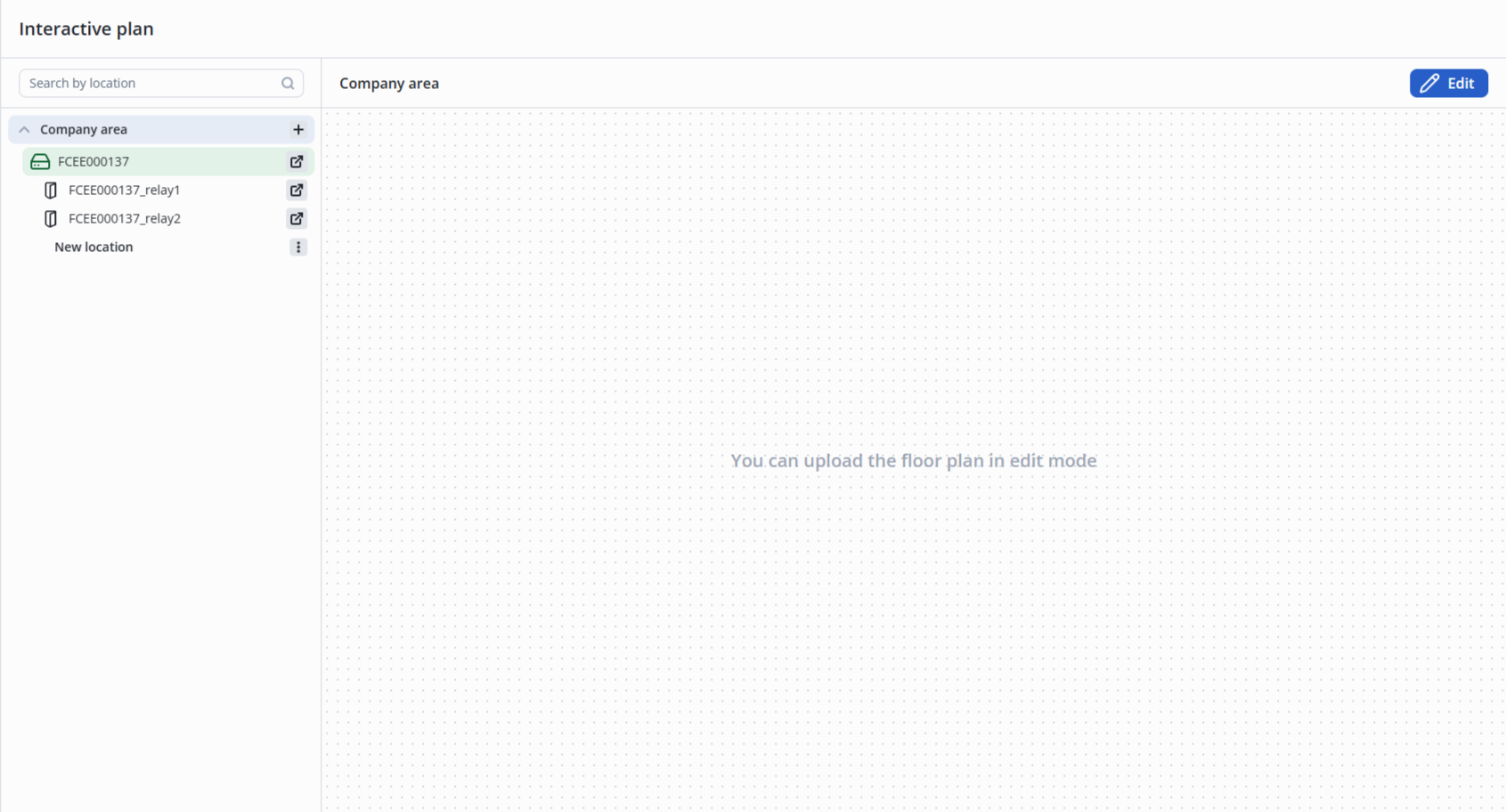
Locations are necessary for tracking employees' movement history and for conveniently managing access to them. |
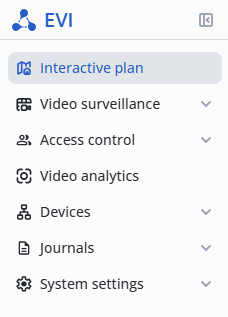
Select Interactive plan from the side menu.
Click the + button under Company area, then Add location.
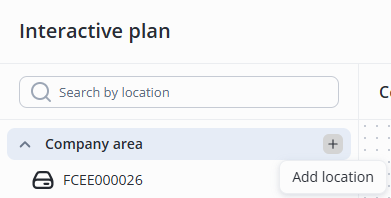
In the window that appears, enter the name of the new room, for example, Cabinet 1, and click the Save button.
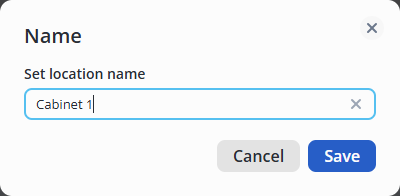
If you saved a room named New location, tap the ellipsis on the right side of the screen and select Rename. Name the room, for example, Cabinet 1.
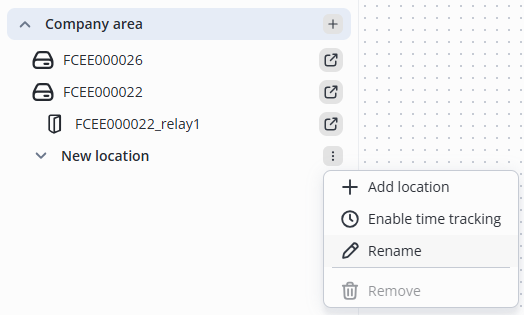
Enter the name of the new location, for example, Cabinet 1, and save it by clicking Save in the pop-up window or pressing the Enter key.
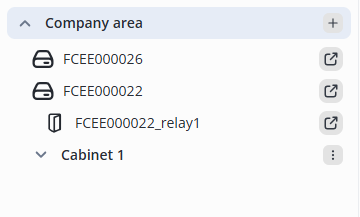
Select Controllers from the side menu in the Devices section.
Click the name of the controller.

Switch to the Relay tab.
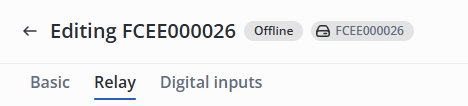
Select the One door Control type in the Settings section.
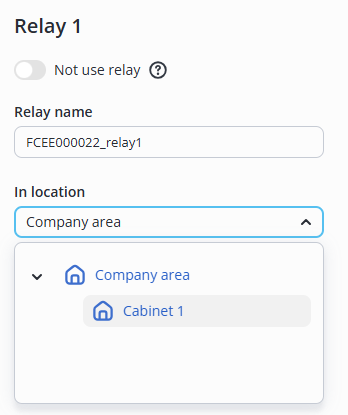
Specify the name of the relay as Cabinet 1.
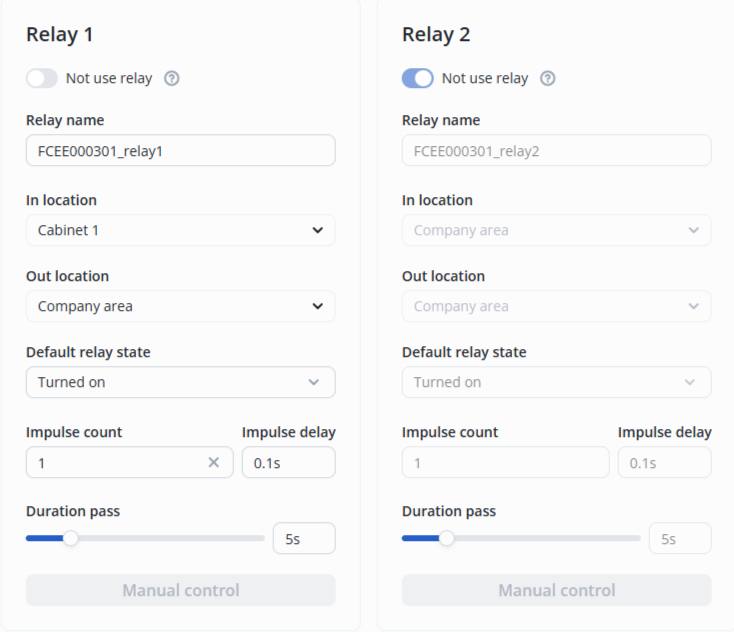
For Relay 1, select the following:
The final configuration looks as follows:
Switch to the Digital inputs tab.
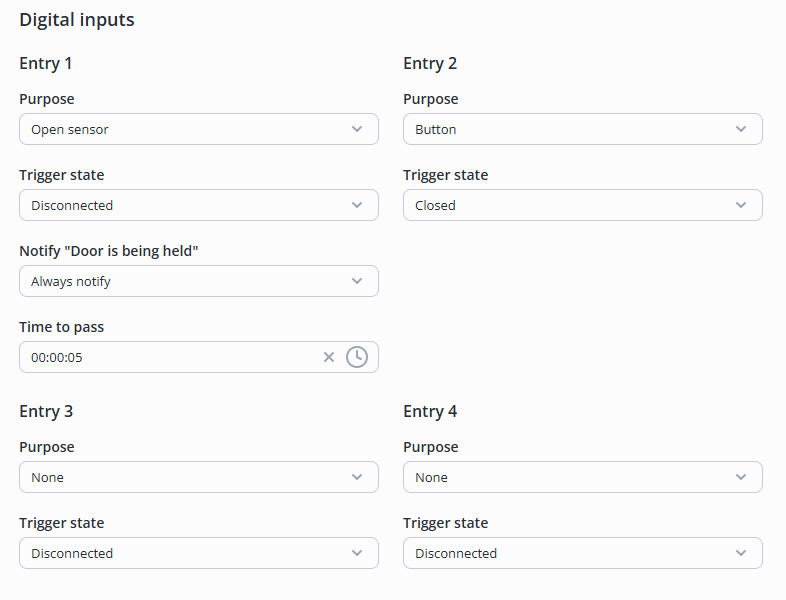
1 and 2 digital inputs are connected to 1 relay.
For 1 digital input, select the following:
For 2 digital input, select the following:
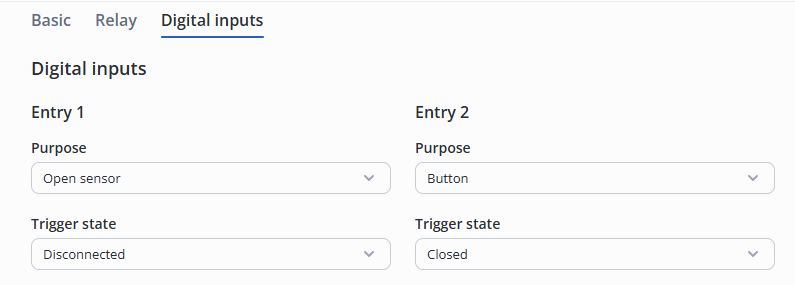
Click the Save button in the lower right corner.
Then, relay 1, which controls the door, will be displayed on the Interactive plan page in Cabinet 1.
Beforehand, open the folder using the  button next to its name.
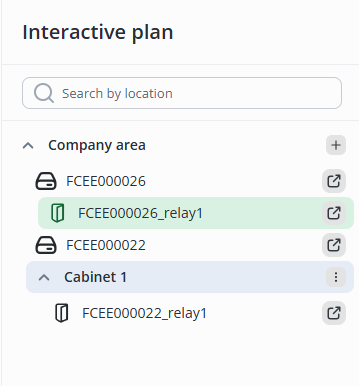
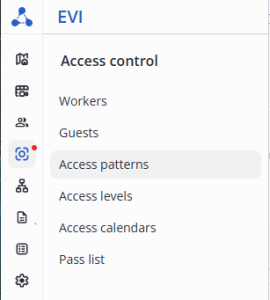
To enable access for a worker to the Cabinet 1, it is necessary to create an access pattern.
Enter the Access control section, and select the Access patterns item in the menu.
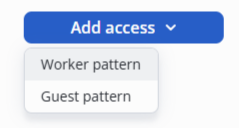
Click the Add access button in the middle of the screen.

Select the Worker pattern item.
Specify the pattern Name as "Access to Cabinet 1".
Select Relay 1 in the Access to location section configured earlier.
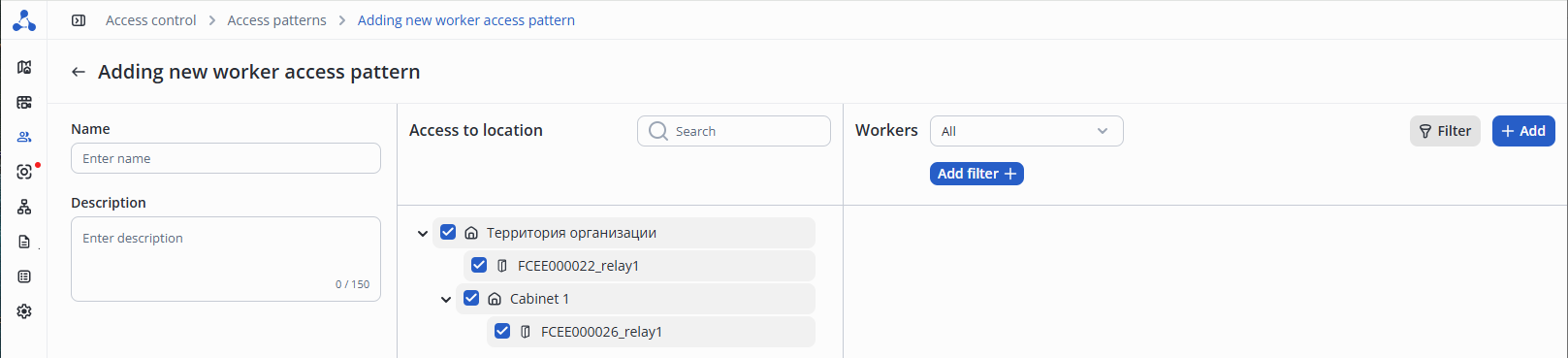
Click the Add button in the upper right corner.
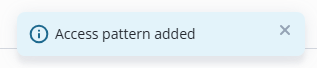
After successful addition, a notification will appear at the bottom middle of the screen to indicate that the operation was successful.
Enter the Workers page in the Access control section.
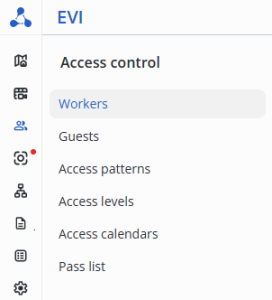
Click the Add worker button in the upper right corner of the screen.

Fill in the Name and Surname. The rest of the fields are optional.
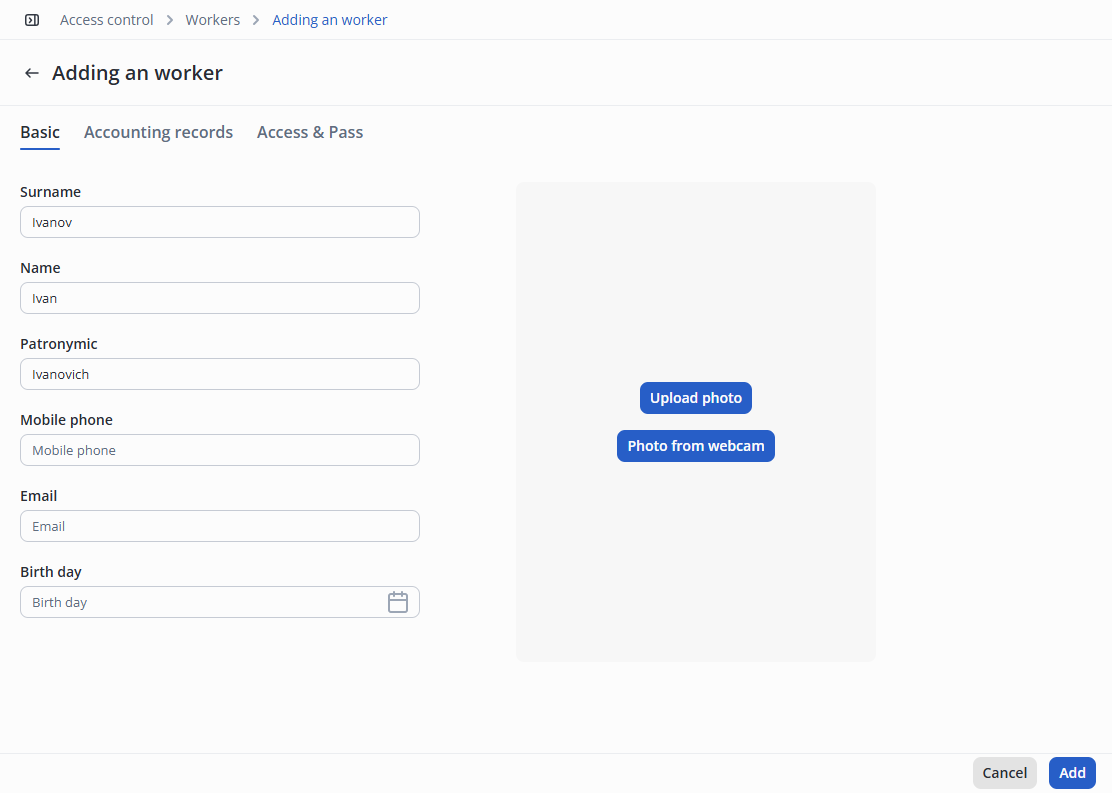
Click the Add button in the lower right corner of the screen.
Switch to the Access & Pass tab.
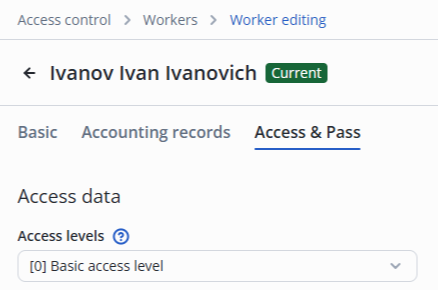
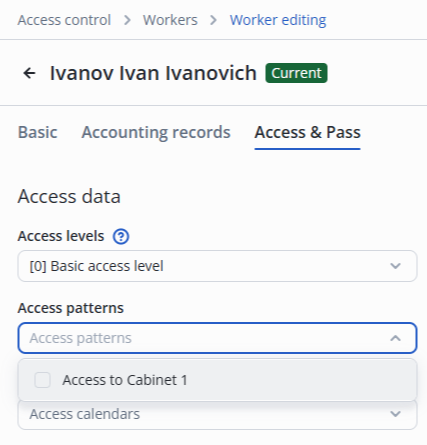
Click Access Patterns, select the previously created Access to Cabinet 1.
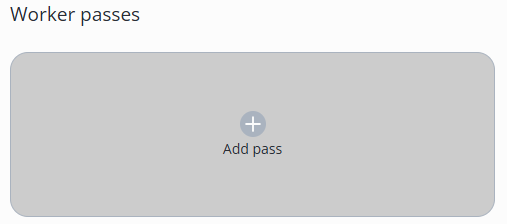
Click the Add pass button in the Worker passes section.
Scan the pass at the USB reader or enter the code from the pass. Example: 15916217.
The pass code is entered without zeros. |
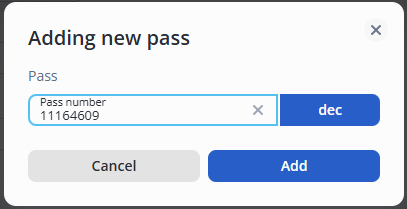
Click the Add button.
After successful addition, a notification will appear at the bottom middle of the screen to indicate that the operation was successful.
 Click the Save button in the lower right corner to save the steps.

Try to make a pass through the door. To do this, perform the following steps:
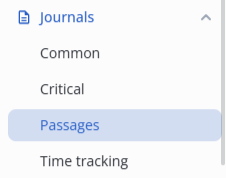
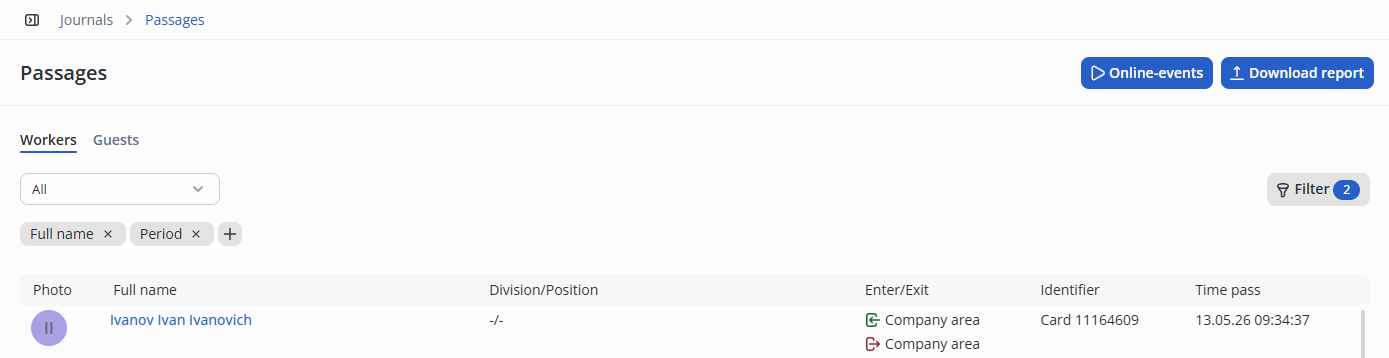
In the Journals section, the worker's pass will be displayed on the Passages page.
A pass record appeared for a worker who left the Company area and entered Cabinet 1.
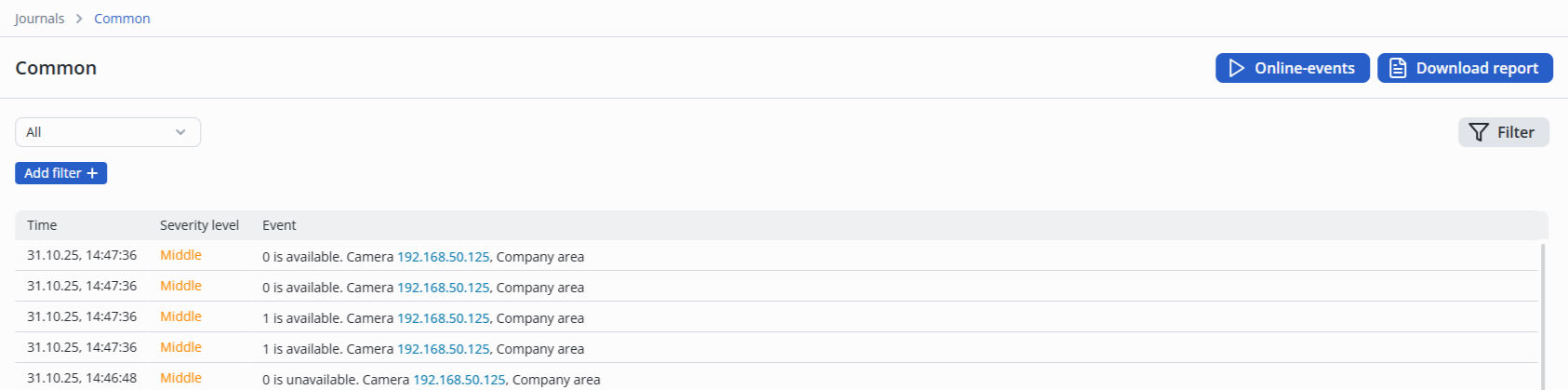
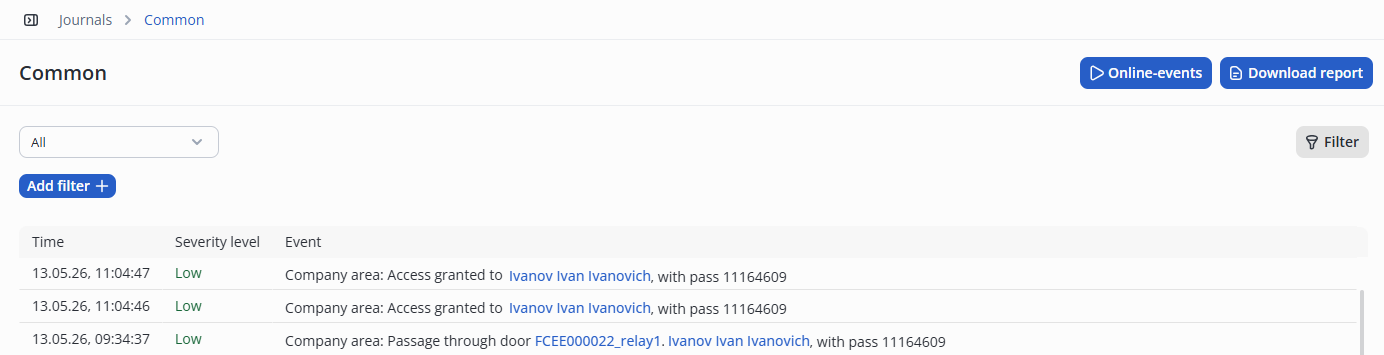
The Common page in the Journals section will display more detailed information about the worker passing through the door.
To configure the system, use an existing controller or add a new one (see the Connecting the IPA-ER Controller section).
You must connect it according to the Turnstile diagram in the Controller connection diagrams and Interactive floor plan sections.
Enter the Controllers page in the Devices section of the web interface.
Click on the name of the FCEE000137 controller.
Switch to the Relay tab.
Select the Turnstile control type in the Settings section.
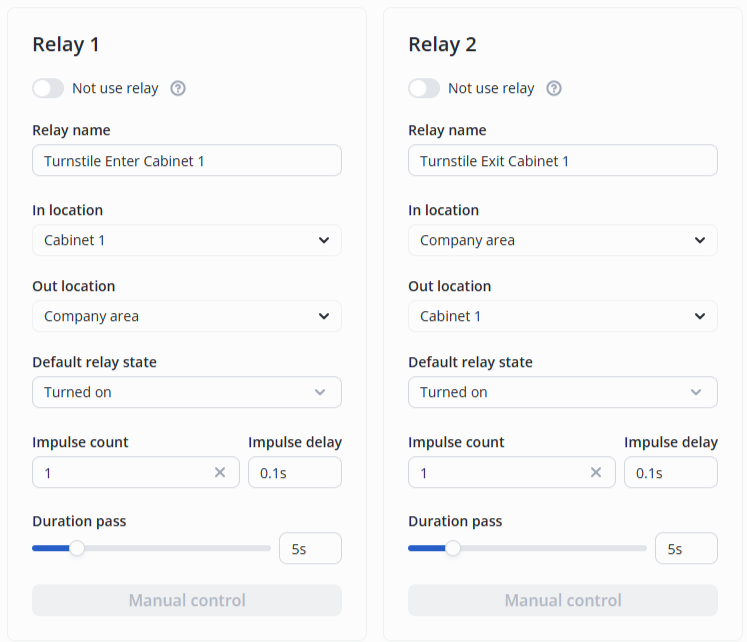
Specify the name of the relay as Turnstile Enter Cabinet 1.
For Relay 1, select the following:
Specify the name of the relay as Turnstile Exit Cabinet 1.
For Relay 2, select the following:
The final configuration looks as follows:
Switch to the Digital inputs tab.
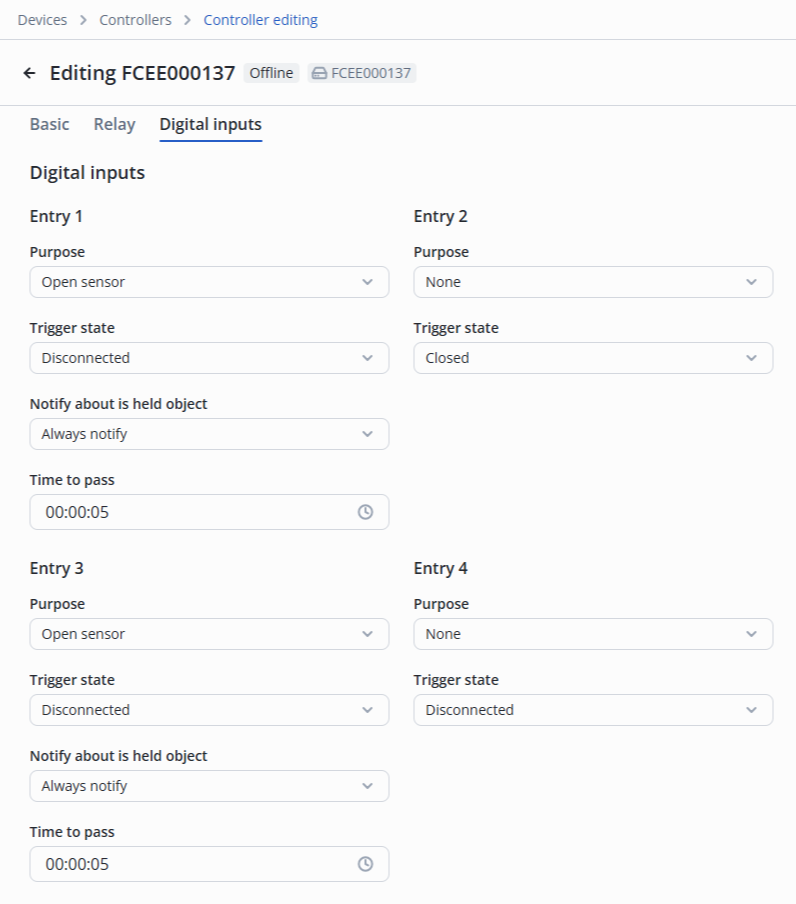
Configure as follows:
Click the Save button in the lower right corner.
After that, on the Interactive plan page Relay 1 will display with the name Turnstile Enter Cabinet 1, which controls the turnstile.
Beforehand, open the folder using the button next to its name.
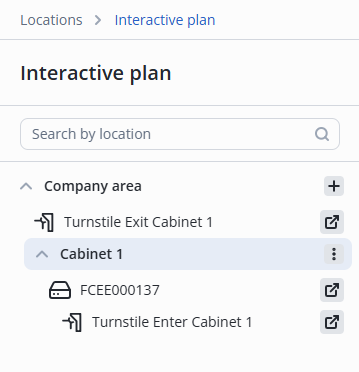
Then it is necessary to add both relays of the controller to the Access to Cabinet 1 access pattern .
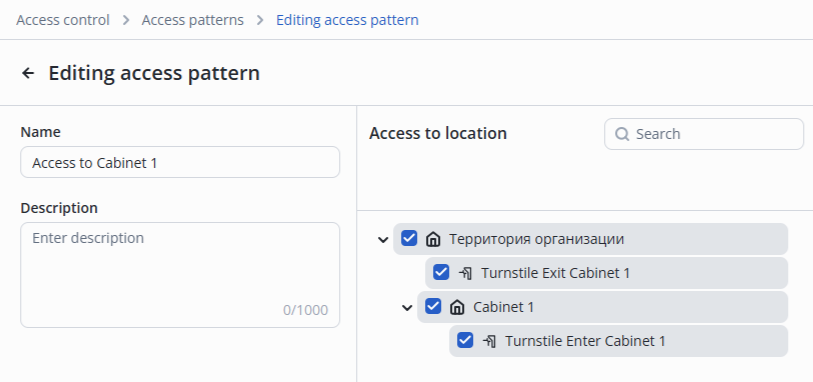
Click the Save button in the lower right corner.
After successful addition, a notification will appear at the bottom middle of the screen to indicate that the operation was successful.
After that, it is possible to add a worker and pass through the turnstile, similar to passing through the door.
To edit a controller, select Controllers from the side menu in the Devices section.
Click the name of the controller.
This tab provides general information about the controller.
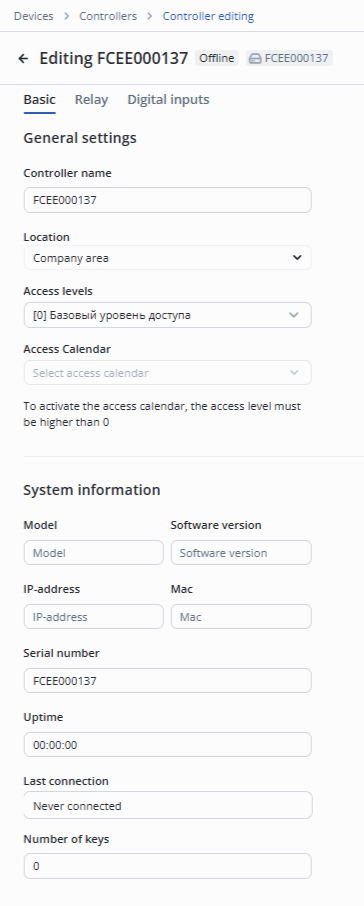
The following fields are available in this section:
The following fields are available for reading in this section:
This tab is used to configure the control mode, readers and relays.
There are 8 types of controller management:
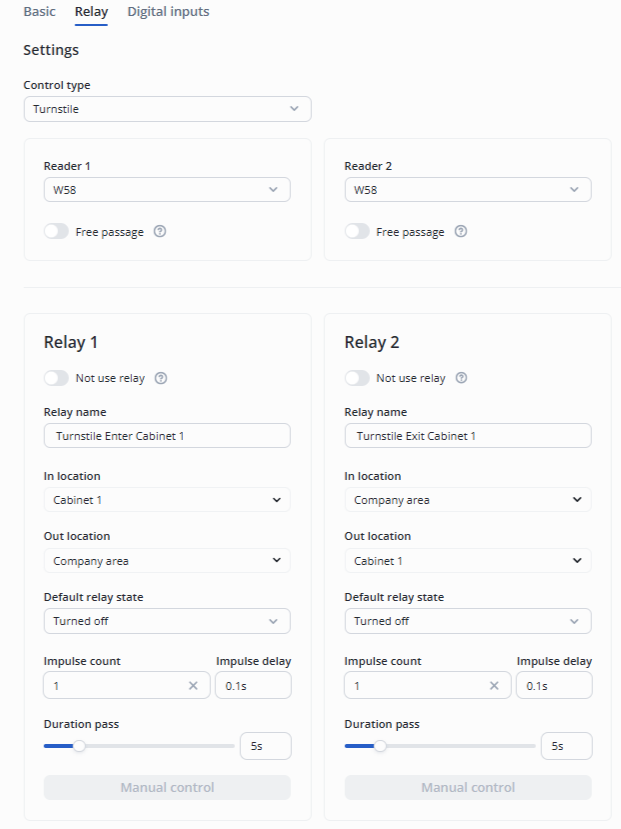
Enabling the Free passage mode provides access to any worker at any time. |
To disable a relay, use the Not use relay switch and the relay will no longer be displayed in the device list. |
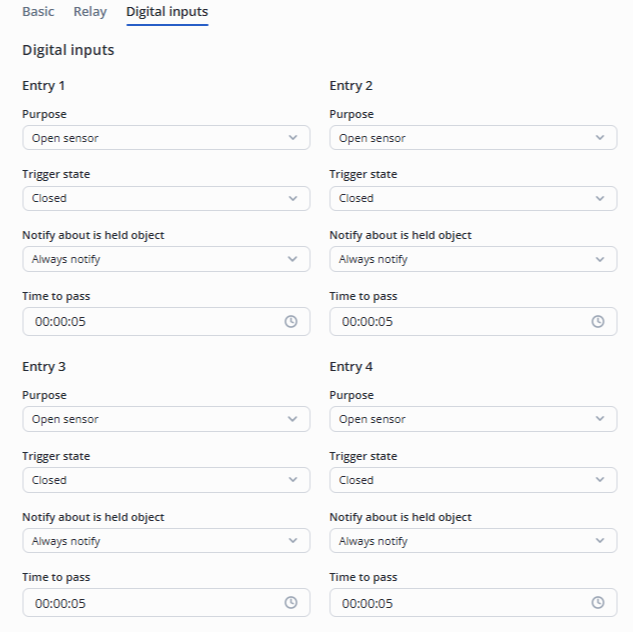
There are 4 digital inputs on the tab, by default Input 1(Di1) and Input 1(Di3) must be Open sensor, to Input 1(Di2) and Input 1(Di4) it is possible to assign a button or sensor and change the Trigger state to open or close.
It is also possible to configure Notification of object being held (Always notify by default) and Time to pass (5 seconds by default).
When configuring the Door or Turnstile mode, the digital inputs are configured automatically. |
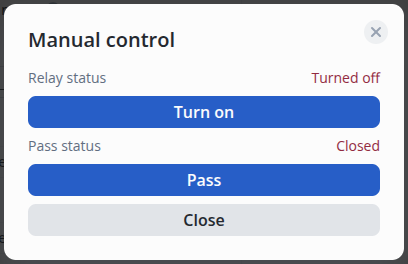
There are two ways to reboot:
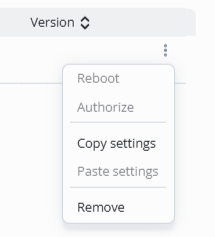
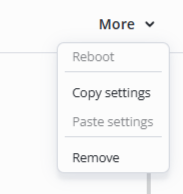
There are two ways to transfer settings — on the Controllers page and on the Edit controller page.
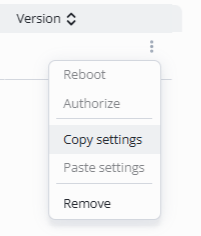
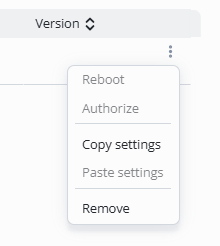
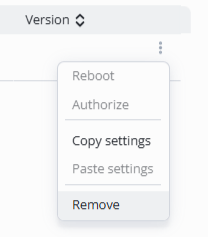
To remove a controller, click on the three dots next to the firmware Version of the desired controller.
Select the Remove option.
 In the Removing controller window that opens, click the Delete button.
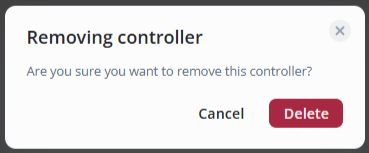
The controller will be considered unauthorized and will continue to appear in the controller list. |
The most popular diagrams of connecting the IPA-ER PACS controller to the passage points are provided below.
| Object | Control type | Reader | Relay | Sensors | Magnet | Additional devices |
|---|---|---|---|---|---|---|
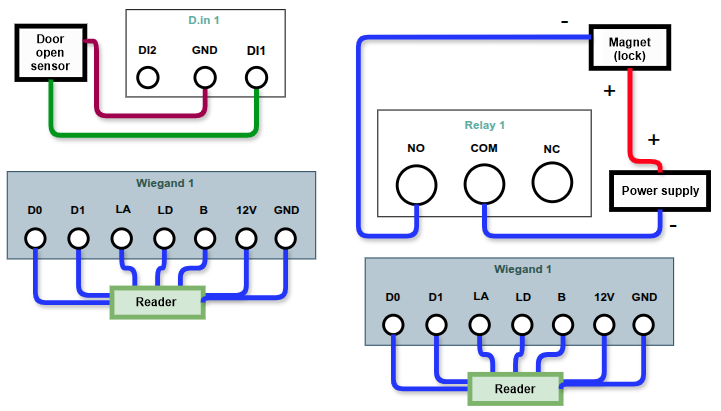
| Door | One door | 2 pcs. | 1 pcs. | Door sensor — 1 pcs. | 1 pcs. | - |
In this diagram, the positive side is connected directly to the magnet, and the negative side is connected via a relay.
The door sensor must be connected to D.in1 to register worker passages (in the Access log in the EVI Platform).
| Object | Control type | Reader | Relay | Sensors | Magnet | Additional devices |
|---|---|---|---|---|---|---|
| Door | One door | 1 pcs. | 1 pcs. | Open sensor — 1 pcs. | 1 pcs. | Button — 1 pcs. |
In this diagram, only one side of the IPA-ER device is used.
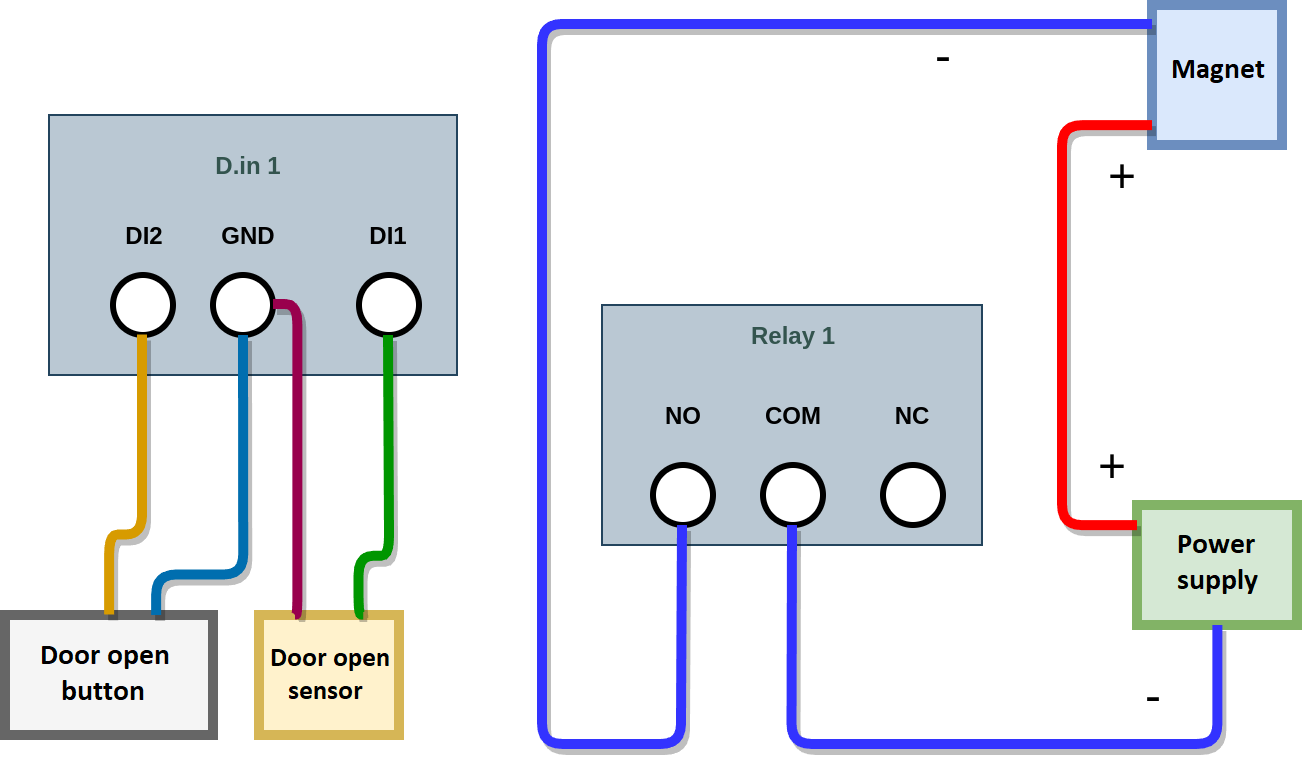
It is necessary to configure the Digital Inputs in the Controller settings in the EVI web interface:
| Object | Control type | Reader | Relay | Sensors | Magnet | Additional devices |
|---|---|---|---|---|---|---|
| Turnstile | Turnstile | 2 pcs. | 2 pcs. | - | - | - |
To connect the turnstile, the following diagram is used.
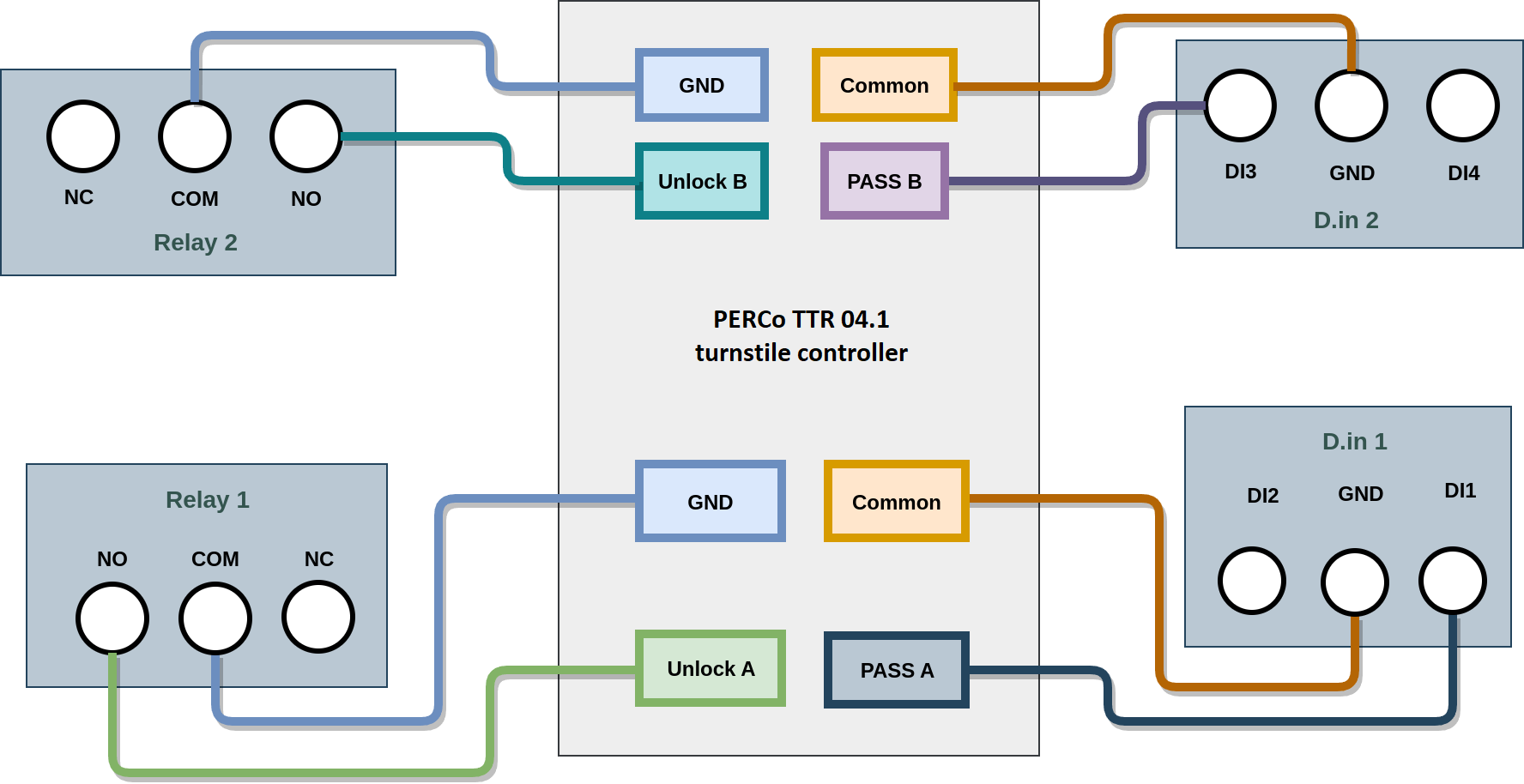
It is necessary to configure the Digital Inputs in the Controller settings in the EVI web interface:
This page is used to configure access points, manage relays and controllers, and arm the system.
Locations are necessary for tracking employees' movement history and for conveniently managing access to them. |
Select Interactive plan from the side menu.
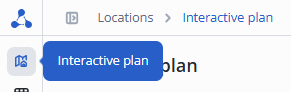
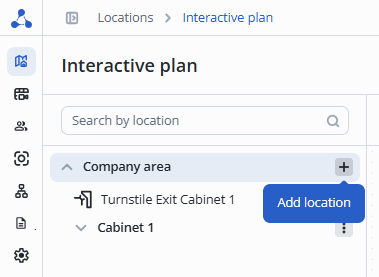
Click the + button under Company area, then Add location.
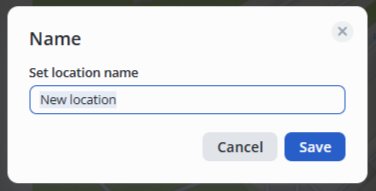
Enter the name of the new location ("New location" by default) and click Save.
Location with the name New location will appear in the list.
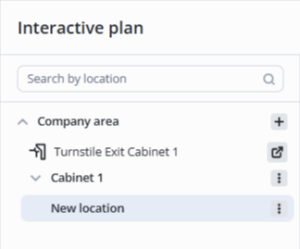
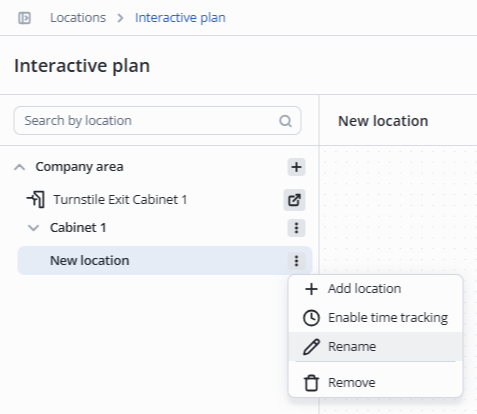
To rename a location, click the three dots on the right side of the screen and select Rename.
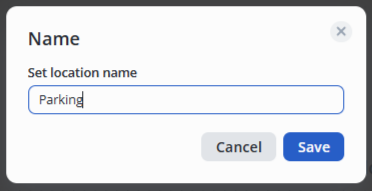
In the pop-up window, enter a name for the new location, for example, Parking, and save by pressing the Save button or the Enter key.
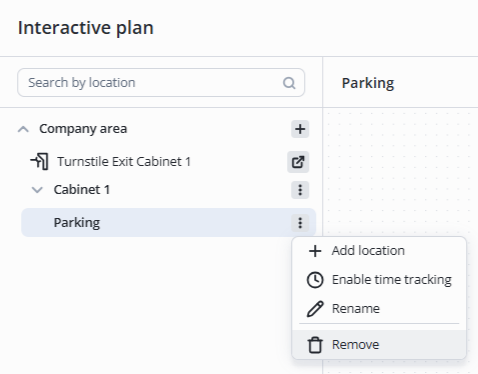
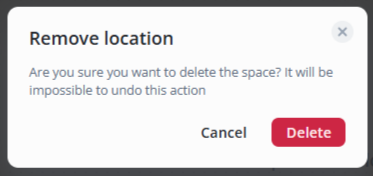
To remove a location, tap the three dots and select Remove.
In the pop-up window, click the Delete button.
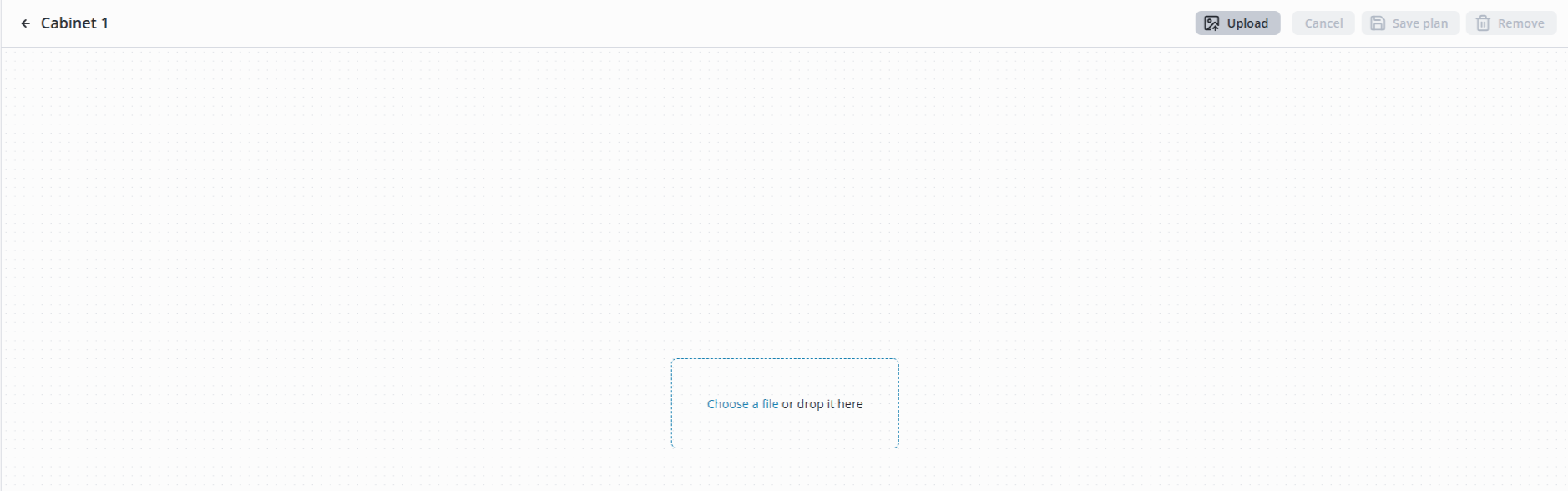
To add an image to the plan, select the required location and click the Edit button.

Click Upload or Choose a file or drop it here button and select the plan image file from your computer.
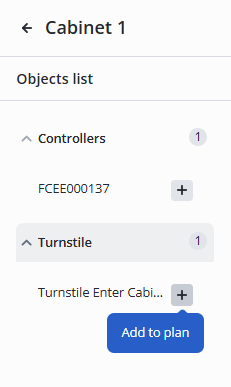
To add an object to the interactive plan, click the + button next to the object.
The objects added to the plan will be displayed in the upper left corner of the plan.
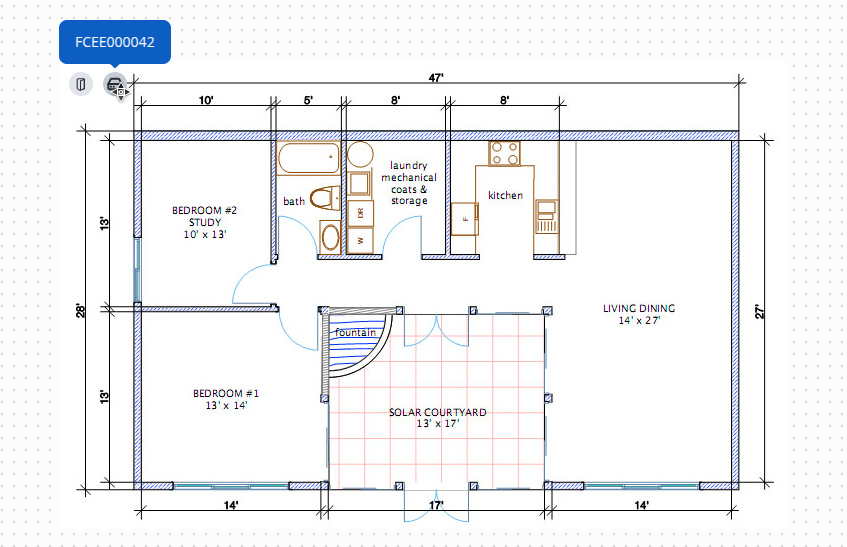
To move an object on the plan, click the Object moving button.
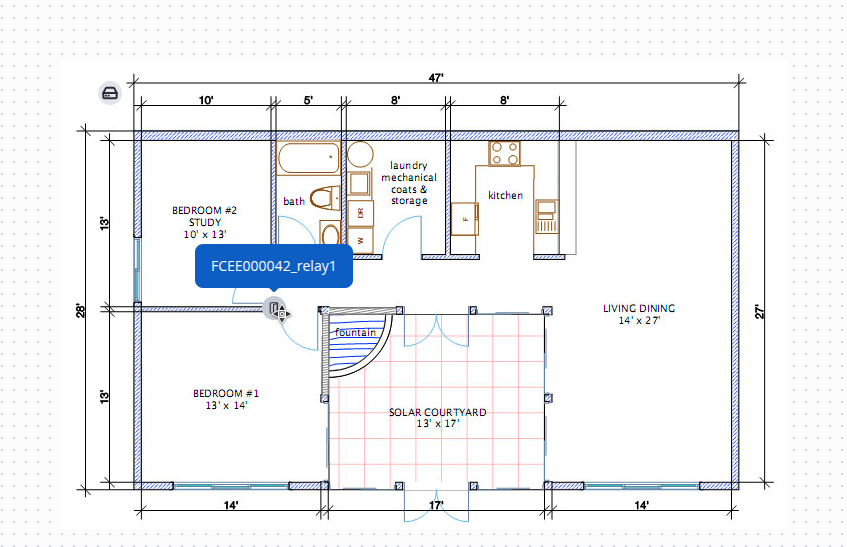
Place the cursor over the object and move it to the required location on the plan.
To remove an object from the plan, click the Object action button.
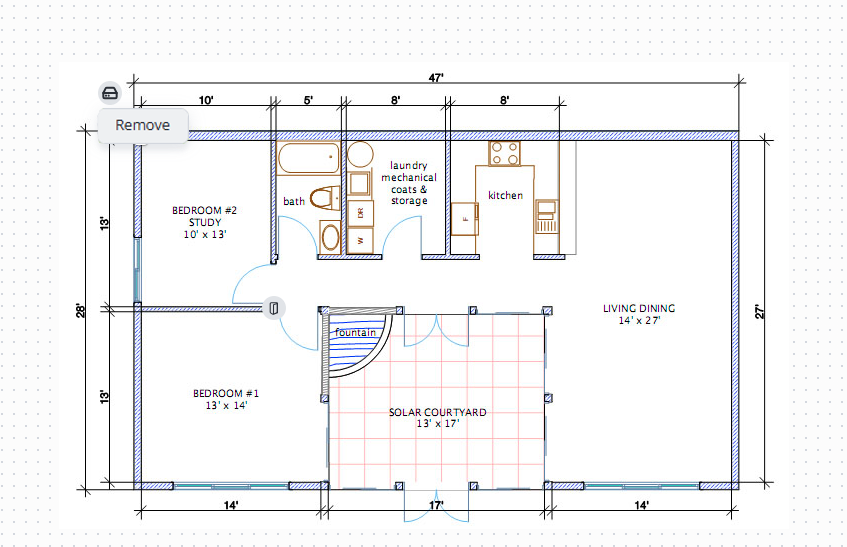
Click on the object and select Remove.
To save the plan, click the Save plan button.

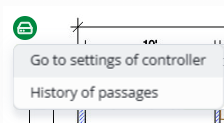
For the controller on the interactive plan, the following options are available:
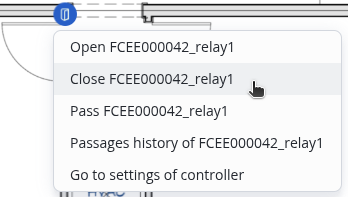
For relays on the interactive plan, the following options are available:
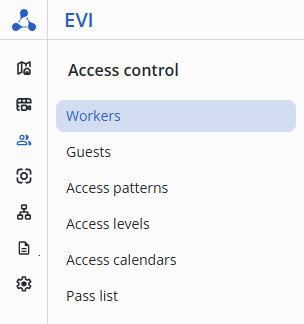
Workers — a list of people who are granted access to premises in accordance with their authorization.
Enter the Workers page in the Access control section.
Click the + Add worker button.

To add a worker, it is sufficient to fill in the Surname and Name fields.
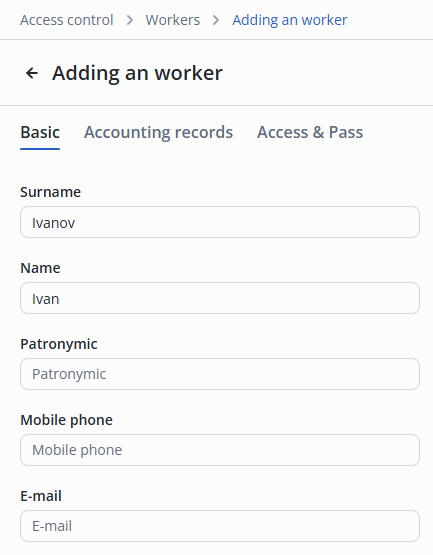
The page has 3 sections available for editing:
The following fields are available in this section:
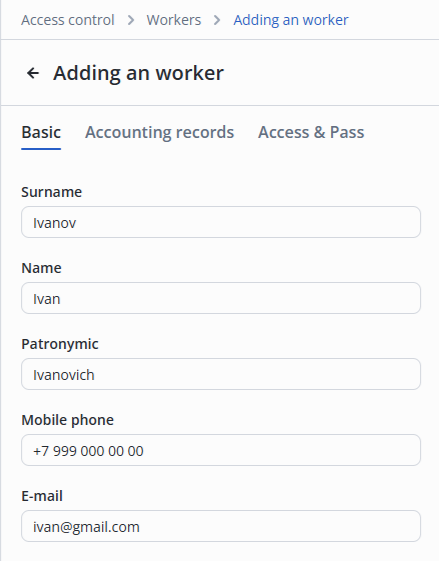
To add a photo, click the Upload photo button.
Select the worker's photo in the operating system's file manager window.
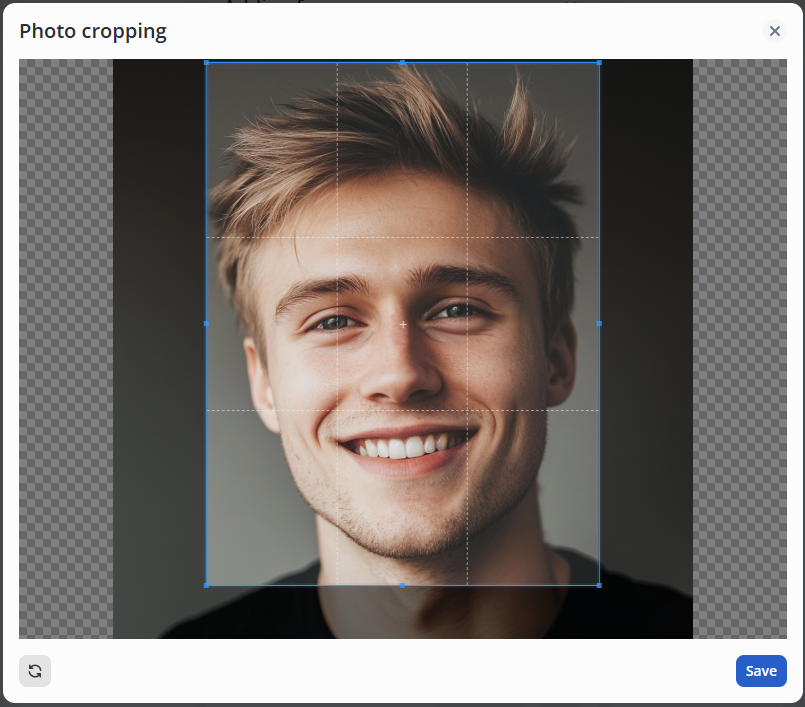
Crop the photo if required by clicking and pulling the blue edges, afterwards click the Save button.
For more information on configuring facial recognition access for employees, see the Configuring facial recognition access through the turnstile section. |
Switch to the edit section.
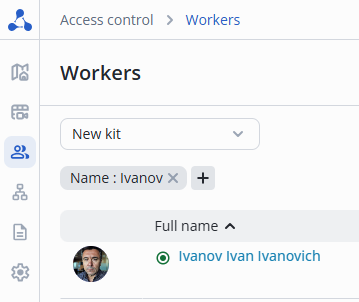
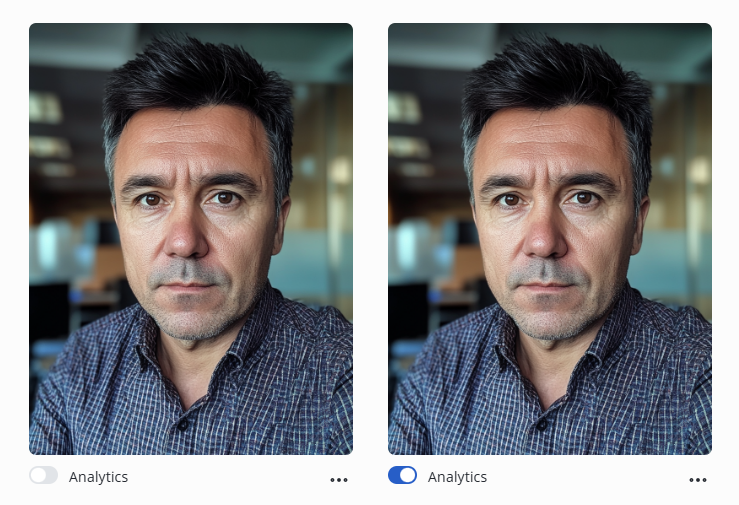
To activate analytics, turn the Analytics switch to the enabled position.
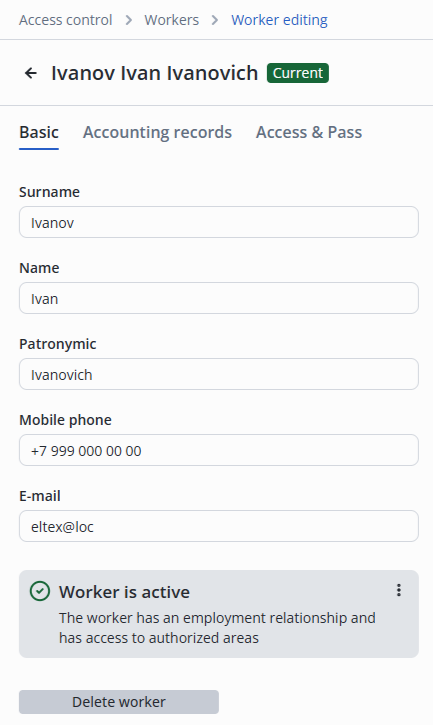
To remove a worker, click the Delete worker button.
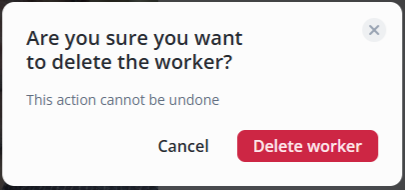
In the pop-up window, click the Delete worker button.
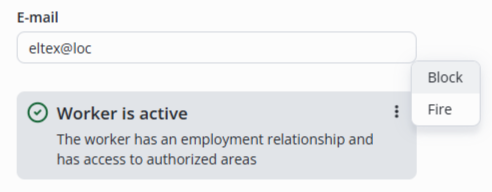
To block a worker, click on the three dots to the right of the Worker is active caption, then select Block.
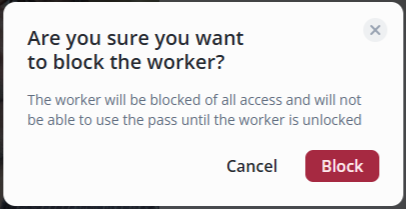
In the pop-up window, click the Block button.
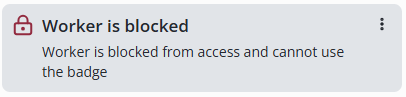
The caption Current next to the worker`s name changed to Blocked.

The info line changes from Worker is active to Worker is blocked.
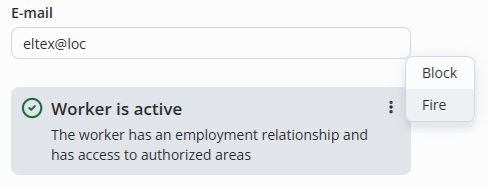
To fire a worker, click on the three dots to the right of the Worker is active caption, then select Fire.
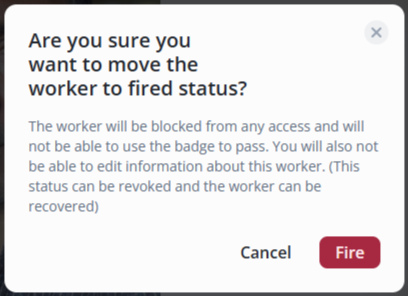
In the pop-up window, click the Fire button.
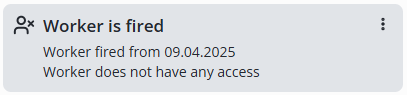
The info line changes from Worker is active to Worker is fired.
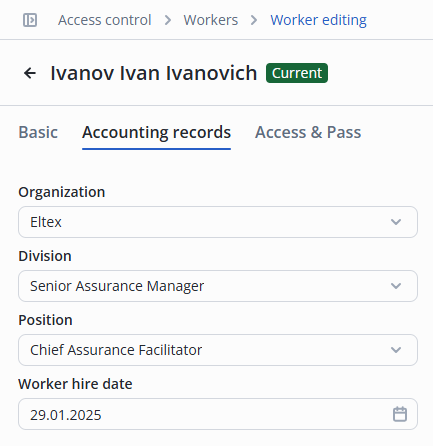
The section provides additional information about the worker:
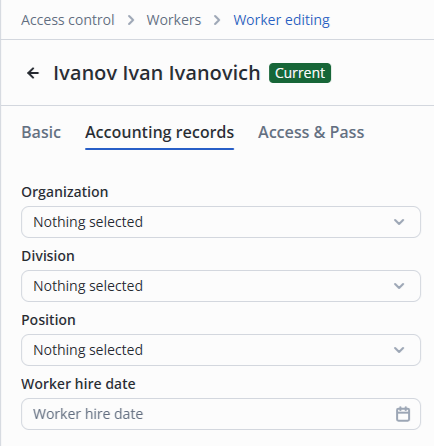
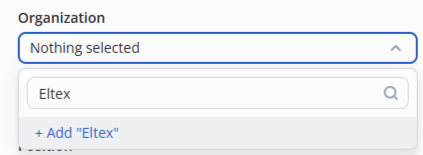
To add an organization, click on Nothing selected and enter a name in the field, such as Eltex.
After that, click the + Add "Eltex" button.
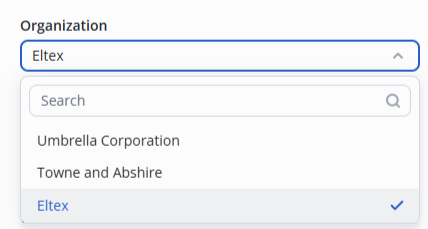
The organization is created. In the future it will be available for selection by any worker.
The interaction with Division and Position is similar.
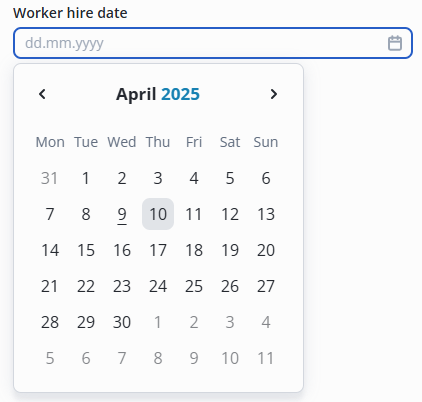
The worker hire date is selected by clicking on the input field and then selecting the day on the calendar, or by manually entering the date in the field.
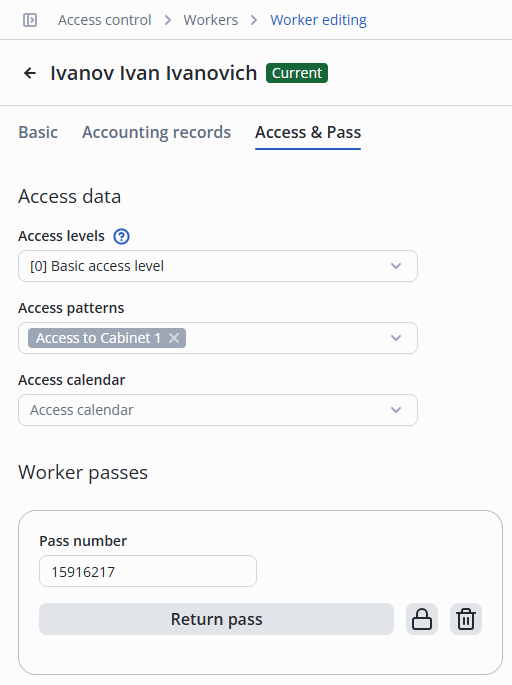
In this section it is possible to configure which locations a worker may have access to and at what time. Passes and cars are also added here.
To configure an employee's access, the following options are available:
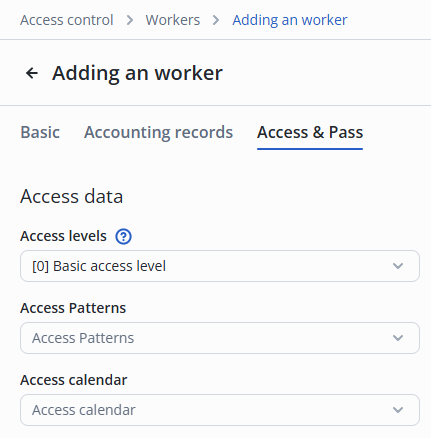
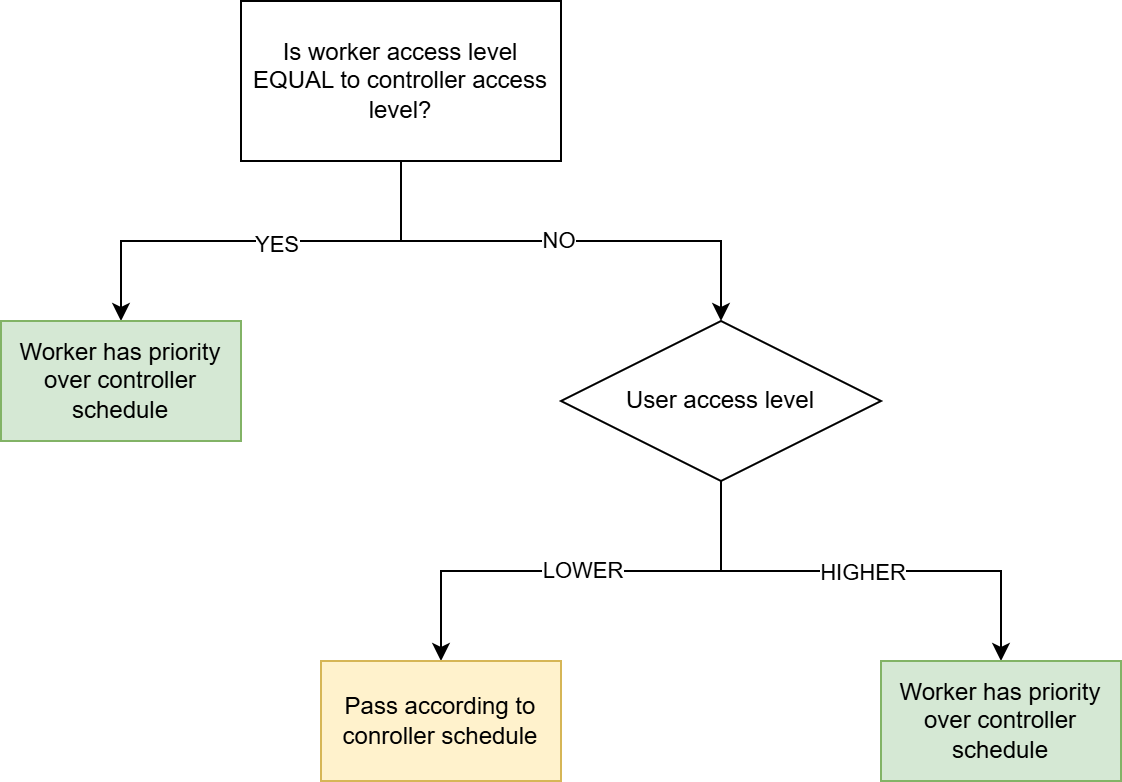
Worker access level means that the worker access priority is higher than the PACS controller schedule. The details are available in the Access levels section.
The worker is provided with access to the locations independently of the visit time specified in the PACS controller.
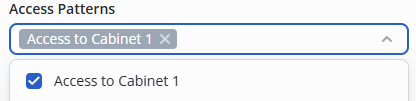
By selecting the access pattern, specify which locations the employee is provided access to.
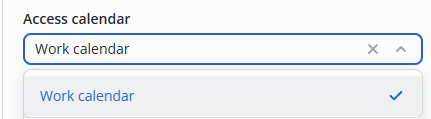
By selecting the access calendar, limit the time for visiting the locations specified in the access pattern.
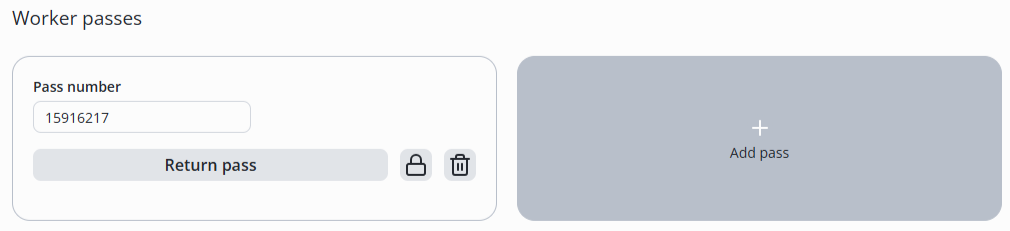
Section for adding, blocking and deleting worker passes.
Click the Access & Pass tab.
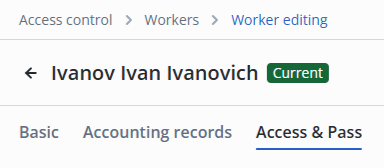
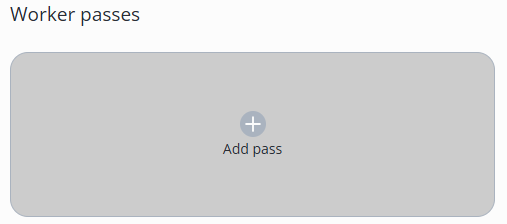
Click on the Add pass button in the Worker passes section.
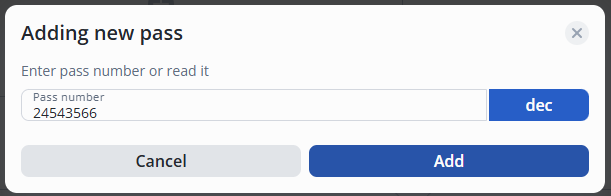
Hold your access card up to the USB reader or enter the code from the card. Example: 0004559976.
The pass code is entered without zeros. |
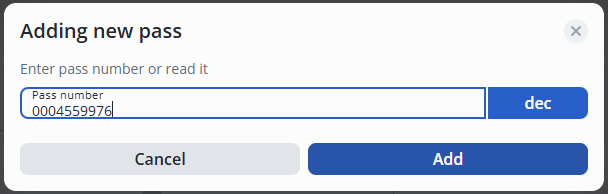
Click the Add button.
Click the Add button in the lower right corner to save the steps.
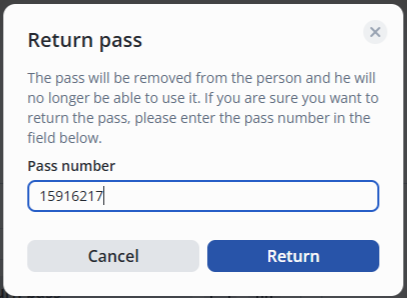
Returning a pass differs from deleting a pass only in that returning a pass requires confirmation of the pass number entry. |
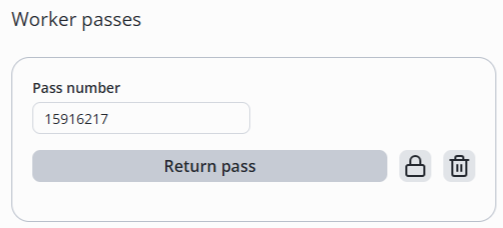
To return a worker's pass, click on the Return pass button in the pass card.
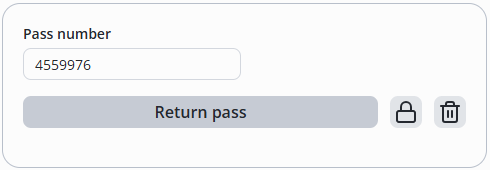
Hold the pass up to the USB reader or enter the code from the pass.
Click the Return button.
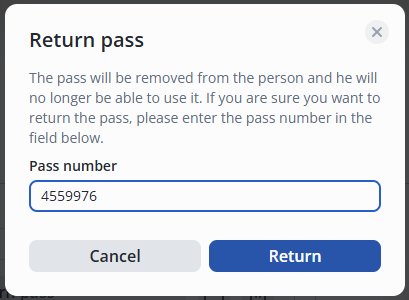
The pass will be considered returned and removed from the system.
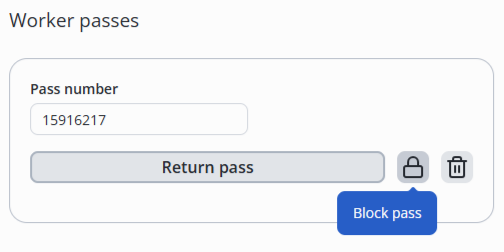
To block a worker's pass, click the Block pass button in the pass card.
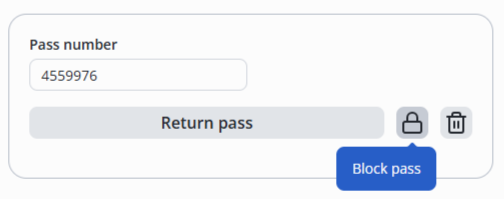
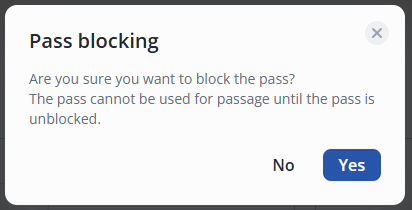
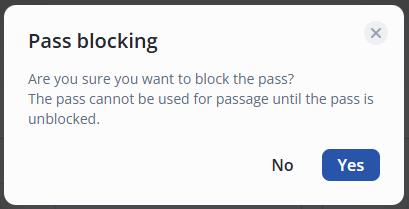
In the pop-up window, click the Yes button.
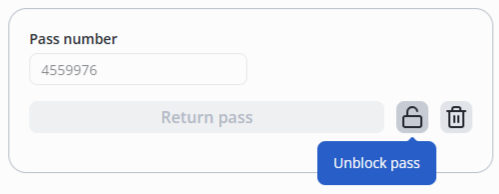
To unblock a pass, click on the Unblock pass button in the pass card.
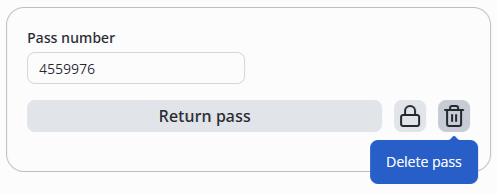
To delete a pass, click the Delete pass button in the pass card.
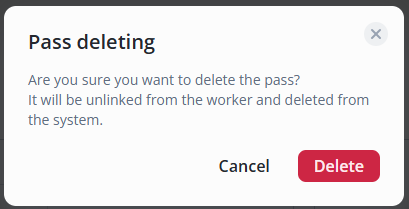
In the pop-up window, click the Delete button.
Section for adding, blocking and deleting a worker's car.
Click the Add car button in the Worker`s car section.

In the pop-up window, select the following:
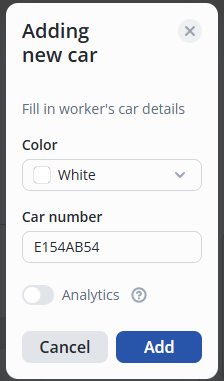
To block worker passage by license plate number, turn the switch to the active position.
Available only with Analytics module. |
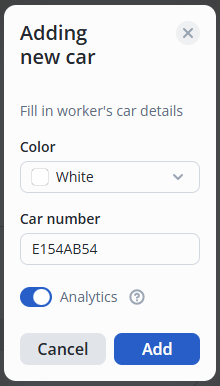
Then click the Save button in the car card.
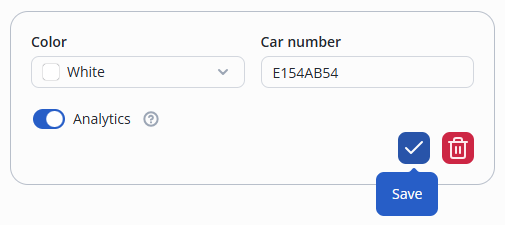
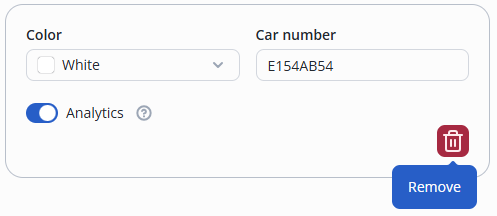
To remove a car, click the Remove button in the car card.
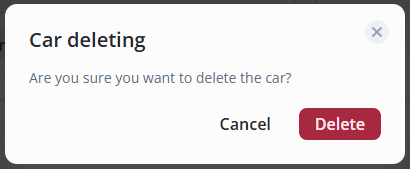
In the pop-up window, click the Delete button on the right.
Guests — a list of people who are granted access to premises in accordance with their authorizations.
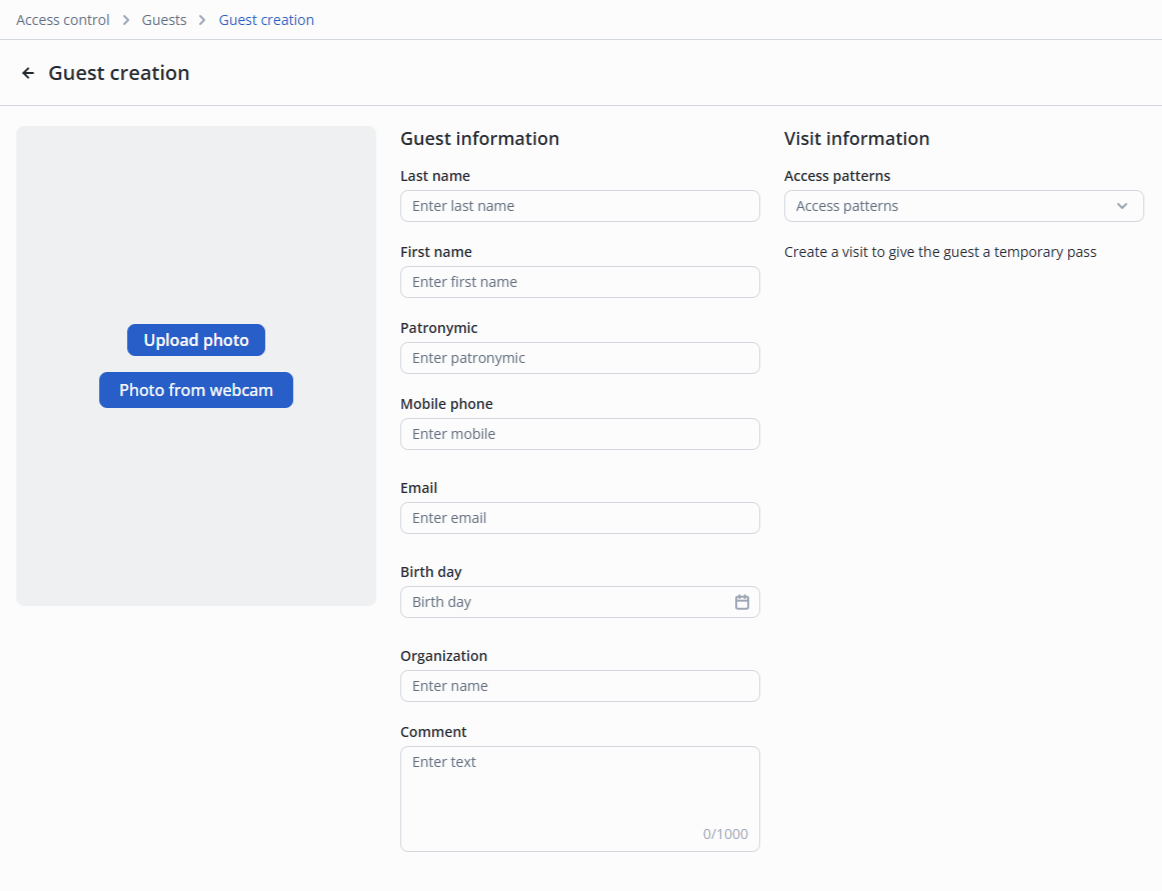
Open the Guests page in the Access control section.
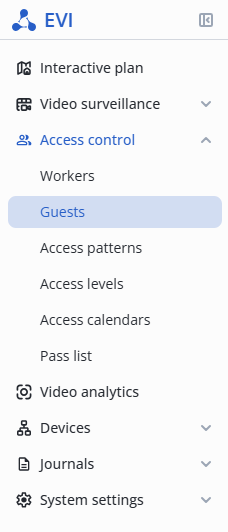
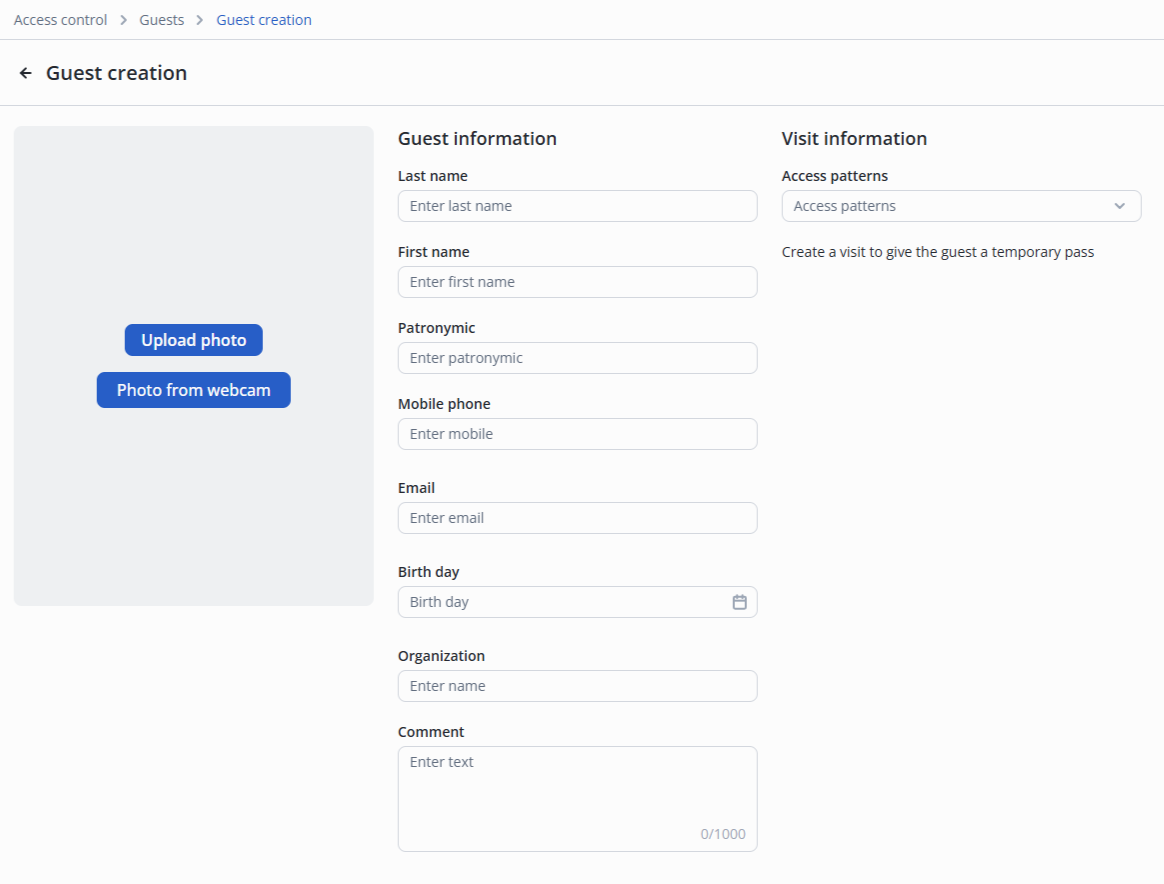
Click the Add guest button.

In the guest card, it is sufficient to fill in the Last name and First name.
Click the Add button.
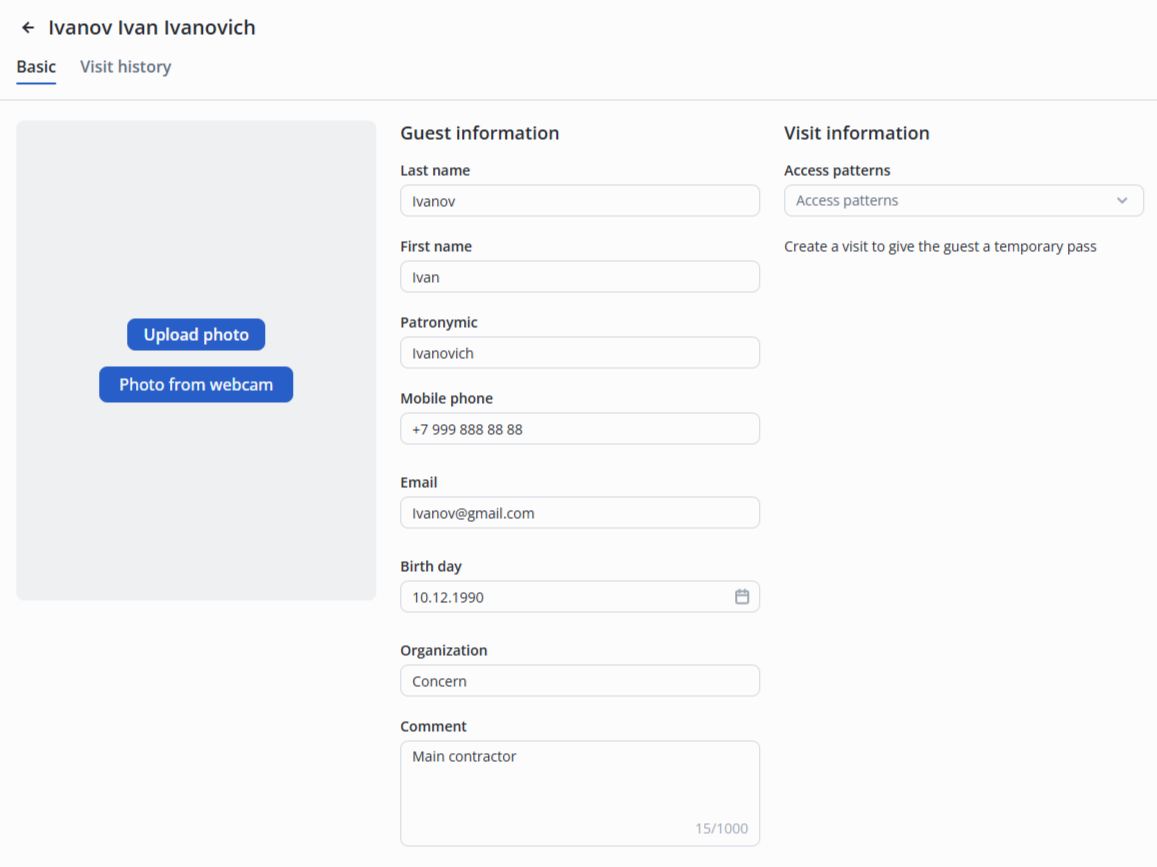
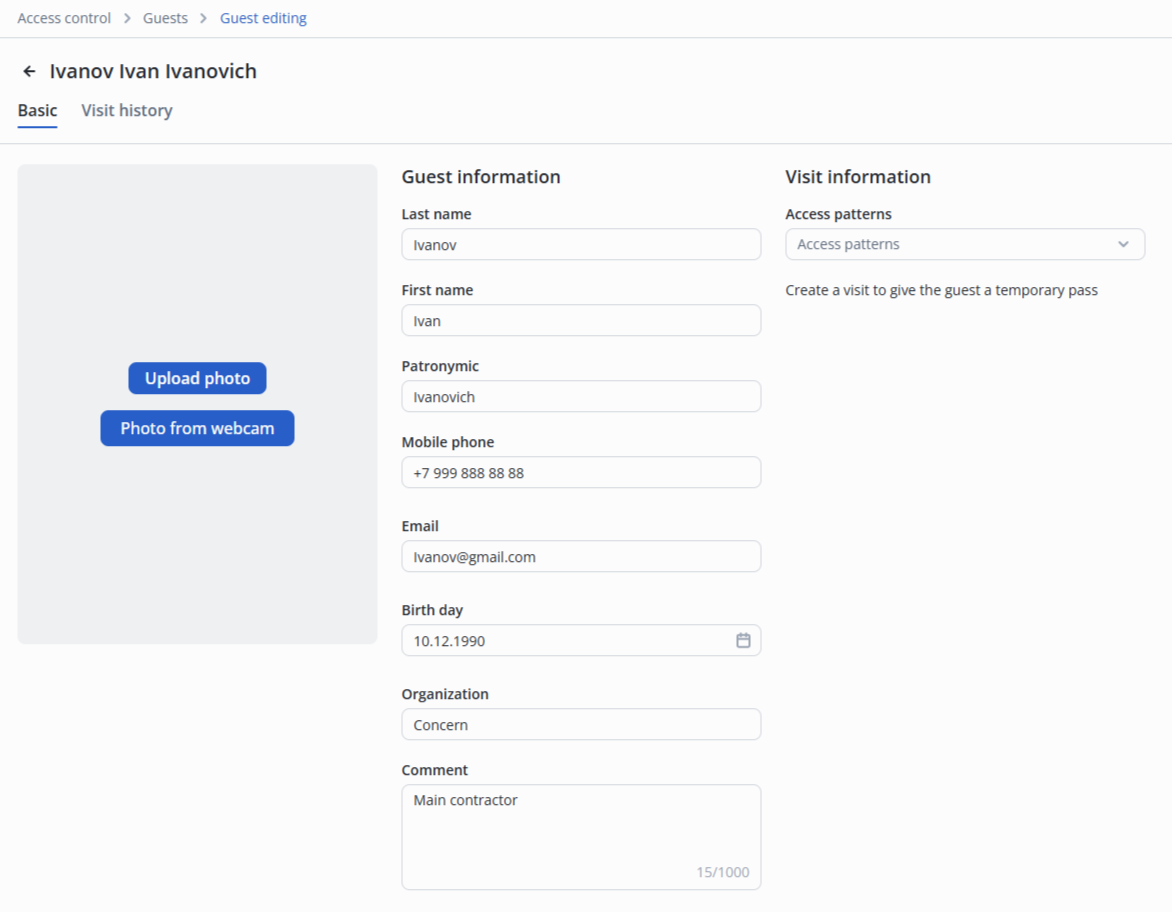
To edit a guest, click the guest's name in the table.

In this section, the following fields are available for filling in:
To add a photo, click Upload photo or Photo from webcam.
Select the guest photo in the operating system's file manager window.
Crop the photo if required by clicking and pulling the blue frame, afterward click the Save button.
The section stores the visit history of the guest.

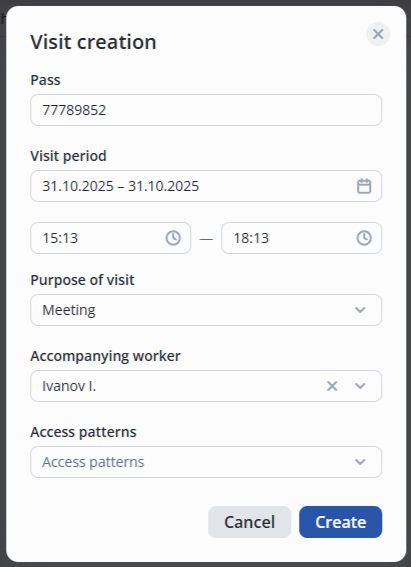
To issue a temporary pass to a guest, click + Create visit.

In the pop-up window, fill in the following fields:
Click the Create button.
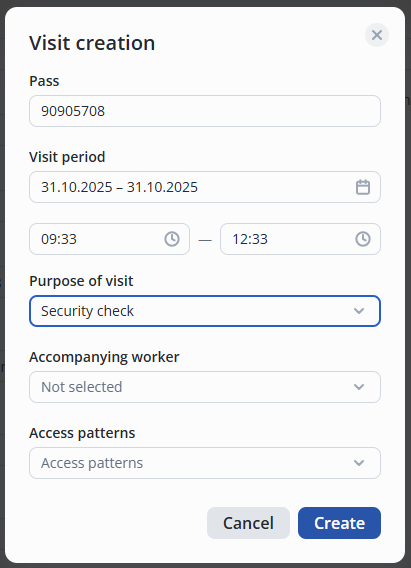
To enable access via facial recognition, set the Analytics switch to the "On" position.

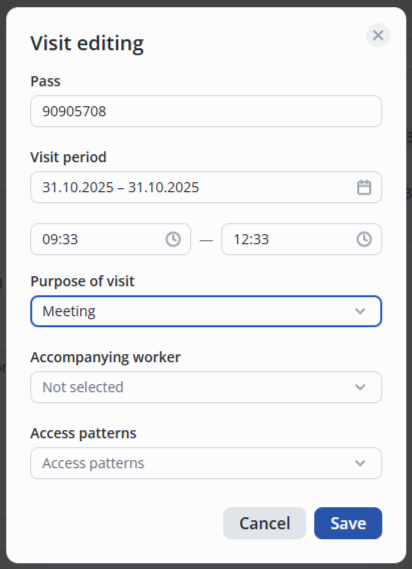
To edit a visit, left click on the Pencil icon.
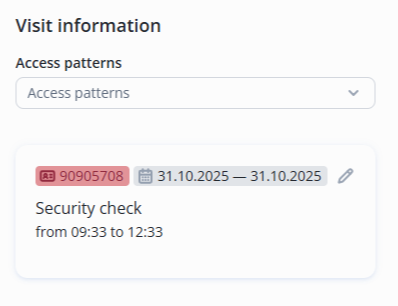
In the pop-up window, fill in the data and click Save.
The visit data is updated.
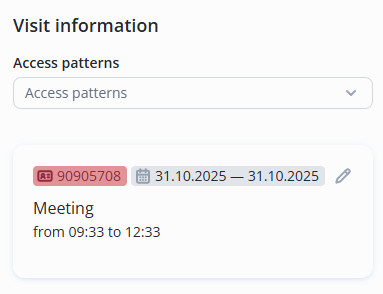
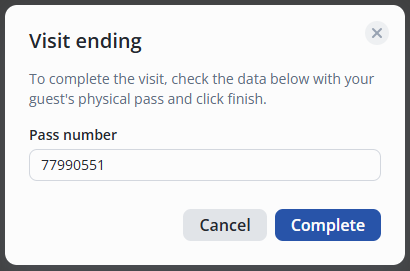
Left click on the three dots in the guest line.
Select End visit option.

Enter the pass number and click Complete.
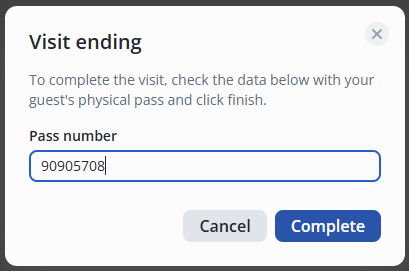
Left click on the three dots in the guest line.
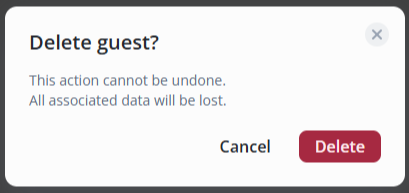
Select the Delete guest option.

Click the Delete button.
Access pattern — a set of locations to which a worker has access.
There are 2 types of access patterns on the EVI Platform:
Adding an access pattern
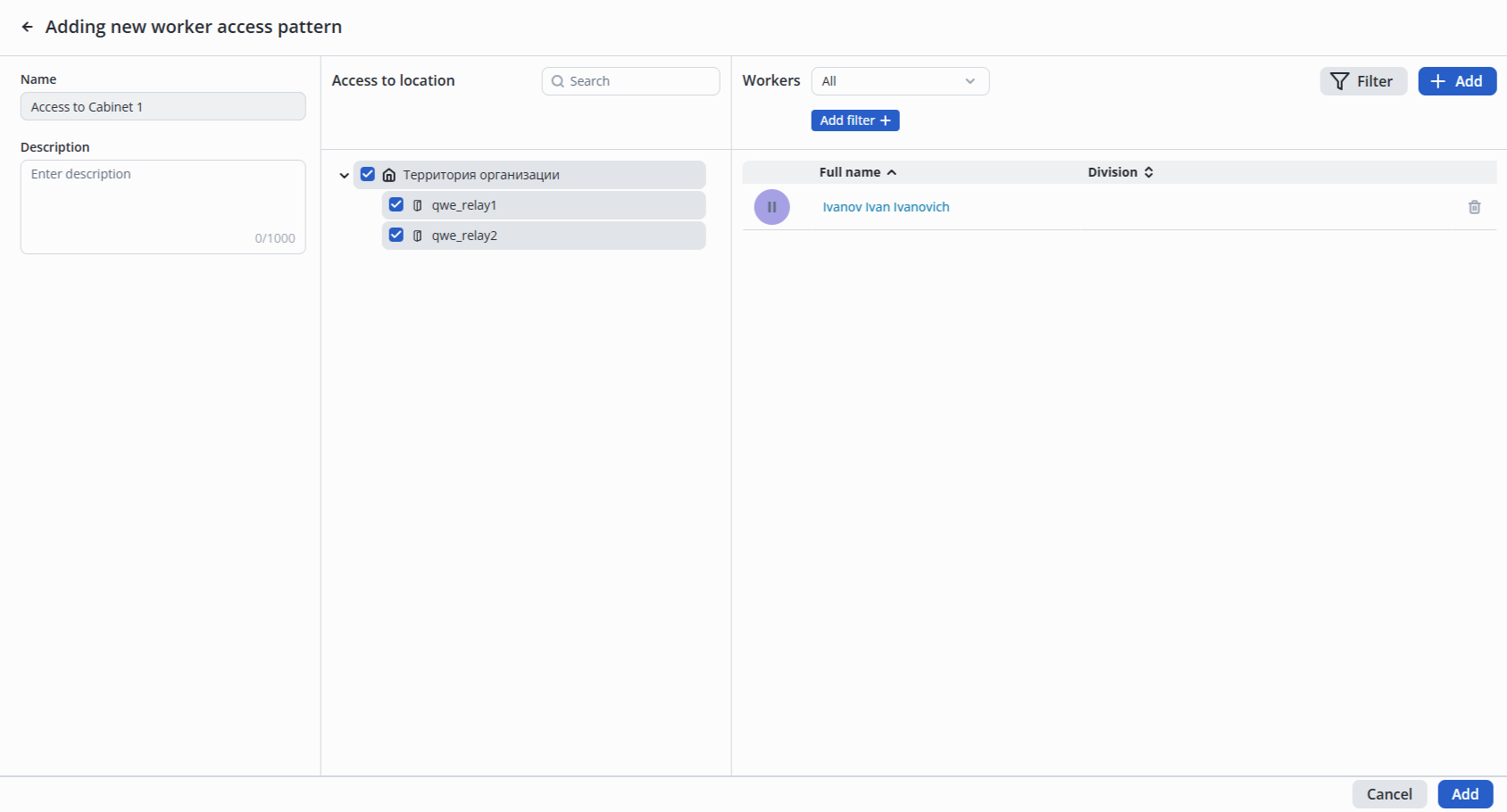
Enter the Access control section, and select the Access patterns item in the menu.
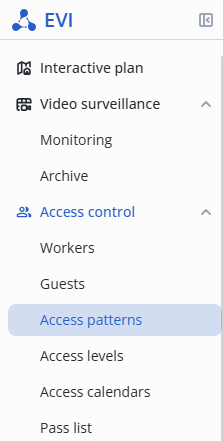
Click the Add access button, select the Worker pattern option.

Fill in the fields:
In the Access to location section, mark the access objects that can be passed through in this access pattern.

Click the Add button in the rightmost column to select employees from the list who will be granted access to the premises under this template.

In the appeared list select workers and click the Add button.
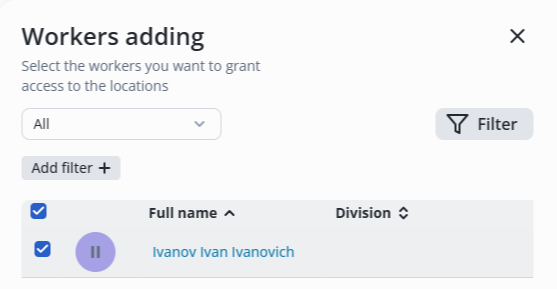
After adding workers, click the Add button in the bottom right corner.
To edit an access pattern, click on the pattern name in the table.

Make the required changes.

Click the Save button in the bottom right corner.
Left-click the three dots in the pattern row.
Select Remove.

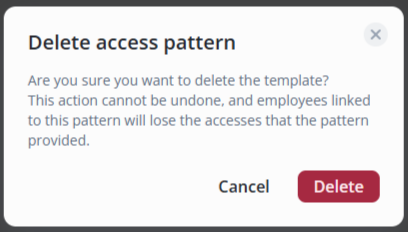
Click the Delete button.
An access calendar restricts an employee’s or guest’s visit times.
If an employee does not have an access calendar or if the access calendar is empty, there are no restrictions on the employee’s visit times.
There are two types of access calendars on the EVI platform:
Enter the Access control section, and select the Access calendars item in the menu.
Click the Add calendar button.

Specify the name and description of the access calendar.
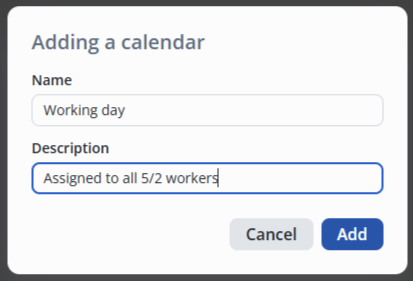
Click the Add button.
To edit Worker or Guest access calendar, click the calendar name in the list.

The access calendar will open.
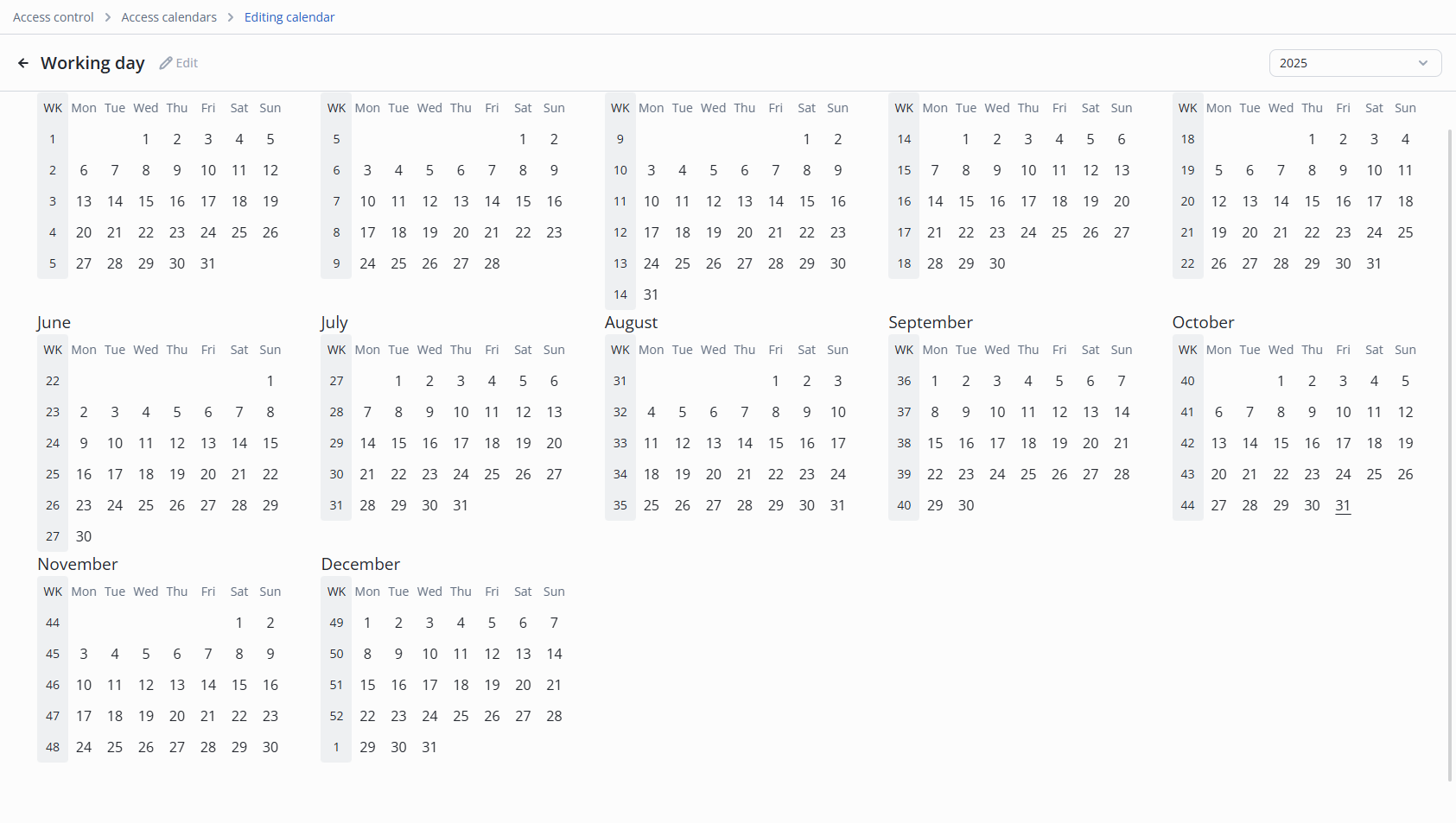
Example: Employees work a standard five-day workweek from 9:00 to 18:00 throughout the year.
To configure the following example, you must select the entire year.
Select January 1 through December 31.
In the pop-up window, the following settings are available:
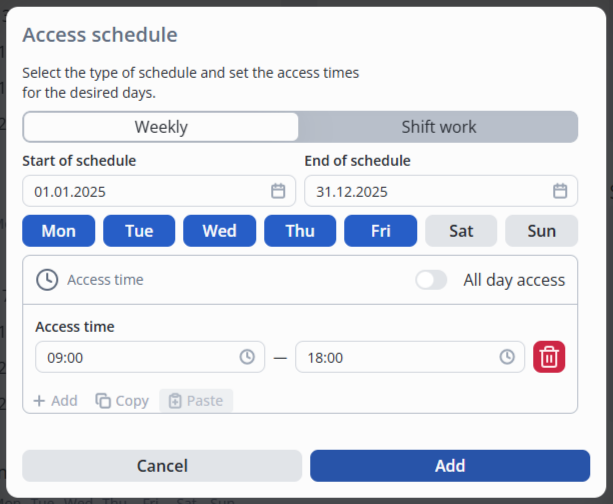
To configure, select the following:
Click the Add button.
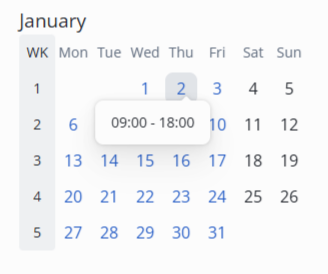
The days on the calendar are now highlighted in blue.
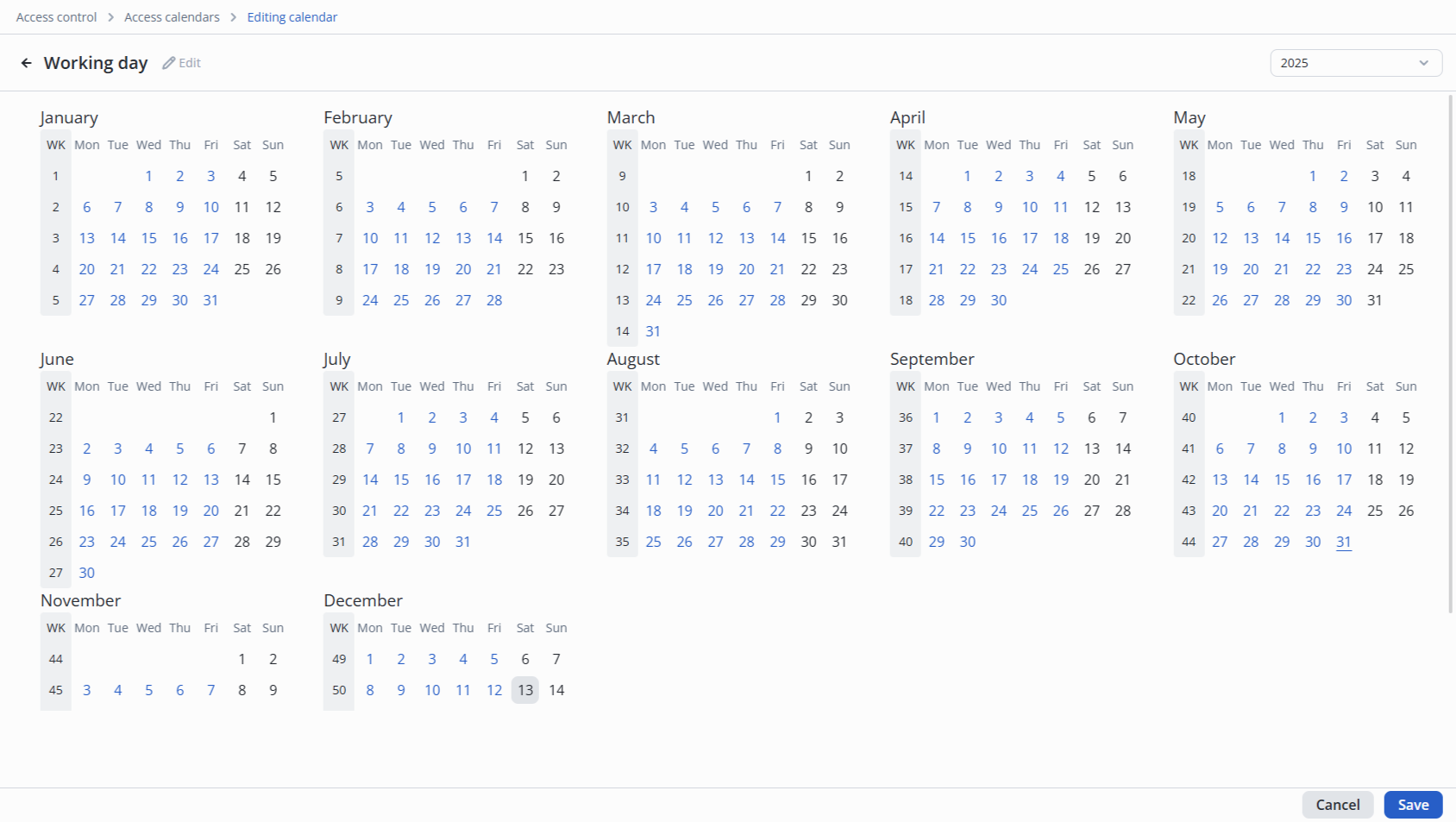
If you move the cursor over the date, the access time within the day is displayed.
To save changes in the calendar, click the Save button in the lower right corner.
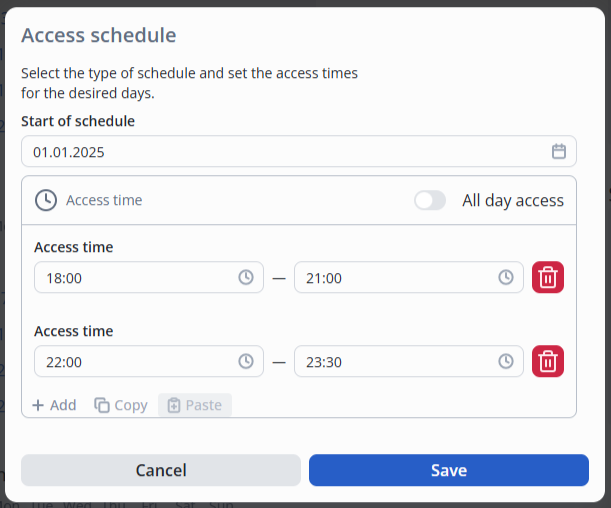
To add multiple time periods within one day, click the +Add caption.
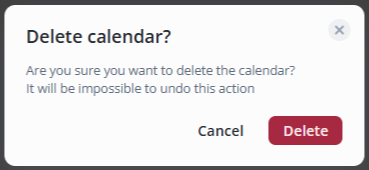
Left click on the three dots in the calendar line.
Select the Remove option.

In the pop-up window, click the Delete button.
With access levels it is possible to create and specify access levels for controllers and workers.
The diagram below shows the different levels of worker access.
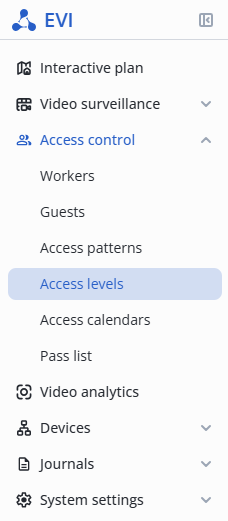
Enter the Access control section, and select the Access levels item in the menu.
Click the Add level button.

In the pop-up window, specify the following:
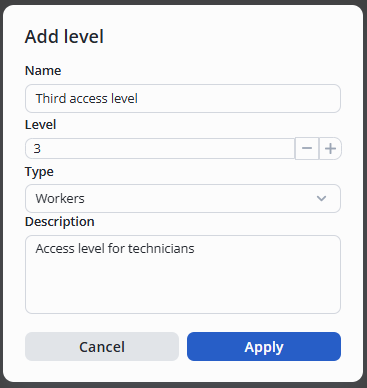
Click the Apply button.
Left-click the three dots in the level line.
Select the Edit option.

In the Edit level window, make the necessary changes to the name and description.
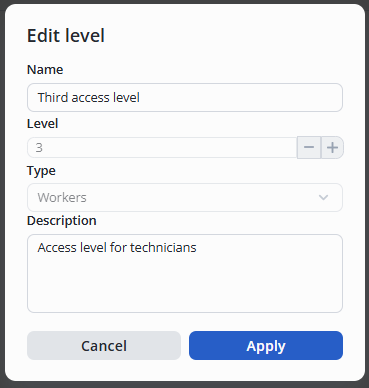
Click the Apply button.
Left-click the three dots in the level line.
Select the Remove option.

Click the Delete button.
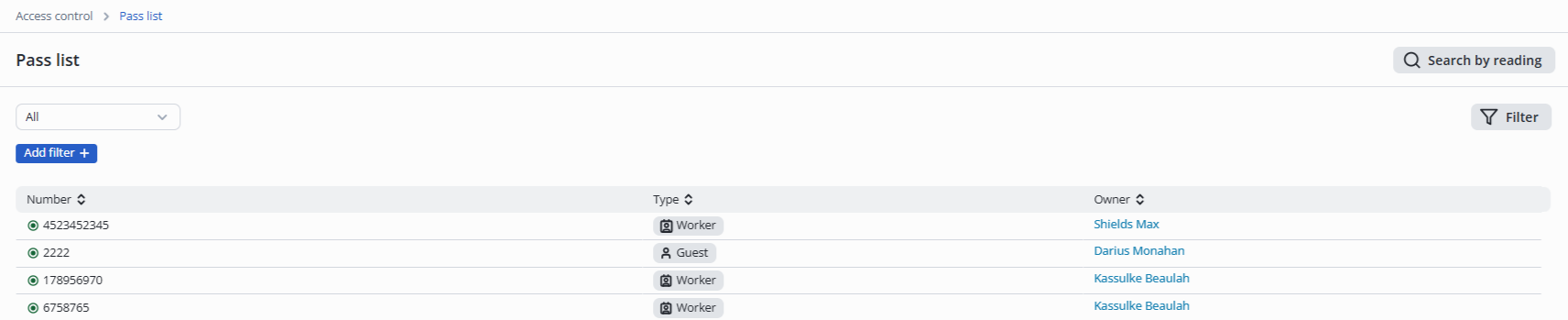
A list of workers and guest passes.
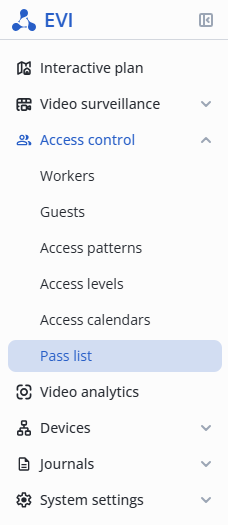
In the Access control section, go to the Pass list page.
Click the owner's name.
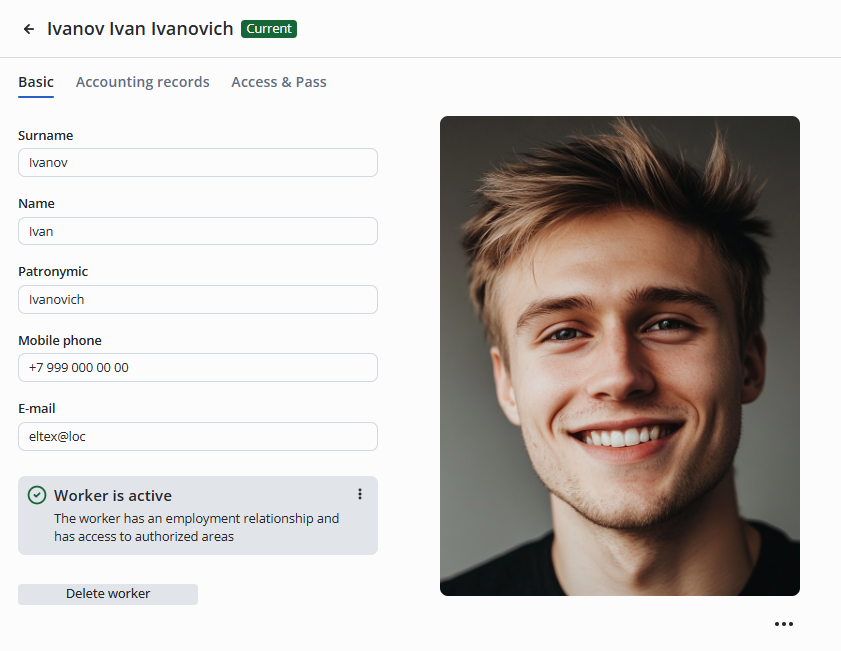
The worker editing card page will open.
For accounting of working hours it is necessary to configure time tracking at the locations that are used as pass points for workers.
When making a through passage, the time tracking counts the time for all workers. In this case, the passage is counted for the first worker passing through; passage for all will be implemented in the next version. |
Only turnstiles are involved in time tracking. |
Enter the Interactive plan section to configure the Time tracking.
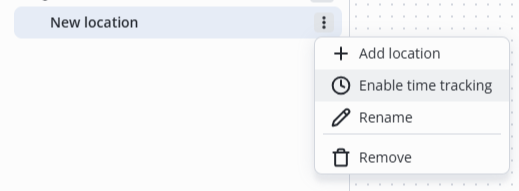
Click on the three dots next to the location and select Enable time tracking.
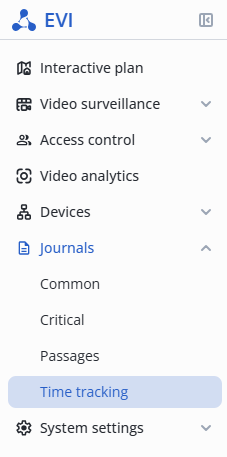
In the Journals section, switch to the Time tracking page.
The Journal page provides information on each worker for the current day.
Working hours and days are fixed in the column Total worked time and Days worked.

To generate a report in csv format, click on the Download report button in the upper right corner of the screen.
The report will be downloaded to your computer via a browser according to the selected filter.
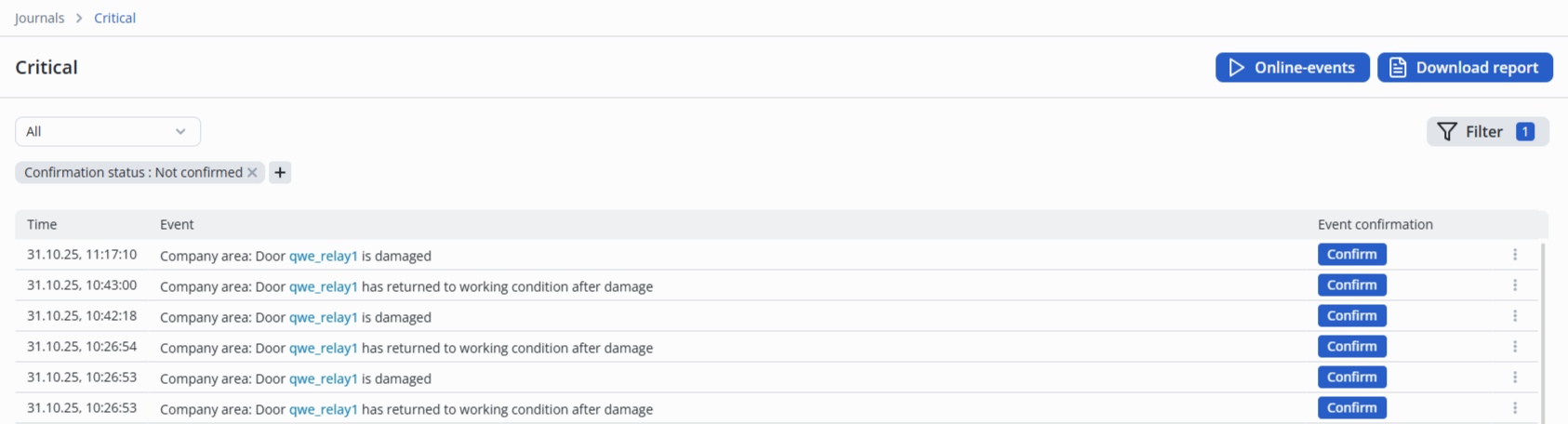
There are three types of journals in the system:
|
To enter the Common journal, click on the journal icon in the left side menu, select Common.
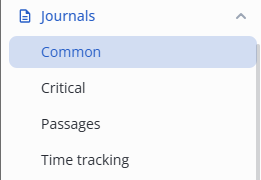
The journal contains all workers passes through the access points.

The page has the following filters:
To generate a report in csv format, click on the Download report button in the upper-right corner of the screen.
The report will be downloaded to your computer via a browser according to the selected filter.
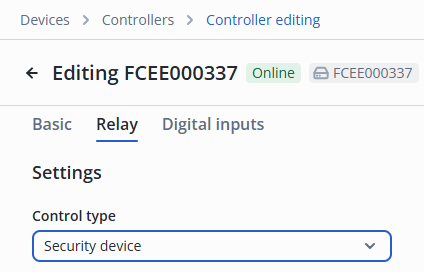
Only a Controller can be set to Guard mode.
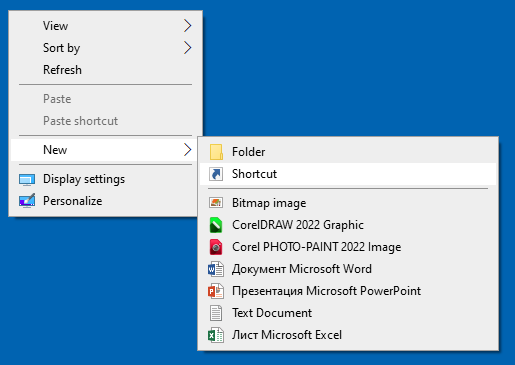
Right-click the desktop.
Select New → Shortcut.
In the shortcut creation wizard, specify the path to the Chrome browser.
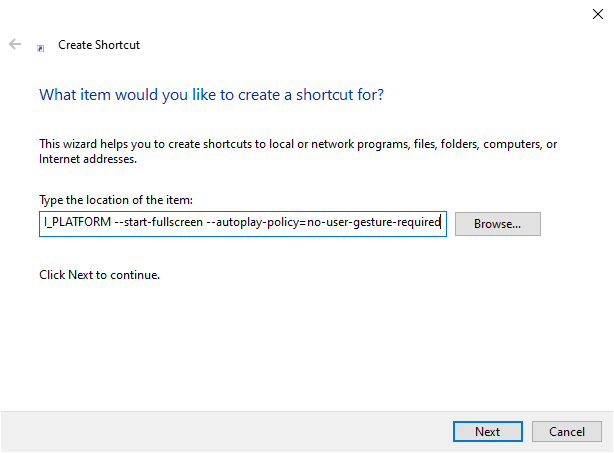
In --app=, specify the address of the EVI Platform.
Option 1:
To play audio alerts (alarms), specify the --autoplay-policy=no-user-gesture-required flag:
"C:\Program Files\Google\Chrome\Application\chrome.exe" --app=https://EVI_PLATFORM --autoplay-policy=no-user-gesture-required |
Option 2:
To force the application to start in full-screen mode, use the --start-fullscreen flag:
"C:\Program Files\Google\Chrome\Application\chrome.exe" --app=https://EVI_PLATFORM --start-fullscreen --autoplay-policy=no-user-gesture-required |
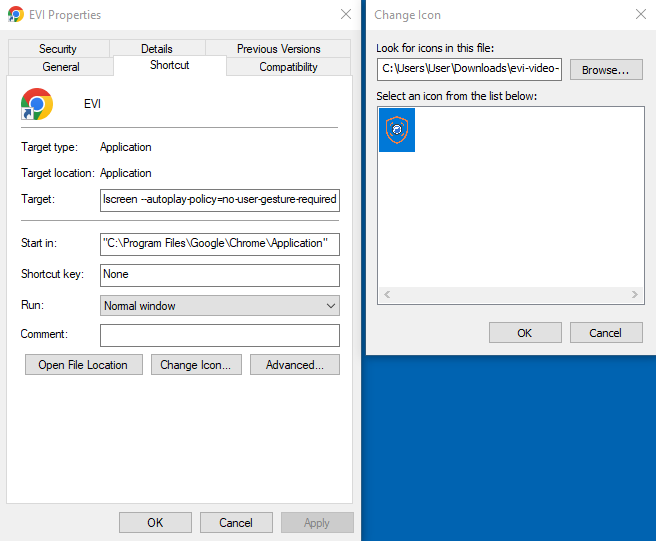
Download the icon for the shortcut below.
Right-click on the desktop.
Select the Properties item.
Click the Change icon button.
Select the downloaded icon and click OK.
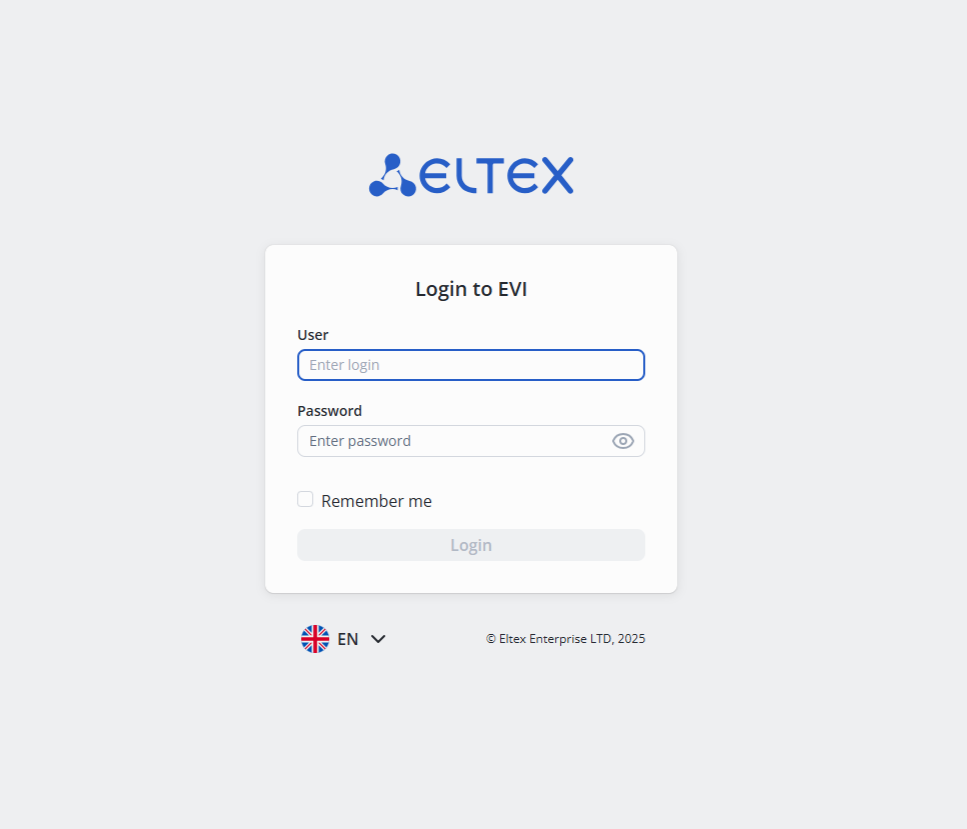
User screen after launching the created shortcut:
Security user screen after authorization on the platform:
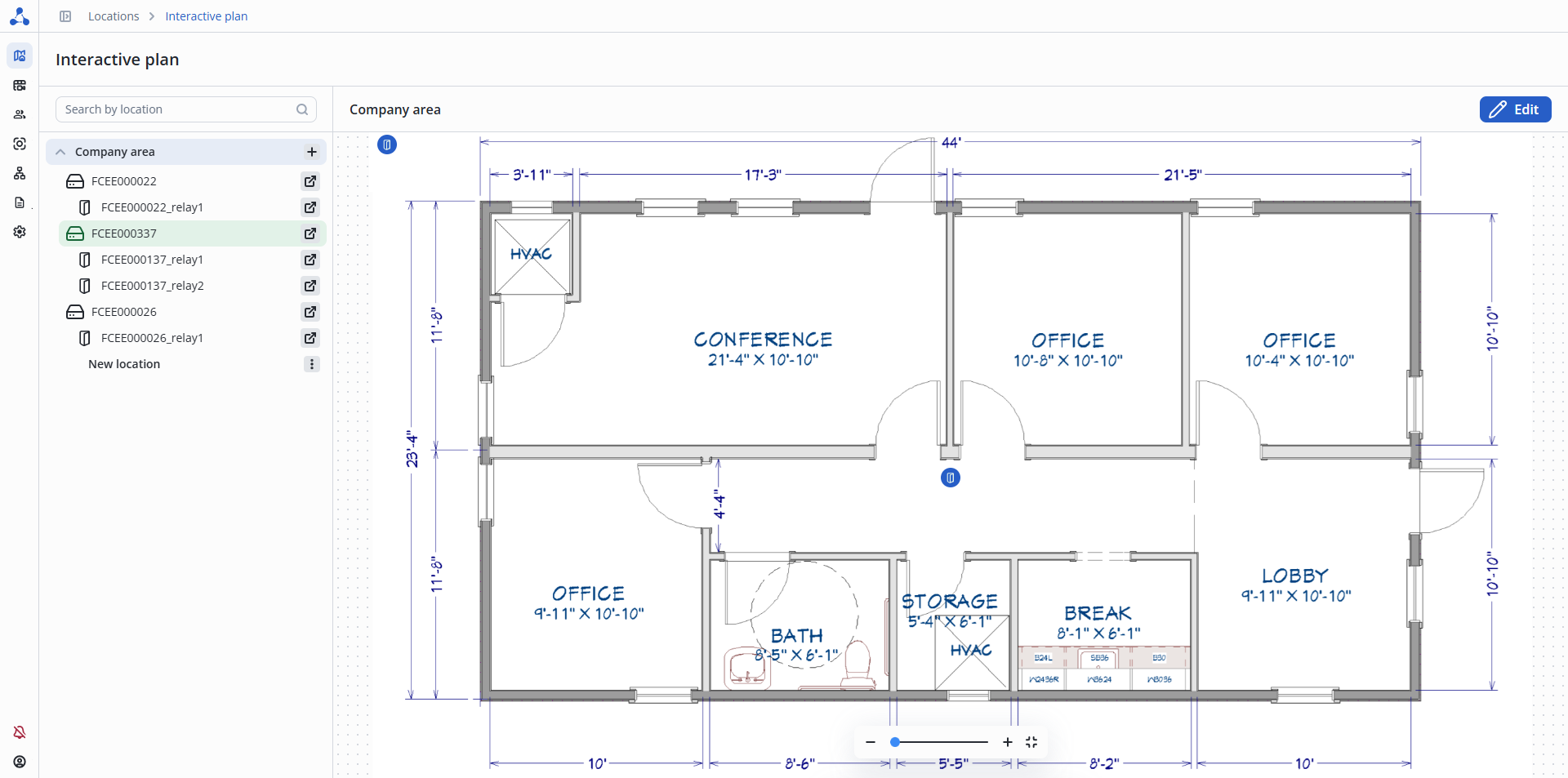
Switch to the Interactive plan page.
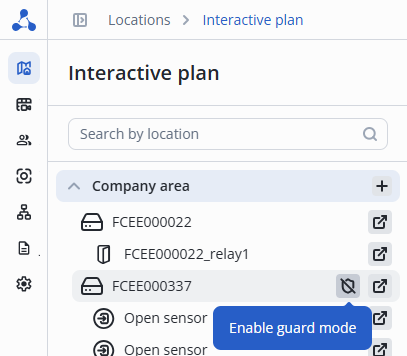
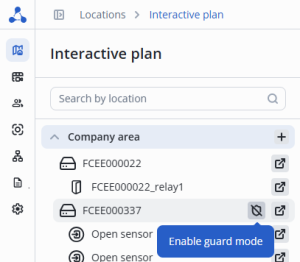
To enable Guard mode click on the crossed-out shield icon in the organization hierarchy.
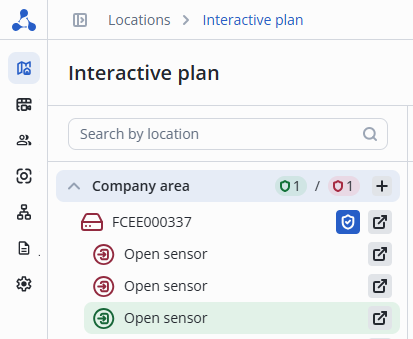
The controller and sensors in the location will change their color to green.
At the bottom of the screen, a notification will appear stating that the guard mode is enabled on the Controller.

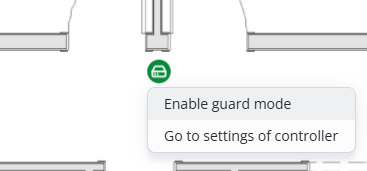
To enable Guard mode click on the controller icon on the interactive plan and click Enable guard mode.
To disable Guard mode click the blue shield icon next to the controller's name in the organization hierarchy.
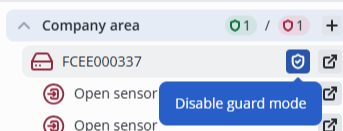
A notification will appear stating that the guard mode is disabled on the Controller.

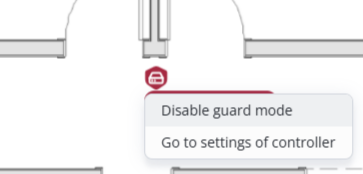
To disable Guard mode, click the green shield icon next to the controller's name on the interactive floor plan and select Disable guard mode.
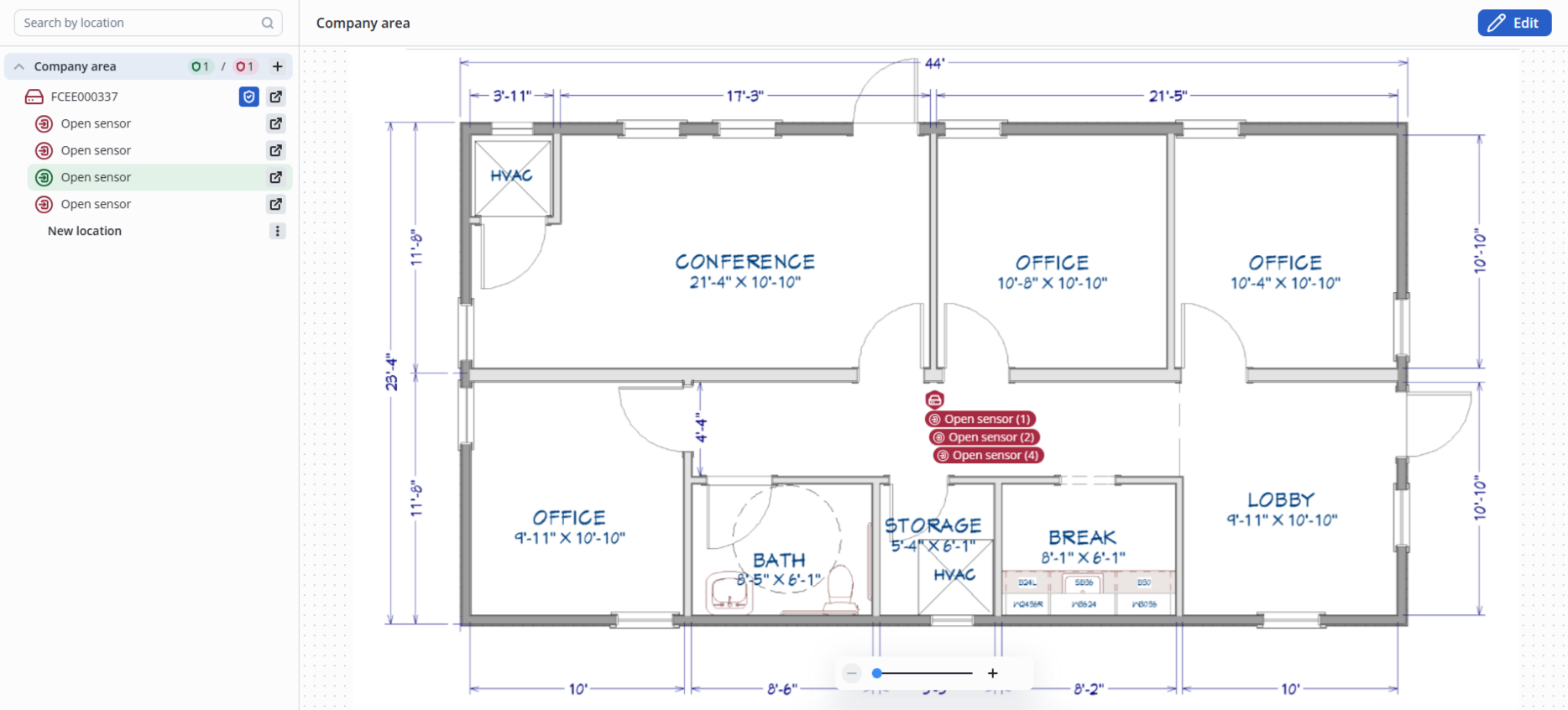
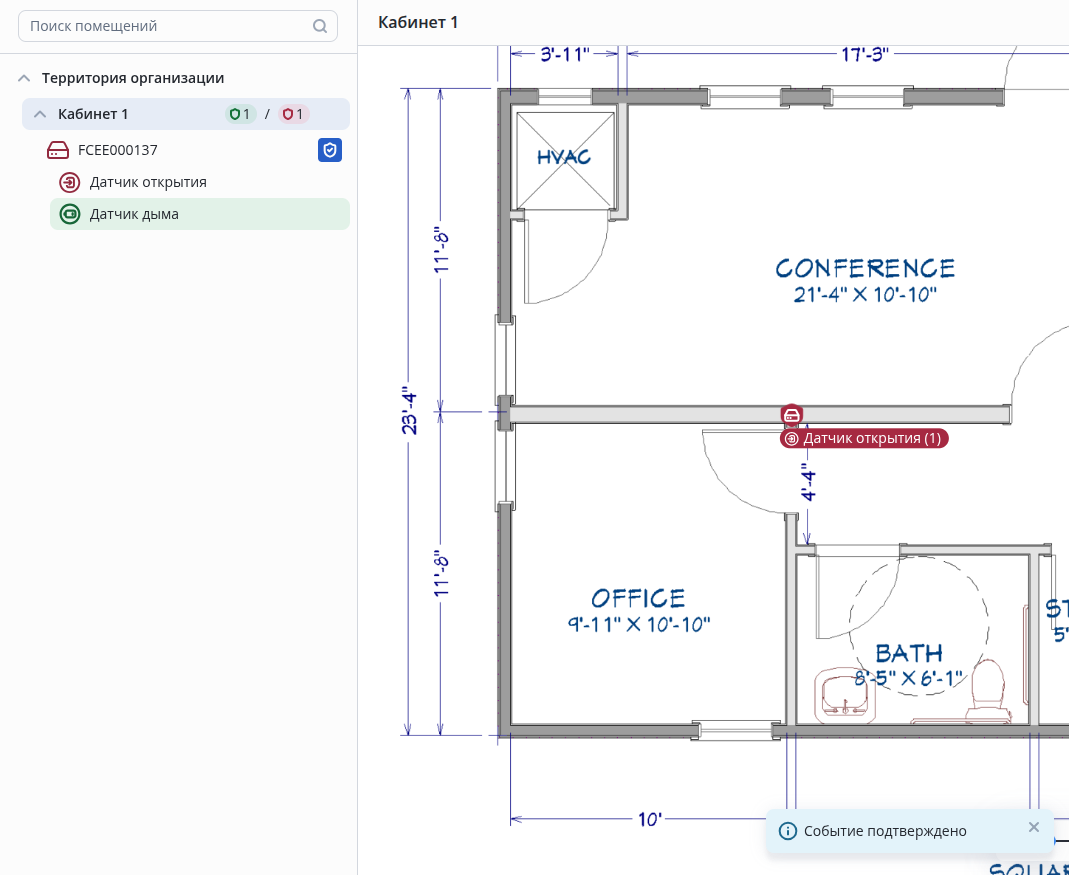
Triggered sensors appear below the controller on the interactive diagram; the number of the controller's discrete input to which the sensor is connected is indicated in parentheses.
When a sensor is triggered, an audible alert sounds. If multiple sensors are triggered in succession, the audible alert will not repeat. |
When the sensor is triggered, a panel will appear on the right with a Confirm button, the event time, and the event text.
Individual confirmation of a triggered sensor hides it from the interactive plan, and the sensor changes color to green in the hierarchy.
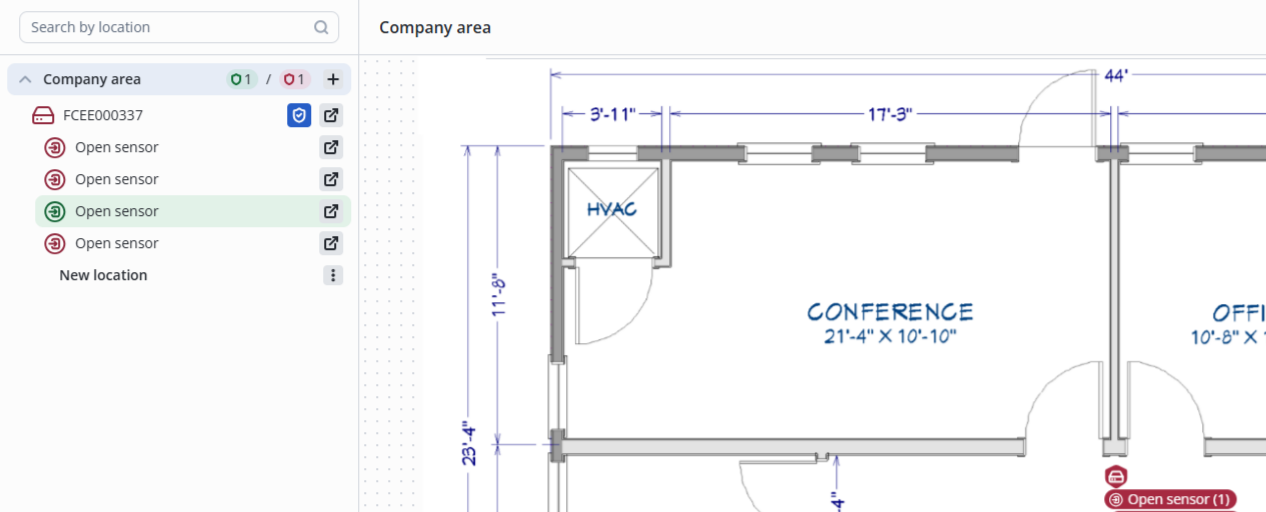
The sensor activation indication will be displayed on the interactive plan until it returns to its initial state, even if the event has been confirmed by a security guard.
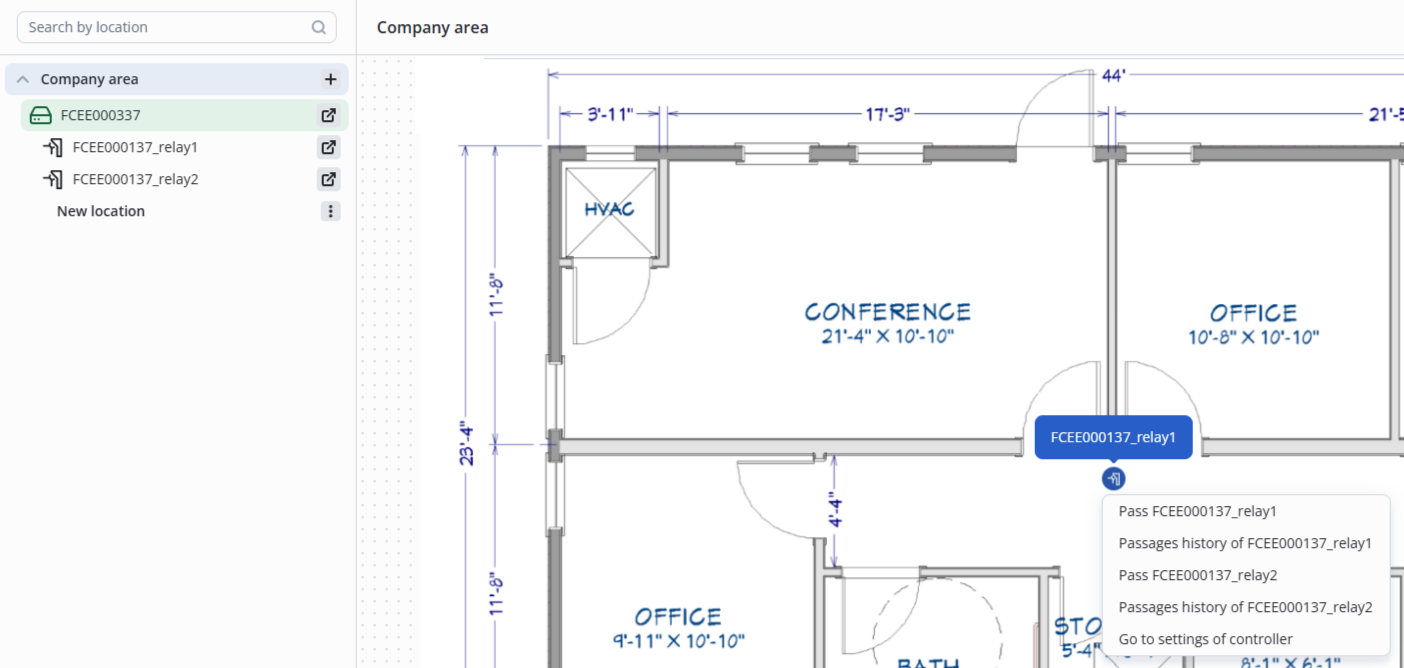
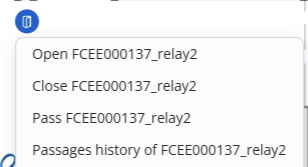
To control objects (doors, turnstiles, barriers, gates), click on the object icon on the interactive plan and select the required option.
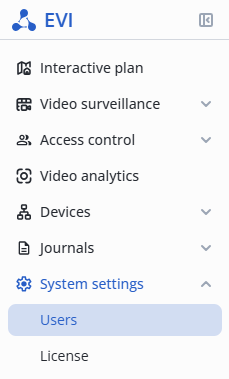
The following pages are available to view for the security role:
Switch to the Users page in the System settings section.
Click the Add user button in the upper right corner.
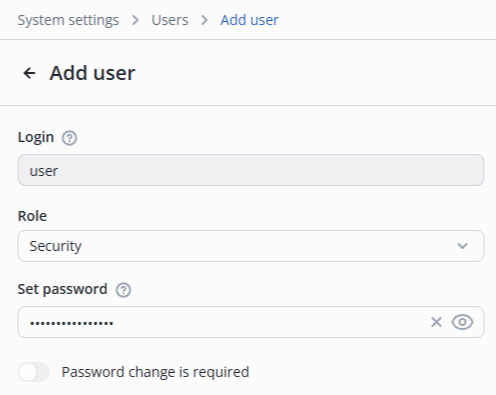
Click the Add button in the lower right corner.

Created user will be displayed in the System users list.
Switch to the Users page in the System settings section.
Click on the system user name.

Change the required fields:
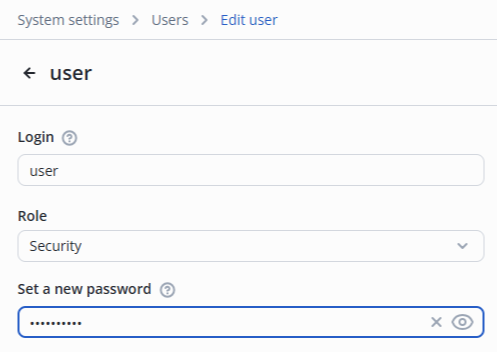
Click the Save button in the lower right corner.
A user with the Security role has access to:
The following options are available for relays on the interactive plan:
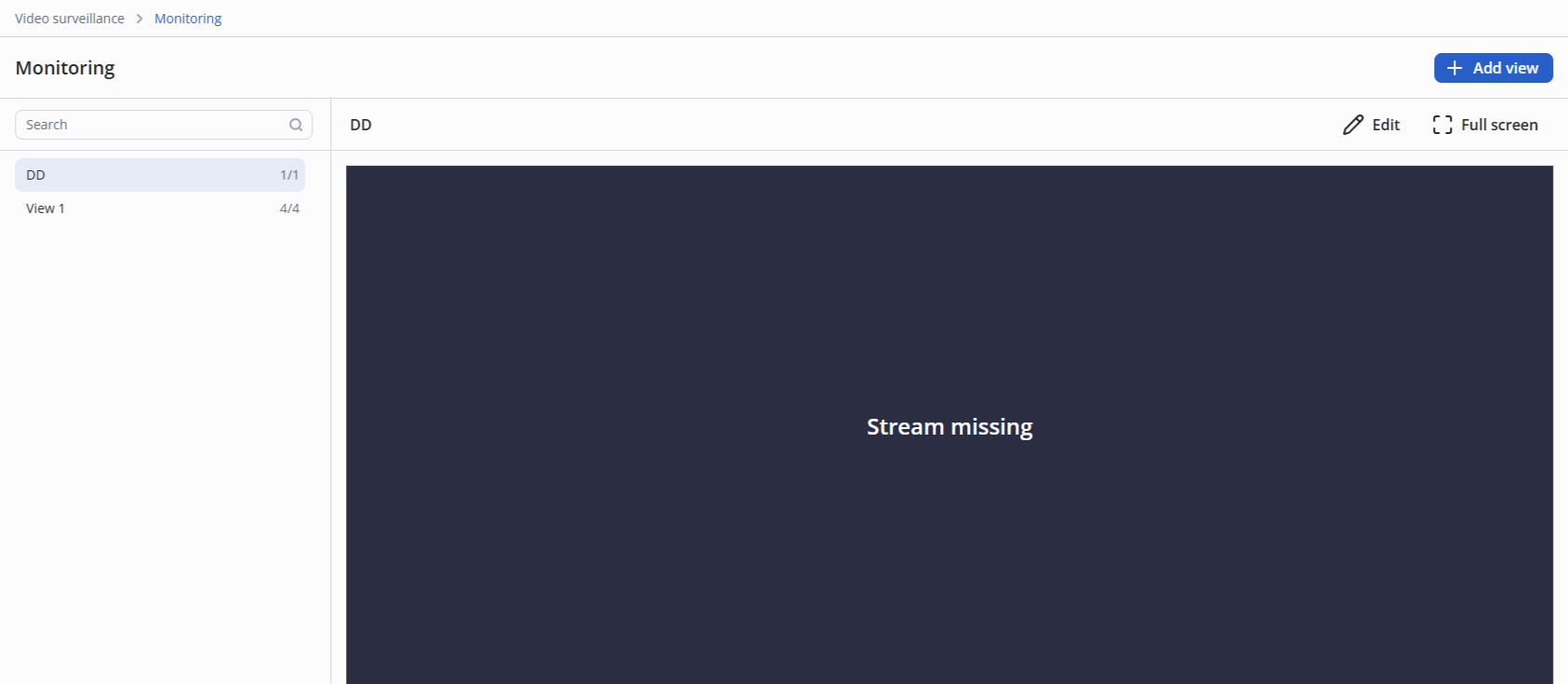
A user with the Guard role is available to view the Video view.
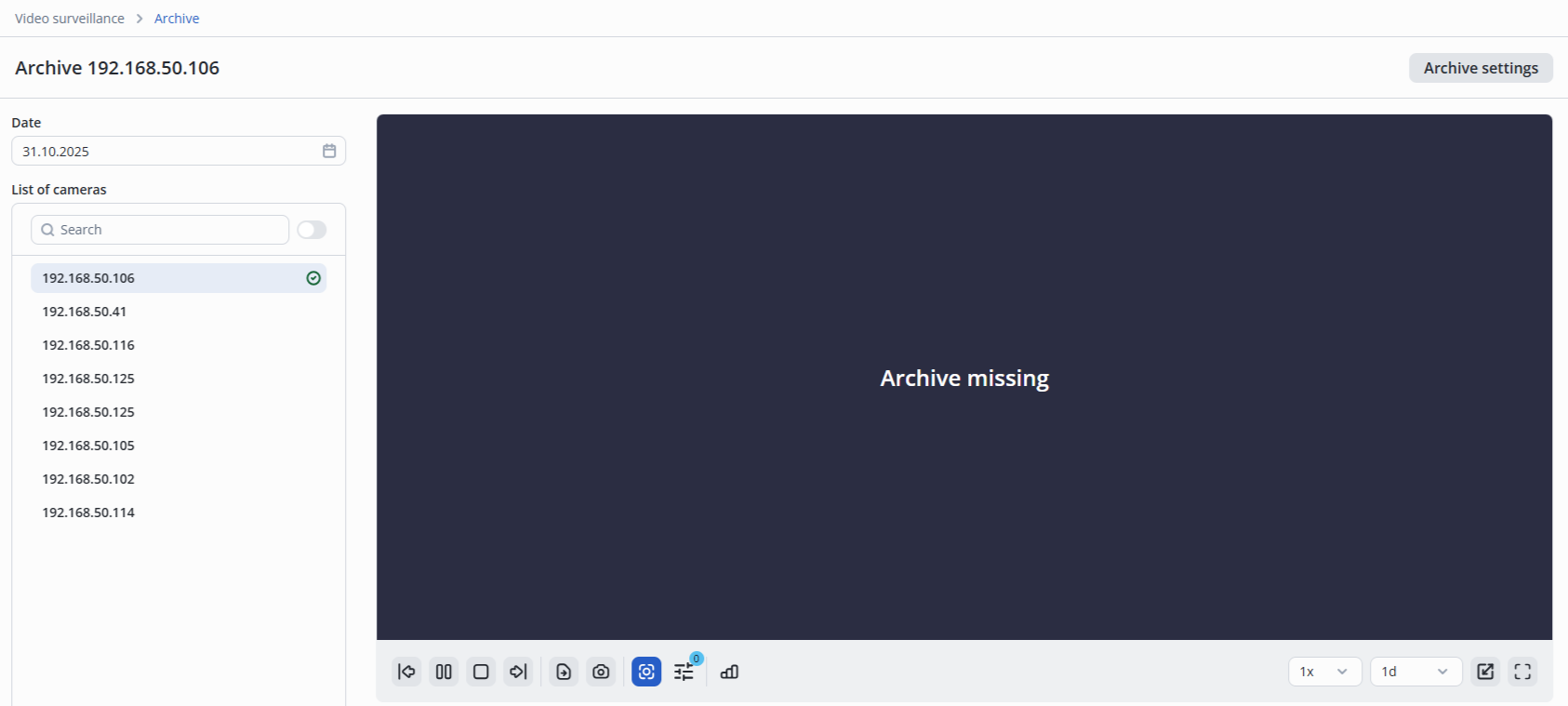
A user with the Guard role is available to view the cameras Archive.
Detailed instructions are available in the Guests section.
A user with the Guard role has access to:
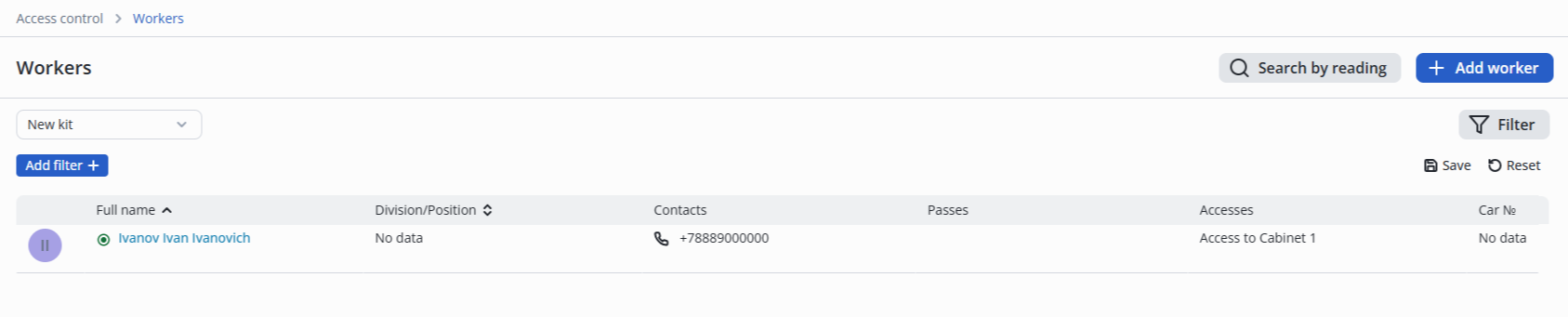
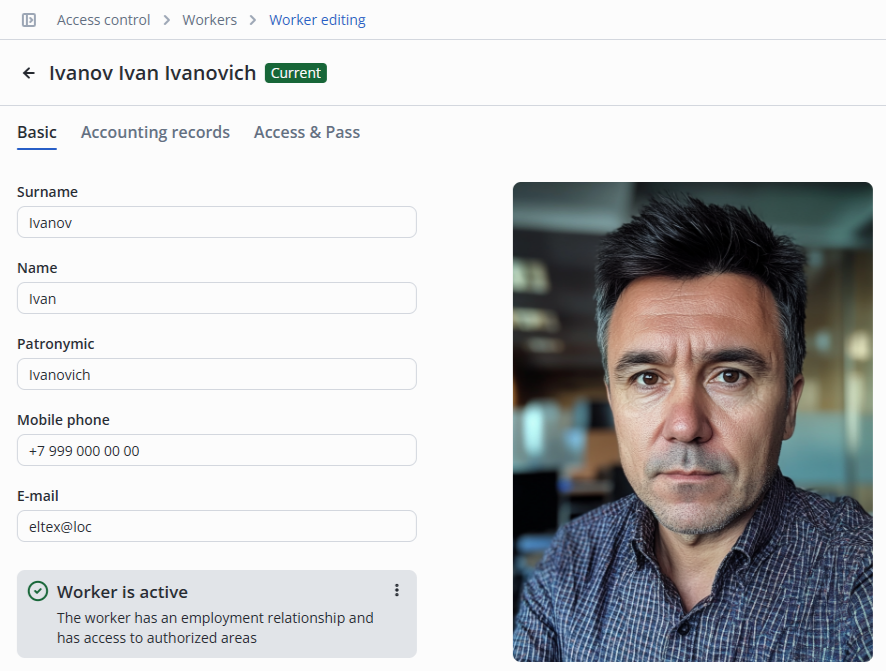
A user with the Guard role has access to:


A user with the Guard role can view the Pass list.

A user with the Guard role has access to: