Managing user authentication and authorization requires ensuring high availability of the NAC system, since, in the event of its failure, connecting users and endpoints will become impossible.
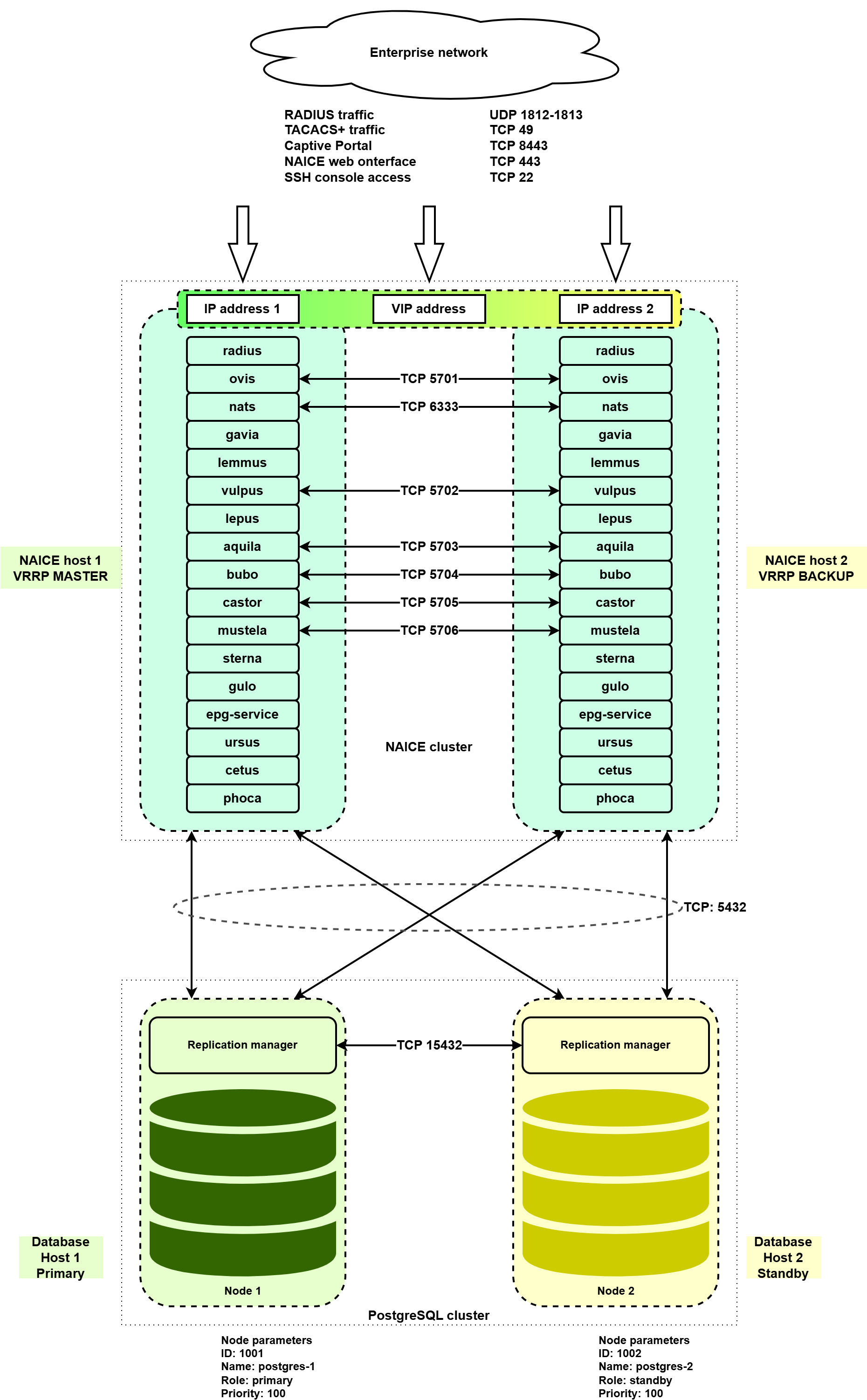
Eltex-NAICE implements high availability using an Active-Active scheme with a VRRP address. This allows a single RADIUS server to be used in the configuration of network devices and provides redundancy for devices that do not support specifying multiple RADIUS servers. To configure the high-availability scheme, four virtual (or physical) servers must be allocated: two for running NAICE services and two for running the PostgreSQL database, which is responsible for storing system data.
Installing or upgrading a high-availability configuration on a host previously used for operating the system in single-host mode is not allowed. |
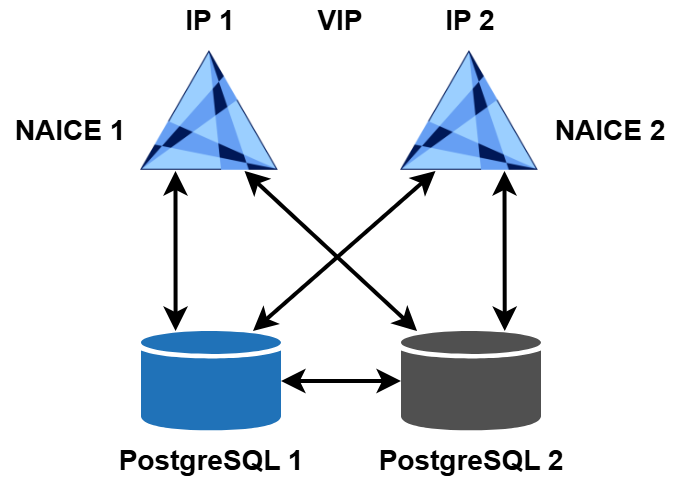
To license a high-availability scheme, two licenses are required, one for each NAICE host. Each license must have its own Product ID while sharing the same license key. |
|
System requirements for the servers are described in the “High-availability deployment” section of v1.1_3.1 System requirements.
Both online and offline installation methods are supported.
Online installation is supported on all operating systems listed as supported and is described below.
Offline installation in an isolated network is described in section v1.1_3.4.1 High-availability installation in an isolated network (using VRRP).
To perform an online installation, the target hosts must have direct Internet access. Using a proxy server or any mechanism that modifies certificates of destination websites accessed during installation is not allowed. |
You must specify IP addresses of the target servers during installation. Using domain names is not permitted. |
The installation is performed using two Ansible playbooks:
install-postgres-cluster.yml.keepalived service are installed using the playbook reservation-naice-services.yml.The addresses of the target hosts on which the installation will be executed are defined in the inventory/hosts-cluster.yml file.
For PostgreSQL, set the addresses in the postgres-cluster section:
# Host group for postgres-cluster installation (primary + standby)
postgres-cluster:
  hosts:
    node_primary:
      ansible_host: <IP address of PostgreSQL node 1>
      ansible_port: 22
      ansible_user: <username>
      ansible_ssh_pass: <password>
      ansible_become_password: <sudo password>
      forwarded_postgresql_port: 5432
      forwarded_ssh_port: 15432
    node_standby:
      ansible_host: <IP address of PostgreSQL node 2>
      ansible_port: 22
      ansible_user: <username>
      ansible_ssh_pass: <password>
      ansible_become_password: <sudo password>
      forwarded_postgresql_port: 5432
forwarded_ssh_port: 15432 |
To install NAICE services with high availability, you must specify the addresses in the reservation section:
# Host group for NAICE high-availability installation
reservation:
  hosts:
    master_host:
      ansible_host: <IP address of NAICE host 1>
      ansible_port: 22
      ansible_user: <username>
      ansible_ssh_pass: <password>
      ansible_become_password: <sudo password>
      keepalived_interface: <interface for VIP address, e.g. eth0>

    backup_host:
      ansible_host: 192.168.0.102
      ansible_port: 22
      ansible_user: <username>
      ansible_ssh_pass: <password>
      ansible_become_password: <sudo password>
      keepalived_interface: <interface for VIP address, e.g. eth0>
  vars:
keepalived_vip: <VIP address, without mask, e.g. 192.168.0.11> |
When performing an online installation, it is not required to specify access credentials for the host from which the playbook is executed in the Local actions section. This section is used only when performing installation in an isolated environment. |
Run the playbook:
ansible-playbook install-postgres-cluster.yml -i inventory/hosts-cluster.yml |
As a result, PostgreSQL will be installed as a cluster on the servers specified in node_primary and node_standby. The master node of the cluster will be located on the node_primary host.
Before starting the installation, make sure that the Primary role belongs to the PostgreSQL node specified in the variable node_primary “ansible_host”. If necessary, perform a Primary role switch. If this requirement is not met, the installation cannot be completed. |
Both database addresses are specified in the NAICE service database connection settings, and database entries can only be made via the primary server. The use of the
The database access addresses are taken from the ansible_host values under the postgres-cluster section in the |
To start the installation, run the playbook:
ansible-playbook reservation-naice-services.yml -i inventory/hosts-cluster.yml |
After the installation is completed, one of the NAICE cluster nodes will take the VRRP master role and bring up the VIP address on its interface. To determine which node currently holds the VIP, run the following command on each node:
ip address show dev <interface name specified in the keepalived_interface variable> |
$ip address show dev eth0
4: eth2: <BROADCAST,MULTICAST,UP,LOWER_UP> mtu 1500 qdisc fq_codel state UP group default qlen 1000
    link/ether 02:00:a5:a1:b2:ce brd ff:ff:ff:ff:ff:ff
    altname enp0s5
    altname ens5
    inet 192.168.0.101/24 brd 192.168.0.255 scope global eth2
       valid_lft forever preferred_lft forever
    inet 192.168.0.103/32 scope global eth2:NAICE
       valid_lft forever preferred_lft forever
    inet6 fe80::a5ff:fea1:b2ce/64 scope link
       valid_lft forever preferred_lft forever
|
$ip a show dev eth2
4: eth2: <BROADCAST,MULTICAST,UP,LOWER_UP> mtu 1500 qdisc fq_codel state UP group default qlen 1000
    link/ether 02:00:a5:a1:b2:cf brd ff:ff:ff:ff:ff:ff
    altname enp0s5
    altname ens5
    inet 192.168.0.102/24 brd 192.168.0.255 scope global eth2
       valid_lft forever preferred_lft forever
    inet6 fe80::a5ff:fea1:b2cf/64 scope link
       valid_lft forever preferred_lft forever
|
The VIP address must be present on only one cluster node. If the address appears on both nodes, this typically indicates a loss of connectivity between them. For VRRP to operate correctly, L2 connectivity is required, as well as the ability to transmit multicast traffic to the VRRP addresses 00:00:5E:00:01:XX (used for VRRP MAC announcement messages as defined in RFC 3768). |
On the host, go to the installation directory (default: /etc/docker-naice) and ensure that the containers are running.
$ sudo docker compose ps -a NAME IMAGE COMMAND SERVICE CREATED STATUS PORTS epg-service naice-build-hosted.registry.eltex.loc/naice/epg-service:1.1-2 "/bin/sh -e /usr/loc…" epg-service 9 minutes ago Up 9 minutes (healthy) 0.0.0.0:8100->8100/tcp, [::]:8100->8100/tcp naice-aquila naice-release.registry.eltex.loc/naice-aquila:1.0 "java -cp @/app/jib-…" naice-aquila 9 minutes ago Up 8 minutes (healthy) 0.0.0.0:49->49/tcp, [::]:49->49/tcp, 0.0.0.0:5703->5703/tcp, [::]:5703->5703/tcp, 0.0.0.0:8091-8092->8091-8092/tcp, [::]:8091-8092->8091-8092/tcp naice-bubo naice-release.registry.eltex.loc/naice-bubo:1.0 "java -cp @/app/jib-…" naice-bubo 9 minutes ago Up 8 minutes (healthy) 0.0.0.0:5704->5704/tcp, [::]:5704->5704/tcp, 0.0.0.0:8093-8094->8093-8094/tcp, [::]:8093-8094->8093-8094/tcp naice-castor naice-release.registry.eltex.loc/naice-castor:1.0 "java -Djava.awt.hea…" naice-castor 9 minutes ago Up 8 minutes (healthy) 0.0.0.0:5705->5705/tcp, [::]:5705->5705/tcp, 0.0.0.0:8095-8096->8095-8096/tcp, [::]:8095-8096->8095-8096/tcp naice-gavia naice-release.registry.eltex.loc/naice-gavia:1.0 "java -cp @/app/jib-…" naice-gavia 9 minutes ago Up 7 minutes (healthy) 0.0.0.0:8080->8080/tcp, [::]:8080->8080/tcp naice-gulo naice-release.registry.eltex.loc/naice-gulo:1.0 "java -cp @/app/jib-…" naice-gulo 9 minutes ago Up 8 minutes (healthy) 0.0.0.0:8089-8090->8089-8090/tcp, [::]:8089-8090->8089-8090/tcp naice-lemmus naice-release.registry.eltex.loc/naice-lemmus:1.0 "java -cp @/app/jib-…" naice-lemmus 9 minutes ago Up 8 minutes (healthy) 0.0.0.0:8083->8083/tcp, [::]:8083->8083/tcp naice-lepus naice-release.registry.eltex.loc/naice-lepus:1.0 "java -cp @/app/jib-…" naice-lepus 9 minutes ago Up 9 minutes (healthy) 0.0.0.0:8087->8087/tcp, [::]:8087->8087/tcp, 0.0.0.0:67->1024/udp, [::]:67->1024/udp naice-mustela naice-release.registry.eltex.loc/naice-mustela:1.0 "java -cp @/app/jib-…" naice-mustela 9 minutes ago Up 8 minutes (healthy) 0.0.0.0:8070-8071->8070-8071/tcp, [::]:8070-8071->8070-8071/tcp naice-nats naice-build-hosted.registry.eltex.loc/naice/nats:0.7.1 "docker-entrypoint.s…" nats 8 hours ago Up 9 minutes (healthy) 0.0.0.0:4222->4222/tcp, [::]:4222->4222/tcp, 0.0.0.0:6222->6222/tcp, [::]:6222->6222/tcp, 0.0.0.0:7777->7777/tcp, [::]:7777->7777/tcp, 0.0.0.0:8222->8222/tcp, [::]:8222->8222/tcp naice-ovis naice-release.registry.eltex.loc/naice-ovis:1.0 "java -cp @/app/jib-…" naice-ovis 9 minutes ago Up 8 minutes (healthy) 0.0.0.0:5701->5701/tcp, [::]:5701->5701/tcp, 0.0.0.0:8084-8085->8084-8085/tcp, [::]:8084-8085->8084-8085/tcp naice-postgres-1 naice-build-hosted.registry.eltex.loc/naice/postgres-repmgr:1.0.6 "/opt/bitnami/script…" postgres-1 8 hours ago Up 8 hours (healthy) 0.0.0.0:5432->5432/tcp, [::]:5432->5432/tcp, 0.0.0.0:15432->22/tcp, [::]:15432->22/tcp naice-radius naice-release.registry.eltex.loc/naice-radius:1.0 "/docker-entrypoint.…" naice-radius 9 minutes ago Up 9 minutes (healthy) 0.0.0.0:1812-1813->1812-1813/udp, [::]:1812-1813->1812-1813/udp, 0.0.0.0:9812->9812/tcp, [::]:9812->9812/tcp naice-sterna naice-release.registry.eltex.loc/naice-sterna:1.0 "/docker-entrypoint.…" naice-sterna 9 minutes ago Up 6 minutes (healthy) 80/tcp, 0.0.0.0:8443->444/tcp, [::]:8443->444/tcp naice-ursus naice-release.registry.eltex.loc/naice-ursus:1.0 "java -cp @/app/jib-…" naice-ursus 9 minutes ago Up 9 minutes (healthy) 0.0.0.0:8081-8082->8081-8082/tcp, [::]:8081-8082->8081-8082/tcp naice-vulpus naice-release.registry.eltex.loc/naice-vulpus:1.0 "java -cp @/app/jib-…" naice-vulpus 9 minutes ago Up 8 minutes (healthy) 0.0.0.0:5702->5702/tcp, [::]:5702->5702/tcp, 0.0.0.0:8086->8086/tcp, [::]:8086->8086/tcp, 0.0.0.0:8088->8088/tcp, [::]:8088->8088/tcp naice-web naice-release.registry.eltex.loc/naice-web:1.0 "/docker-entrypoint.…" naice-web 9 minutes ago Up 6 minutes (healthy) 80/tcp, 0.0.0.0:443->443/tcp, [::]:443->443/tcp, 0.0.0.0:80->4200/tcp, [::]:80->4200/tcp |
In the normal state, all four hosts are functioning.
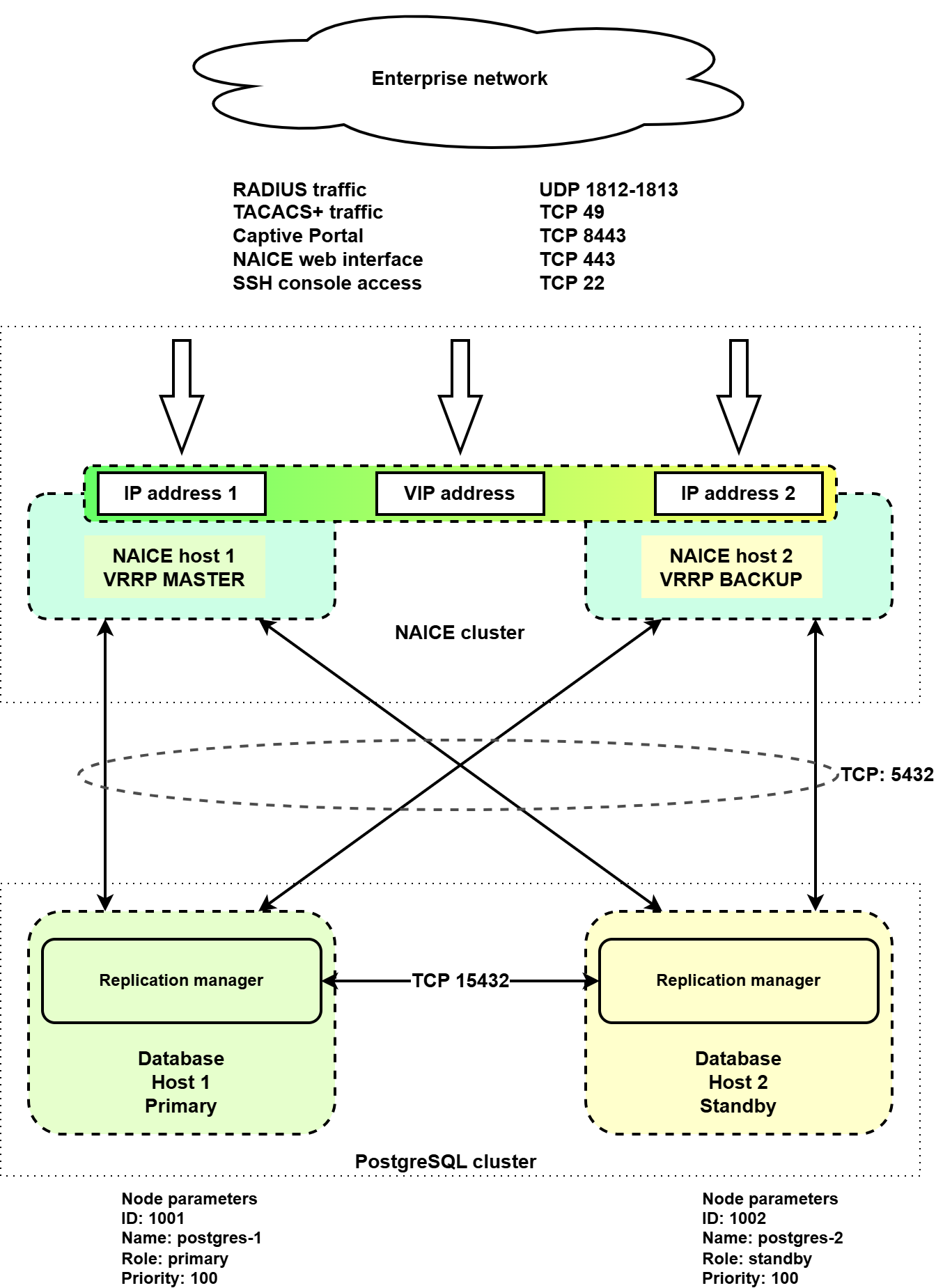
If NAICE Host 1 fails, the following actions will be performed automatically:
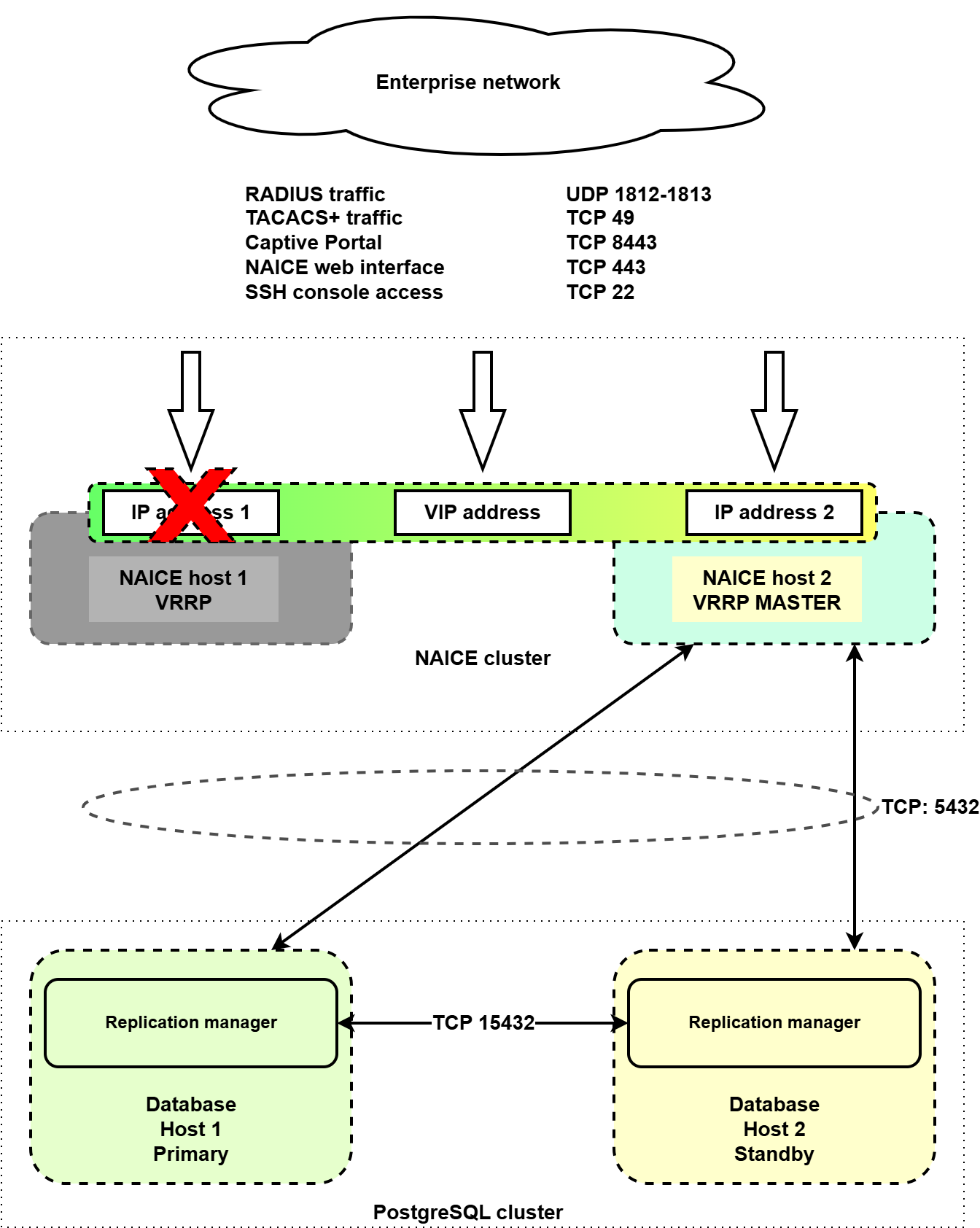
If database host 1 fails, the following actions will be performed automatically:
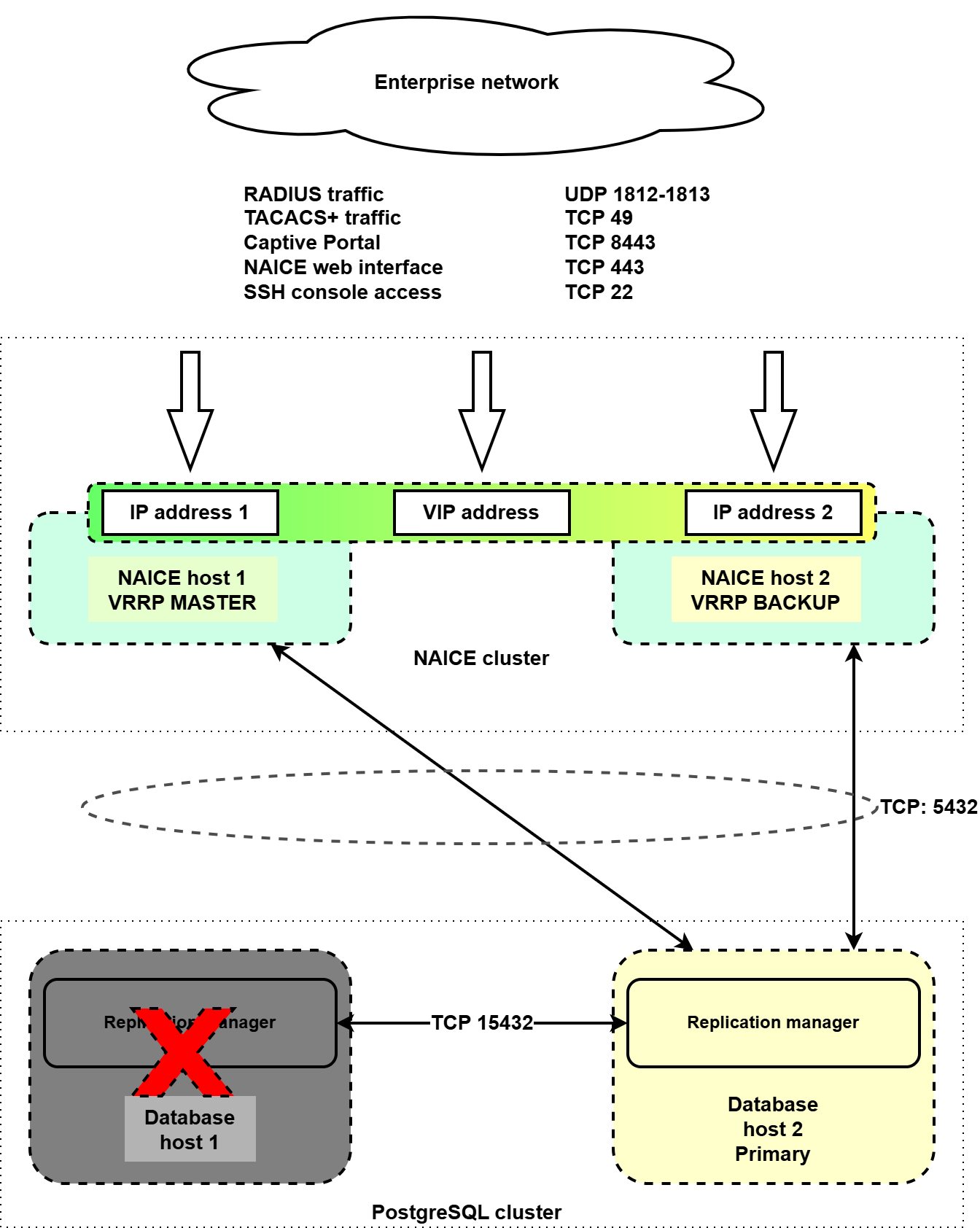
If one of the hosts is completely lost, first restore its initial state: deploy the operating system, configure IP addressing and user accounts as they were before, and then perform the recovery procedure.
On the remaining operational node, create a backup of the data according to the instructions in v1.1_3.8 Creating and restoring database backup.
Redeploy the host corresponding to the failed cluster node, using the same OS, IP addressing, and user configuration as before.
Run the playbook:
ansible-playbook install-postgres-cluster.yml -i inventory/hosts-cluster.yml |
After completing the playbook, check the state of the PostgreSQL database cluster, verify that it is operational, and confirm that authentication and configuration in the GUI are functioning correctly.
Redeploy the host corresponding to the failed cluster node, using the same operating system, IP addressing, and user configuration as before.
Run the playbook:
ansible-playbook reservation-naice-services.yml -i inventory/hosts-cluster.yml |
When the installation is executed again, all NAICE services will be restarted, which will result in a short service interruption (up to 5 minutes). This must be taken into account when planning recovery work. The keepalived service will also be restarted, causing the VRRP master role to switch to the higher-priority instance. If the first NAICE host is being restored, a new self-signed HTTPS certificate will be generated. |
After recovery, verify that authentication is working correctly and ensure that all services are operating properly.