
Q: What should be the signal levels on XGS-PON, and how can I view them?
A: The key characteristics of XGS-PON transceivers are: transmit power (tx power) and receive power (rx power). There are two directions of optical signal transmission on PON: OLT→ONT and ONT→OLT. Measurements are possible in both directions. The permissible ranges of values for these parameters are defined by ITU-T G.9807.1 standard and vary depending on the transceiver class. The following table shows the ranges of the radiated signal strengths and the ranges of possible values for the received signal for the different transceiver classes.
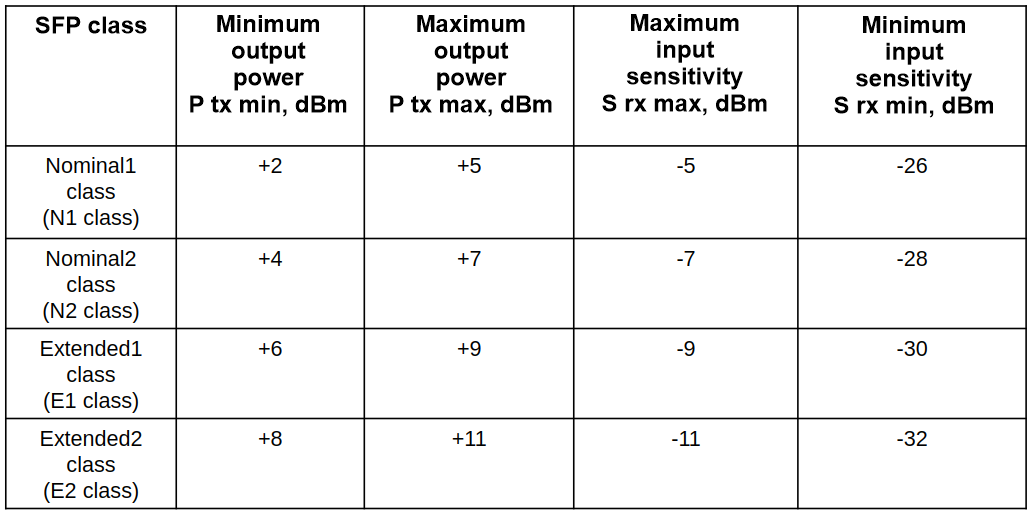
Based on this table, the following is true:
- A transceiver of a certain class will have a constant unchanged transmitter power, which will be in the range P tx min ≥ P ≤ P tx max;
- The received signal level at the transceiver must remain strictly within the S rx min ≥ S ≤ S rx max values for a certain class. If the value of the received signal exceeds the specified limits, the ONT may operate intermittently or not register on the OLT at all. Also, if the received signal level is too high, there is a high risk of transceiver failure.
In addition, the following should be considered:
- On the OLT side, the transceiver in the PON-port has an SFP module form factor, SFPs of different classes can be used;
- On the ONT side, the transceiver is usually not replaceable. ONTs manufactured by Eltex use transceivers conforming to the N2 class;
- The signal level that the OLT receives from the ONT is calculated individually for all connected ONTs and is labeled RSSI. On the ONT side, only one value of the received signal is calculated – from the OLT.
To view the values of signal levels, ONT must be registered on the OLT. Commands can be used to output RSSI information:
show interface ont 1/1 rssi
RSSI will also be displayed when the list of ONTs connected to the channel is displayed:
show interface ont 1 connected
To view the level value of the signal received from OLT on a particular ONT, the command below is used. Here, this value reflects the Rx power value:
show interface ont 1/1 laser
Q: How to avoid signal level mismatch issues on XGS-PON?
A: At the stage of FOCL design, the optical line attenuation and optical power budget are calculated.
Q: PON technologies use a common transmission medium (common optical fiber) to connect multiple subscriber terminals. Why do collisions not occur?
A: Collisions are avoided by time division multiplexing (TDM) and upstream bandwidth control (DBA) mechanisms. As a result, all ONTs transmit data one at a time.