
Aim of the guide
The aim of this guide is to demonstrate a solution for providing telephone communication to a small business or isolated branch office with a small number (up to 250) of subscribers.
To connect to the PSTN, SIP protocol connections are used via an operator providing a trusted Ethernet interface.
Using the SMG-500 IP PBX by Eltex is optimal for this task.
Proposed network diagrams
|
|
|---|---|
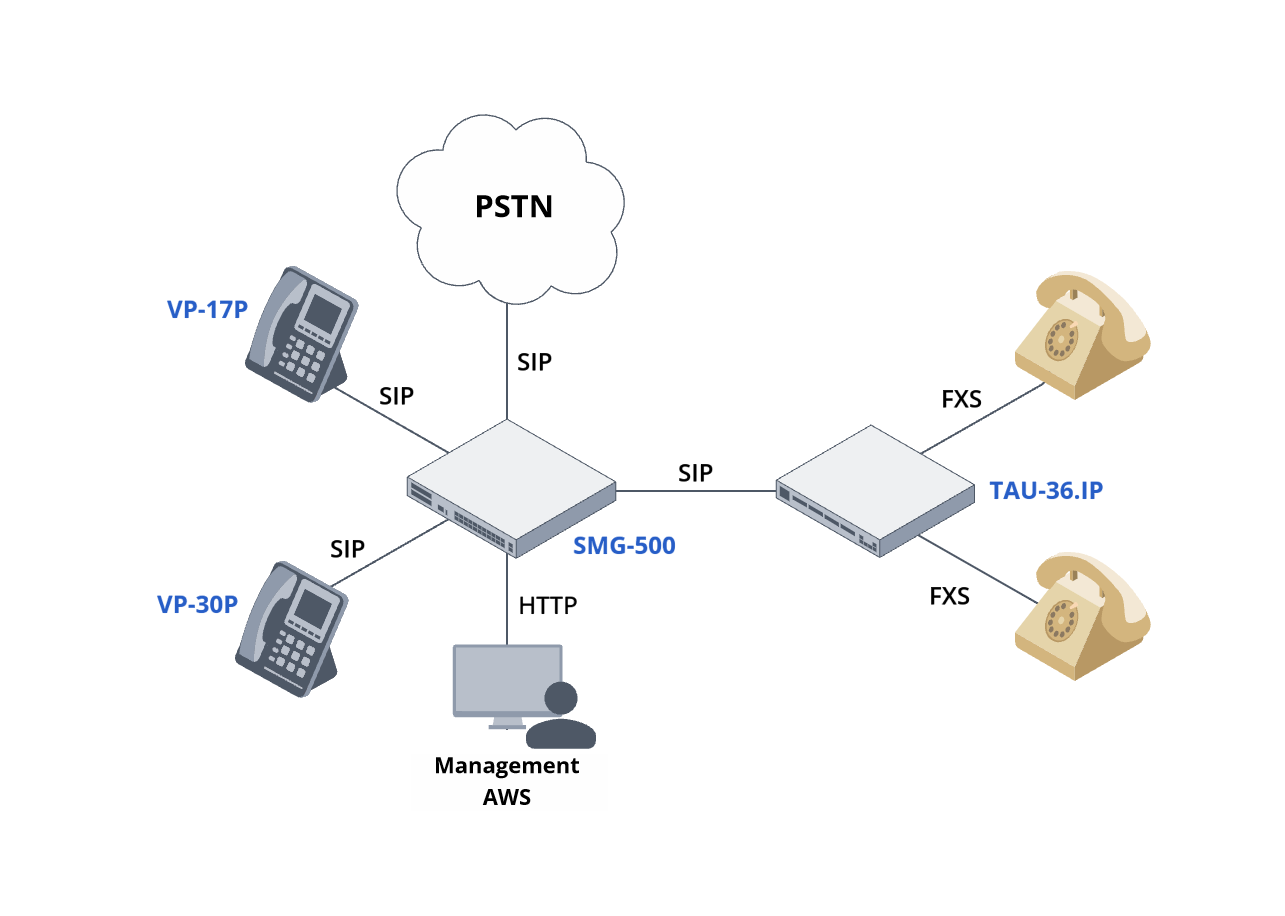
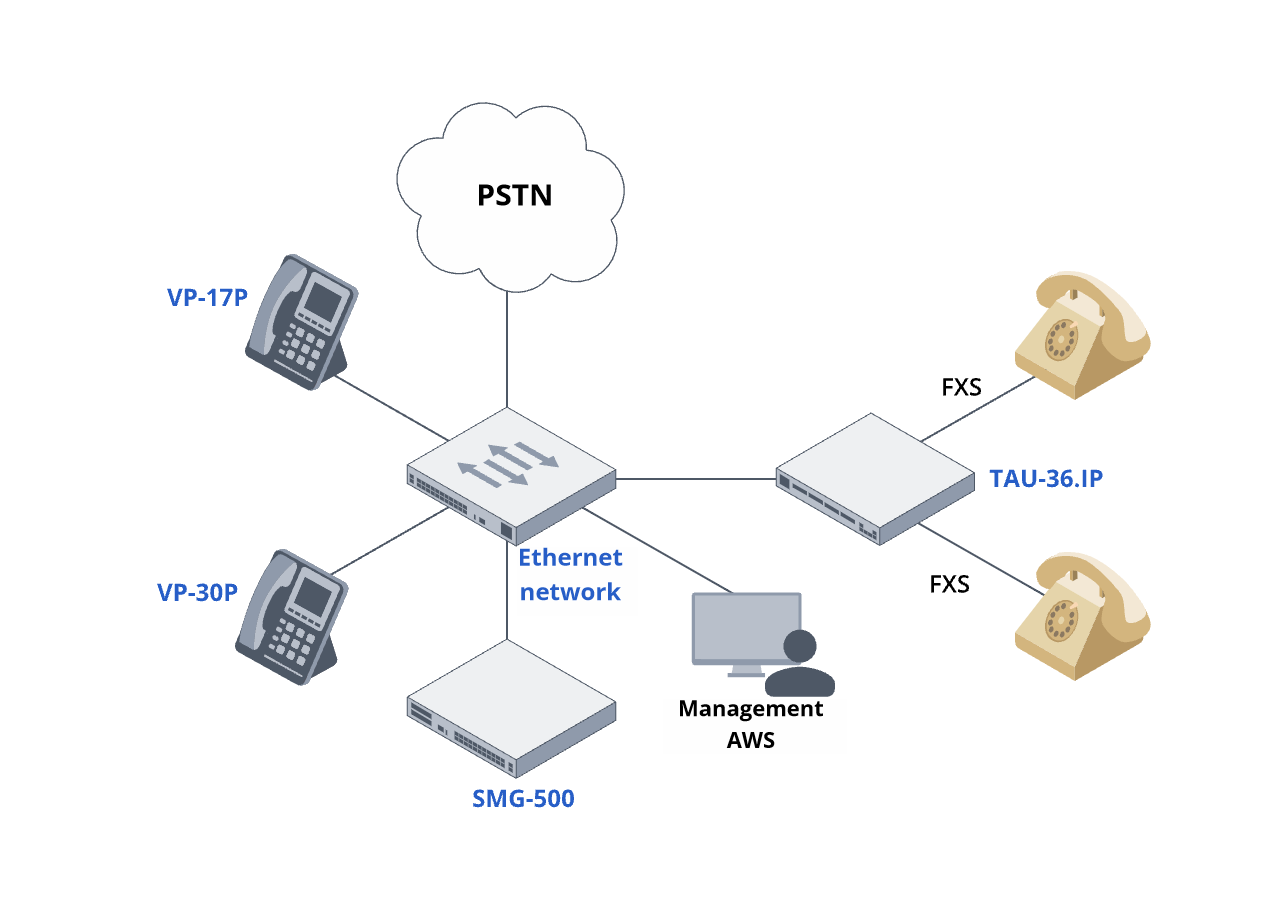
Logical network diagram | Physical network diagram |
Description of diagrams
The telephony core is SMG-500 IP PBX with M8O submodules.
IP phones are registered on the SMG-500 via a network of Ethernet switches.
Analog phones are connected to IP PBX via subscriber gateways, such as TAU-36.IP.
The subscriber gateway is connected to IP PBX via an Ethernet network. Subscribers are registered on the PBX via SIP.
Used types of Ethernet ports
The following Ethernet interface names are used in this guide:
| Port designation | Port purpose | Port requirements |
|---|---|---|
| A1 | SMG-500 IP PBX connection port | Trunk port with specified native VLAN |
| Px | IP phone connection ports | Access port with Voice VLAN and PoE |
| U1 | Port for connecting to an IP telephony provider | Access or trunk port |
| Tx | Ports for connecting analog TAU gateways | Access port |
| M1 | Port for connecting AWS, which is used to configure and manage an IP PBX and phones. | Access port |
Used VLANs
In the guide, the following virtual local area networks (VLAN) are used.
| VLAN name | VLAN purpose | Ports included in VLAN |
|---|---|---|
| Mgm_Vlan | PBX management | A1 – untagged |
| Data_Vlan | Telephony signalling and media traffic | A1 – tagged |
| Provider_Vlan | Link towards the provider | U1 - tagged or untagged |
Traffic restrictions between VLANs
The necessary permissions for this example are listed in the table:
| From \ To | Mgm_Vlan | Data_Vlan | Provider_Vlan |
|---|---|---|---|
| Mgm_Vlan | Allow HTTP, HTTPS | ||
| Data_Vlan | Allow SIP, RTP from the A1 host to the U1 host | ||
| Provider_Vlan | Allow SIP, RTP from the U1 host to the A1 host |
IP addressing and dial plan
For demonstration purposes, this guide will use the following:
Dial plan:
- Internal phones:
- Three-digit dial: xxx
- Numbers used in the example: 200 – 419
- Numbers 380 through 415 inclusive are assigned to subscribers with analog telephones connected via TAU-36.IP.
- Three-digit dial: xxx
- PSTN phones:
- Area code (383). Within the area, seven digits: xxxxxxx
- Our office has been assigned the following numbers: (383)9741001 – 9741010
- Incoming calls from the PSTN to numbers 974100x are forwarded to internal 20x numbers accordingly.
- The number 9741010 is used for outgoing PSTN calls for subscribers who do not have a connected local number.
IP addressing:
- Telephony network (Data_Vlan):
- Network: 192.0.2.0/24
- VLAN ID: 92
- Default gateway: 192.0.2.1
- SMG-500 IP PBX: 192.0.2.10
- TAU-36.IP subscriber gateway: 192.0.2.16
- IP phones: 192.0.2.20 192.0.2.240
- Management network (Mgm_Vlan):
- Network: 192.168.1.0/24
- SMG-500 IP PBX: 192.168.1.10
- Provider connection network (Provider_Vlan):
- Network: 198.51.100.0/28
- Provider's IP PBX: 198.51.100.1
- Addresses of services:
- NTP server: 192.0.2.1
Tables for configuration are available via the link.
Before configuring IP telephony, ensure that the data network is functioning properly. Check the network connectivity.
Equipment configuration
SMG has a dynamic firewall enabled by default, which automatically blocks device access in case of multiple unsuccessful authorization attempts. This may be inconvenient during the configuration process. It is recommended to disable the dynamic firewall according to the instructions before starting the configuration. It is recommended to enable the dynamic firewall after completing the configuration for security reasons.
Minimum required configuration
Configuring IP PBX
The SMG-500 IP PBX is configured via a web interface. Default account details:
- Username: admin
- Password: rootpasswd
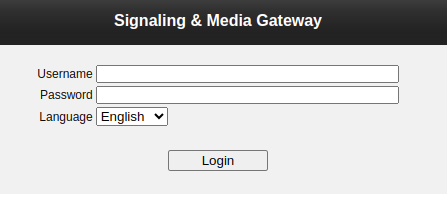
The necessary IP PBX configuration includes the following steps:
Configuring the management interface
Follow the instructions to change the IP settings on the main interface. Specify:
- Network name: Mgm_Vlan
- IP address: 192.168.1.10
- Netowrk mask: 255.255.255.0
- Gateway: 0.0.0.0 – the gateway will not be used for this interface.
- Disable all services except “Web Management”.
Adding an interface for telephony
Follow the instructions to add and configure an interface for RTP and SIP traffic:
- Network name: Data_Vlan
- VLAN ID: 92
- IP address: 192.0.2.10
- Network mask: 255.255.255.0
- Gateway: 192.0.2.1
- Check the “SIP signaling” and “Forward RTP” boxes.
Configuring network parameters
Follow the instructions to change the used interface gateway to
Configuring date and time
For IP telephony to function correctly, set the current date and time on the device.
Time and date are configured on an NTP server.
For automatic time synchronization via NTP on SMG-500, the NTP server on the ESR router or L3 MES switch with the 192.0.2.1 address is used.
To configure NTP synchronization, use the instructions to specify the NTP server address:
- Time server (NTP): 192.0.2.1
- Time zone: select the required time zone.
Creating an SIP profile
Follow the instructions to create a SIP profile.
In the “Name” field, enter “SIP subscribers”.
In the “Network interface for SIP” and “Network interface for RTP” fields, select
Creating SIP subscribers
Follow the instructions to create SIP subscribers. When creating, specify:
- Number of subscribers: 220
- Starting number: 200
- SIP profile: SIP subscribers.
- Password: 1234
Configuring a DHCP server
IP phones require IP addresses to operate. These can be configured manually on each device or assigned using a DHCP server. Configure the DHCP server according to the instructions.
Specify the following parameters:
- Source address: 192.0.2.20
- Destination address: 192.0.2.240
- Subnet mask: 255.255.255.0
- Gateway/router address: 192.0.2.1
Saving the configuration
After completing the initial configuration, it is recommended to save the device configuration.
Configuring the connection to PSTN
To connect the company's telephone network to the public telephone network, it is necessary to configure the trunk to the PBX and configure the routing of calls from and to the city. For incoming routing, the B number will also need to be modified to connect an external number such as 73831234567 to one of the internal numbers. For outgoing routing, the A number will need to be modified to an external number.
Creating a SIP interface for accessing PSTN
Follow the instructions to create a SIP interface. When creating it, specify:
- Trunk group:
- Name: TG to PSTN.
- SIP interface:
- Name: to PSTN.
- Trunk group: TG to PSTN.
- Host name/IP address: 198.51.100.1
- In the “Signaling network interface” and “Network interface for RTP” fields, select

Configuring the modification of incoming call numbers from the PSTN
Following the instructions, create a table of modifiers named “B-number substitution from PBX”.
Following the instructions, create a B-number modification for calls from PBX in the “B-number substitution from PBX” modifier table. When creating, specify:
- Number mask: (7383974100[1-9])
- Modification rule for CdPN/Original CdPN: --------20$
Following the instructions, assign the modification to the trunk group. When creating, specify:
- Add: CdPN
- CdPN: Replacement of B-number from PSTN.
Configuring routing to PSTN numbers
Follow the instructions to create a prefix in the dial plan. When creating, specify:
- Name: to PSTN.
- Trunk group: TG to PSTN.
- Mask: (xxxxxxx|[78][3489]xxxxxxxxx|810x.)
Configuring routing to PSTN numbers
Following the instructions, create a modifier table named “B-number in E.164”.
Following the instructions, create three B-number modifications for calls to PSTN.
- Modification of “local” numbers
- Number mask: (xxxxxxx)
- Modification rule for CdPN/Original CdPN: +7383$
- Modification of long-distance numbers
- Number mask: (8[3489]xxxxxxxxx)
- Modification rule for CdPN/Original CdPN: 7$
- Modification of international numbers
- Number mask: (810x.)
- Modification rule for CdPN/Original CdPN: ---$
Following the instructions, create a table of modifiers named “A-number in E.164 PSTN”.
Following the instructions, create two modifications of the A-number for calls to PSTN.
- Modification of numbers 201-209 to numbers 7941001-7941009
- Number mask: (20[1-9])
- Modification rule for CgPN/RedirPN/Generic/Location: +738397410-$
- Modification of other numbers to number 9741010
- Number mask: (xxx)
- Modification rule for CgPN/RedirPN/Generic/Location: +73839741010!
Follow the instructions to assign the modification to the trunk group. When creating, specify:
- Add: CdPN
- Add: CgPN
- CdPN: B-number in Е.164
- CgPN: A-number in Е.164 PSTN
Saving the SMG-500 configuration
Save the device configuration.
Connecting IP phones
VP-17P and VP-30P phones can be powered by switches using PoE technology or from a 230 V network via personal power supplies.
If the phones are turned on after completing all of the above settings, they will receive IP addresses automatically.
The first phone turned on will receive the 192.0.2.20 address, the second one will receive the 192.0.2.21 address, and so on.
If the MAC addresses of the phones are known (written on a sticker on the back of each device), it is possible to find out the correspondence between the devices and addresses by going to the “Network Services” → “DHCP Server” menu of the SMG-200 web interface. The list of MAC addresses and IP addresses is located at the bottom of the page in the “Assigned IP Addresses” table.
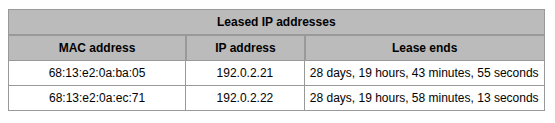
On the phone, the IP address can be found in “Menu” → ‘Status’ → “Network.”
The IP address of the phone will be needed to configure it via the web interface.
Configuring the phone
Follow the instructions to configure the phones.
Fill in the following fields:
- Phone number: values from 200 to 267 without repetitions.
- Username: value similar to the previous item.
- Password: 1234
- SIP proxy server: 192.0.2.10
- Registration server: 192.0.2.10
Connecting analog phones
Analog phones are connected to the SMG-500 IP PBX via TAU series analog gateways.
Configuring the TAU-36.IP analog gateway
The TAU-16.IP analog gateway (referred to as TAU) is configured via the web interface in the example below.
- Default IP address: 192.168.1.2
- Default username: admin
- Default password: rootpasswd
Proposed network diagrams
|
|
|---|---|
Logical network diagram | Physical network diagram |
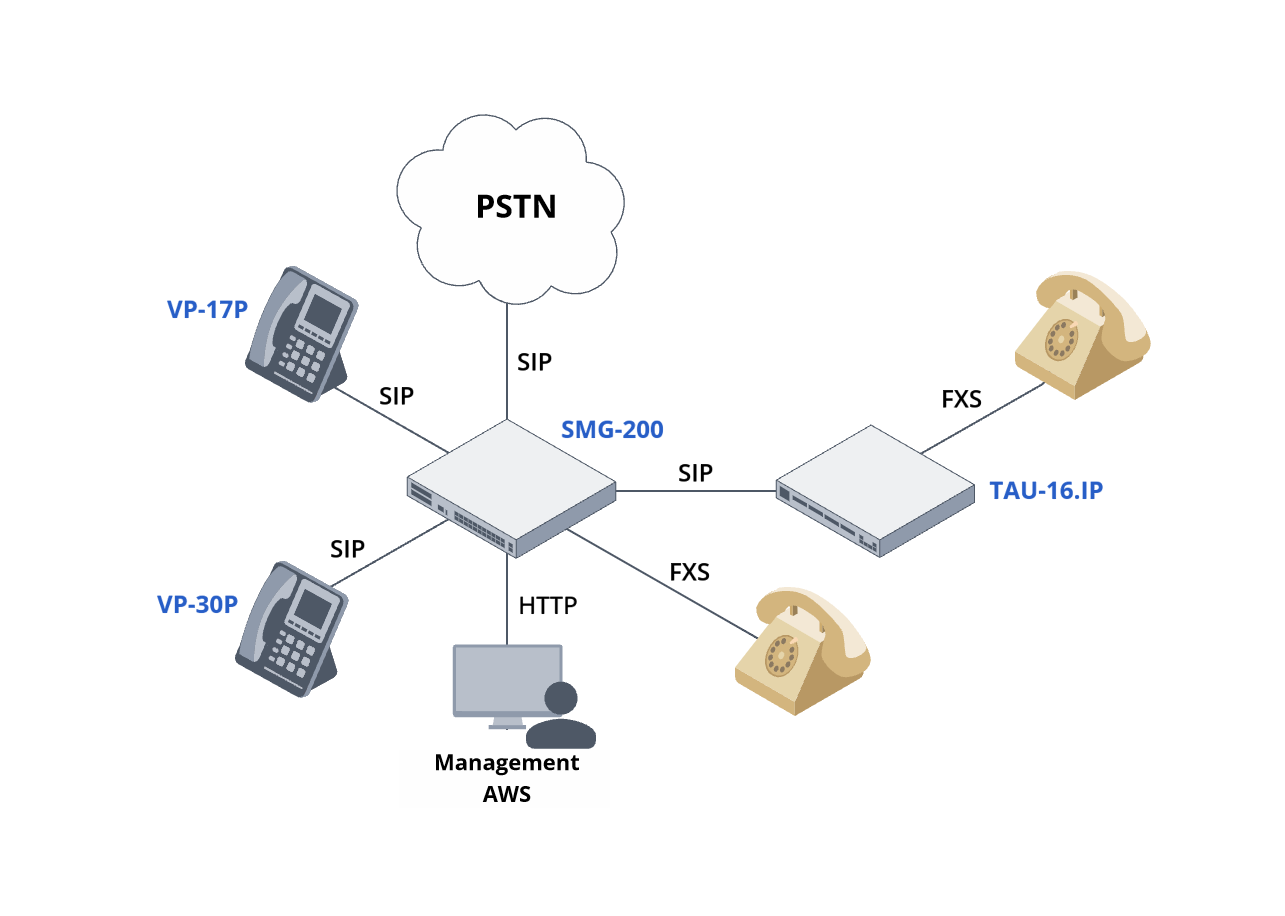
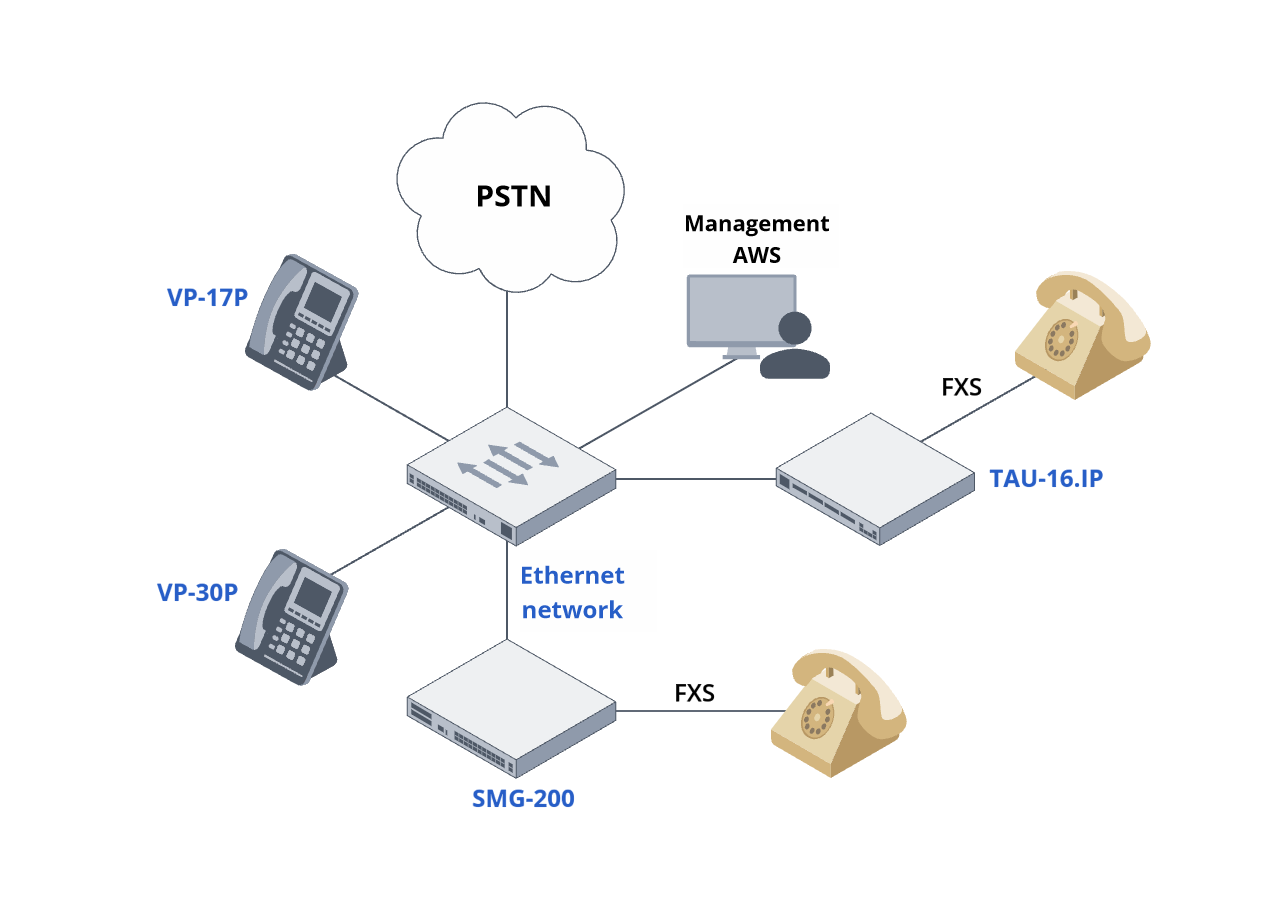
The description of diagrams
The telephony core is SMG-200 IP PBX with M8O submodules.
IP phones are registered on the SMG-200 via a network of Ethernet switches.
Analog phones are connected to IP PBX via subscriber gateways, such as TAU-16.IP.
The subscriber gateway is connected to IP PBX via an Ethernet network. Subscribers are registered on the PBX via SIP.
The SMG-200 can be equipped with one or two M8S submodules, each with 8 FXS ports. Accordingly, 8 or 16 analog phones can be connected directly to the SMG-200.
Used types of Ethernet ports
The following names for Ethernet connections are used in this document:
| Port designation | Port purpose | Port requirements |
|---|---|---|
| A1 | SMG-200 IP PBX connection port | Trunk port with specified native VLAN |
| Px | IP phone connection ports | Access port with Voice VLAN and PoE |
| U1 | Port for connecting to an IP telephony provider | Access or trunk port |
| Tx | Ports for connecting analog TAU gateways | Access port |
| M1 | Port for connecting AWS, which is used to configure and manage an IP PBX and phones. | Access port |
Used VLANs
In the guide the following virtual local area networks (VLAN) are used.
| VLAN name | VLAN purpose | Ports included in VLAN |
|---|---|---|
| Mgm_Vlan | PBX management | A1 – untagged |
| Data_Vlan | Telephony signalling and media traffic | A1 – tagged |
| Provider_Vlan | Link towards the provider | U1 – tagged or untaged |
Traffic restrictions between VLANs
Permissions required for this example.
| From \ To | Mgm_Vlan | Data_Vlan | Provider_Vlan |
|---|---|---|---|
| Mgm_Vlan | Allow HTTP, HTTPS | ||
| Data_Vlan | Allow SIP, RTP from the A1 host to the U1 host | ||
| Provider_Vlan | Allow SIP, RTP from the U1 host to the A1 host |
IP addressing and dial plan
For demonstration purposes, this guide will use the following:
Dial plan:
- Internal phones:
- Three-digit dial: xxx
- Numbers used in the example: 200 – 299
- Numbers 268 through 283 inclusive are assigned to subscribers with analog telephones connected directly to SMG-200.
- Numbers 284 through 299 inclusive are assigned to subscribers with analog telephones connected via TAU-16.IP.
- Three-digit dial: xxx
- PSTN phones:
- Area code (383). Within the area, seven digits: xxxxxxx
- Our office has been assigned the following numbers: (383)9741001 – 9741010
- Incoming calls from the PSTN to numbers 974100x are forwarded to internal 20x numbers accordingly.
- The number 9741010 is used for outgoing PSTN calls for subscribers who do not have a connected city number.
IP addressing:
- Telephony network (Data_Vlan):
- Network: 192.0.2.0/24
- VLAN ID: 92
- Default gateway: 192.0.2.1
- SMG-200 IP PBX: 192.0.2.10
- TAU-16.IP subscriber gateway: 192.0.2.16
- IP phones: 192.0.2.20 - 192.0.2.240
- Management network (Mgm_Vlan):
- Network: 192.168.1.0/24
- SMG-200 IP PBX: 192.168.1.10
- Provider connection network (Provider_Vlan):
- Network: 198.51.100.0/28
- Provider's IP PBX: 198.51.100.1
- Addresses of services:
- NTP server: 192.0.2.1
Tables for configuration are available via the link.
Before configuring IP telephony, ensure that the data network is functioning properly. Check the network connectivity.
Equipment configuration
SMG has a dynamic firewall enabled by default, which automatically blocks device access in case of multiple unsuccessful authorization attempts. This may be inconvenient during the configuration process. It is recommended to disable the dynamic firewall according to the instructions before starting the configuration. It is recommended to enable the dynamic firewall after completing the configuration for security reasons.
Minimum required configuration
Configuring IP PBX
The SMG-200 IP PBX is configured via a web interface. Default account details:
- Username: admin
- Password: rootpasswd
The necessary IP PBX configuration includes the following steps:
Configuring the management interface
Follow the instructions to change the IP settings on the main interface. Specify:
- Network name: Mgm_Vlan
- IP address: 192.168.1.10
- Network mask: 255.255.255.0
- Gateway: 0.0.0.0 – the gateway for this interface will not be used.
- Disable all services except “Web Management”.
Adding an interface for telephony
Follow the instructions to add and configure an interface for RTP and SIP traffic:
- Network name: Data_Vlan
- VLAN ID: 92
- IP address: 192.0.2.10
- Network mask: 255.255.255.0
- Gateway: 192.0.2.1
- Check the “SIP signaling” and “Forward RTP” boxes.
Configuring network parameters
Follow the instructions to change the used interface gateway to
Configuring date and time
For IP telephony to function correctly, set the current date and time on the device.
Time and date are configured on the NTP server.
For automatic time synchronization via the NTP protocol on the SMG-200, the NTP server on the ESR router or L3 MES switch with the 192.0.2.1 address is used.
To configure NTP synchronization, use the instructions to specify the NTP server address:
- Time server (NTP): 192.0.2.1
- Time zone: select the required time zone.
Creating an SIP profile
Follow the instructions to create an SIP profile.
In the “Name” field, enter “SIP subscribers”.
In the “Network interface for SIP” and “Network interface for RTP” fields, select
Creating SIP subscribers
Follow the instructions to create SIP subscribers. When creating, specify:
- Number of subscribers: 100
- Starting number: 200
- SIP profile: SIP subscribers.
- Password: 1234
Configuring the DHCP server
IP phones require IP addresses to operate. These can be configured manually on each device or assigned using a DHCP server. Configure the DHCP server according to the instructions.
Specify the following parameters:
- Source address: 192.0.2.20
- Destination address: 192.0.2.240
- Subnet mask: 255.255.255.0
- Gateway/router address: 192.0.2.1
Saving the configuration
After completing the initial configuration, it is recommended to save the device configuration.
Configuring the connection to PSTN
To connect the company's telephone network to the public telephone network, it is necessary to configure the trunk to the PBX and configure the routing of incoming and outgoing city calls. For incoming routing, the B number will also need to be modified to connect an external number such as 73831234567 to one of the internal numbers. For outgoing routing, the A number will need to be modified to an external number.
Creating a SIP interface for accessing PSTN
Follow the instructions to create a SIP interface. When creating it, specify:
- Trunk group:
- Name: TG to PSTN.
- SIP interface:
- Name: to PSTN.
- Trunk group: TG to PSTN.
- Host name/IP address: 198.51.100.1
- In the “Signaling network interface” and “Network interface for RTP” fields, select
Configuring the modification of incoming call numbers from the PSTN
Following the instructions, create a table of modifiers named “B-number substitution from PBX”.
Following the instructions, create a B-number modification for calls from PBX in the “B-number substitution from PBX” modifier table. When creating, specify:
- Number mask: (7383974100[1-9])
- Modification rule for CdPN/Original CdPN: --------20$
Following the instructions, assign the modification to the trunk group. When creating, specify:
- Add: CdPN
- CdPN: Replacement of B-number from PSTN.
Configuring routing to PSTN numbers
Follow the instructions to create a prefix in the dial plan. When creating, specify:
- Name: to PSTN.
- Trunk group: TG to PSTN.
- Mask: (xxxxxxx|[78][3489]xxxxxxxxx|810x.)
Configuring modifications for calls to the PSTN
Follow the instructions to create a table of modifiers named “B-number in E.164”.
Follow the instructions, create three B-number modifications for calls going to PSTN.
- Modification of “local” numbers:
- Number mask: (xxxxxxx)
- Modification rule for CdPN/Original CdPN: +7383$
- Modification of long-distance numbers:
- Number mask: (8[3489]xxxxxxxxx)
- Modification rule for CdPN/Original CdPN: 7$
- Modification of international numbers:
- Number mask: (810x.)
- Modification rule forCdPN/Original CdPN: ---$
Following the instructions, create a table of modifiers named “A-number in E.164 PSTN”.
Following the instructions, create two modifications of the A-number for calls going to PSTN.
- Modification of numbers 201-209 to numbers 7941001-7941009
- Number mask: (20[1-9])
- Modification rule for CgPN/RedirPN/Generic/Location: +738397410-$
- Modification of other numbers to number 9741010
- Number mask: (xxx)
- Modification rule for CgPN/RedirPN/Generic/Location: +73839741010!
Follow the instructions to assign the modification to the trunk group. When creating, specify:
- Add: CdPN
- Add: CgPN
- CdPN: B-number in Е.164
- CgPN: A-number in Е.164 PSTN
Saving the SMG-200 configuration
Save the device configuration.
Connecting IP phones
VP-17P and VP-30P phones can be powered by switches using PoE technology or from a 230 V network via personal power supplies.
If the phones are turned on after completing all of the above settings, they will receive IP addresses automatically.
The first phone turned on will receive the 192.0.2.20 address, the second one will receive the 192.0.2.21 address, and so on.
If the MAC addresses of the phones are known (written on a sticker on the back of each device), it is possible to find out the correspondence between the devices and addresses by going to the “Network Services” → “DHCP Server” menu of the SMG-200 web interface. The list of MAC addresses and IP addresses is located at the bottom of the page in the “Assigned IP Addresses” table.
On the phone, the IP address can be found in “Menu” → ‘Status’ → “Network.”
The IP address of the phone will be needed to configure it via the web interface.
Configuring the phone
Follow the instructions to configure the phones.
Fill in the following fields:
- Phone number: values from 200 to 267 without repetitions.
- Username: value similar to the previous item.
- Password: 1234
- SIP proxy server: 192.0.2.10
- Registration server: 192.0.2.10
Connecting analog phones
Analog phones are connected to the SMG-200 IP PBX via TAU series analog gateways or directly, if M8S submodules are installed
Creating analog subscribers on SMG-200
Follow the instructions to configure analog subscribers.
For all FXS ports, enter numbers from 268 to 275 in the “Number” field without repetition if one M8S submodule is installed, or up to 283 if two submodules are installed.
Configuring the TAU-16.IP analog gateway
The TAU-16.IP analog gateway (hereinafter referred to as TAU) is configured via the web interface in the example below.
- Default IP address: 192.168.1.2
- Default username: admin
- Default password: rootpasswd
The necessary TAU configuration includes the following steps:
Configuring the connection to the local network
Follow the instructions to configure the TAU:
- IP address: 192.0.2.16
- Network mask: 255.255.255.0
- Gateway: 192.0.2.1
Configuring date and time
Since TAU does not have a built-in clock, time synchronization from an external server is required to use real time for monitoring and statistics. For automatic time synchronization via NTP with TAU, an NTP server located on the local network or on the Internet must be available. SMG-500 cannot act as an NTP server.
Follow the instructions to configure synchronization with the following parameters:
- Enable NTP
 .
. - NTP server address: 192.0.2.1
- Allow periodic synchronization.
- Synchronization period: 3600
Configuring the SIP profile
Follow the instructions to configure the SIP profile. When configuring, specify the following:
- Operating mode: «Parking».
- Proxy address / Registrar address / Use registration 1: 192.0.2.10/192.0.2.10/Activate the checkbox.
Creating subscribers
Follow the instructions to create subscribers with numbers 380 – 415. When creating, specify the following:
- In the "Initial number" field, enter 380
Specifying subscriber login details
Follow the instructions to specify subscriber login details. In the (“1-18” “19-36”) port group tabs, go through all subscribers. In the port cards, specify:
- Name for authentication/authorization: the value is equal to the value in the “Phone number” field.
- Password for authentication/authorization: 1234
Setting up a dialing plan
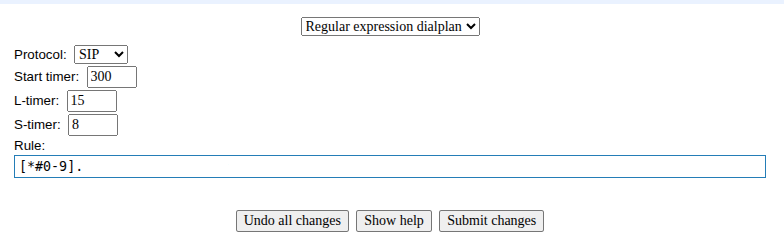
Follow the instructions to set up a dialing plan. Select “Regular expression dialplan.” In the “Rule:” field, enter “[*#0-9]”.
Saving the configuration
All settings are stored in the TAU's RAM and will be lost upon reboot if not saved. To save the current configuration, select one of the following items from the main menu: “Network settings”/"PBX"/“Switch”

and click the “Save” button in the lower right corner.
Configuring additional functionality
If the dynamic firewall was disabled before starting the configuration, it is recommended to enable it according to the instructions.